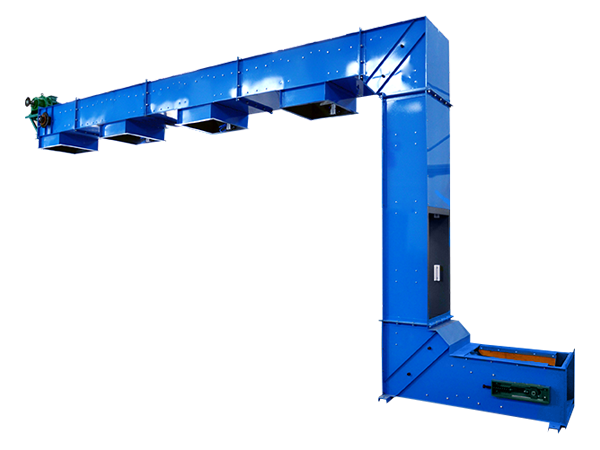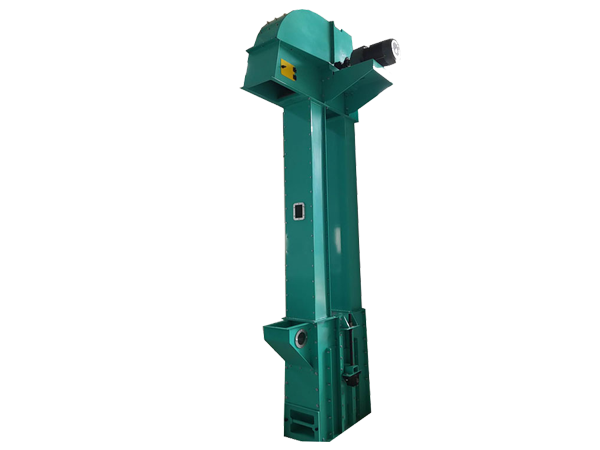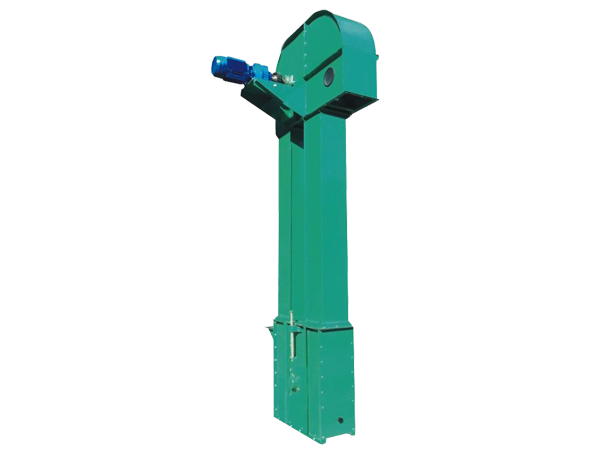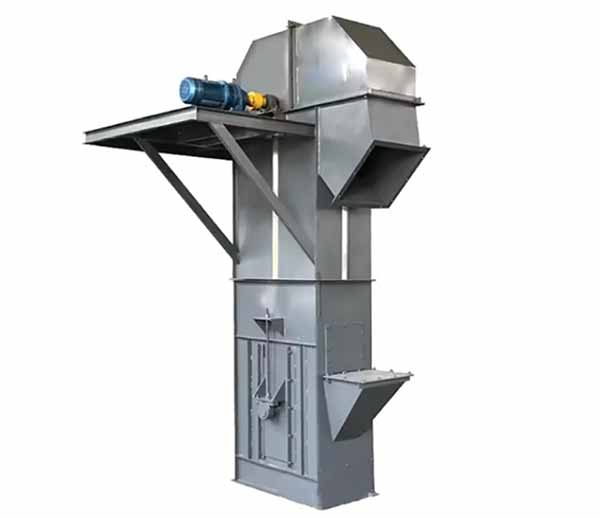
Grain Silo Bucket Elevator
A heavy-duty, dust-explosion-proof vertical conveyor engineered to lift bulk grains up to 45 meters into storage silos with near-zero kernel damage.
Capacity: 10 - 600 t/h
Lifting Height: Up to 45 m
Belt Speed: 2.0 - 2.8 m/s
Safety Grade: ATEX Zone 21 / Class II, Div 1
Coating: ≥ 275 g/m² Galvanized
In grain storage and terminal logistics, lifting bulk crops vertically into towering storage structures demands reliable mechanical performance. A Grain Silo Bucket Elevator serves as the vertical backbone for bulk material handling plants, conveying grains like corn, wheat, paddy, and soybeans from receiving pits up to the top inlets of steel or concrete silos. Depending on the operational scale of the facility, these industrial lifters deliver a throughput capacity ranging from 10 to over 600 metric tons per hour ($10 \sim 600\text{ t/h}$). To match the stature of modern industrial commercial bins, the lifting height easily scales from a modest 5 meters up to an impressive vertical reach of 45 meters, establishing a continuous flow from ground discharge points to overhead distribution conveyors.
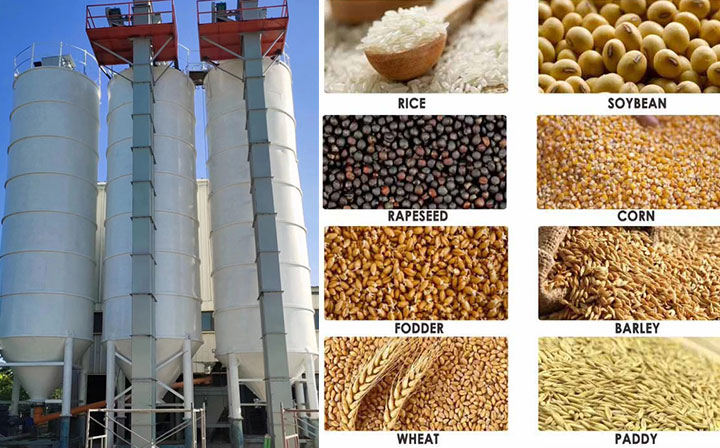
Real-world Operational Perks: Safety, Integrity, and Weatherproofing
Operating a vertical conveyor in agricultural sectors involves managing dust hazards, product devaluation through grain cracking, and severe outdoor elements. Incorporating this equipment into your system addresses three fundamental field challenges:
- Dust Explosion Mitigation: Grain dust becomes combustible when confined. The elevator housing integrates standardized explosion-venting panels that rupture safely outward if internal pressure spikes. Combined with non-sparking materials and speed monitoring switches that detect belt slippage before friction generates heat, the risk of catastrophic thermal ignition is minimized under the ATEX Zone 21 / Class II, Div 1 safety grades.
- Reduced Grain Degradation: When corn or rice hits mechanical parts at high velocities, kernels fracture, reducing market value and inviting pest infestation. By engineering a tangential discharge trajectory at the head station, the grains slide smoothly off the buckets rather than violently slamming into the steel hood, keeping broken grain rates below 0.5%.
- All-Weather Corrosion Defiance: Silo elevators almost exclusively stand outdoors, exposed to driving rain, humidity, and temperature swings. The entire casing is constructed from hot-dip galvanized steel plates with a zinc coating thickness exceeding $275\text{ g/m}^2$. Sealed rubber gaskets between structural casing sections block rainwater infiltration, protecting both the internal mechanical components and the dry grain stream inside.
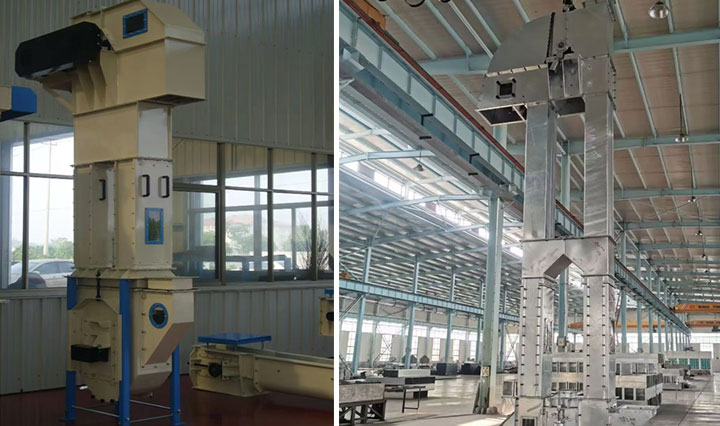
Inside Bucket Elevator: Structural Elements Anchoring Grain Quality
Looking past the outer casing reveals structural elements engineered specifically to preserve crop quality and operational stability. Every part performs a distinct role in safeguarding the commercial value of the hauled harvest.
Non-Sparking Polymeric Buckets
Traditional steel buckets can strike sparks against the casing if a belt misalignment occurs. To eliminate this hazard, the system utilizes high-density polyethylene (HDPE) or polyurethane buckets. These polymer buckets possess inherent flexibility; if a foreign object like a stone enters the boot, the bucket deforms slightly rather than shearing or throwing sparks, maintaining a spark-free internal environment while cushioning the grain during scooping.
Anti-Static, Flame-Retardant Conveyor Belting
The vertical belt carries the entire load of filled buckets. The belting material features multi-ply polyester-nylon (EP) fabrics sandwiched within a specialized rubber compound. This cover compound is certified with static-conductive properties to bleed off frictional static electricity into the grounded machine frame. It also features self-extinguishing flame properties, meaning it will not support combustion if localized overheating occurs.
Curved Boot Bottom & Cleanout Slides
A flat-bottomed elevator boot leaves a dead zone where residual grain accumulates, rots, and cross-contaminates subsequent batches. The boot section features a self-cleaning curved bottom profile. The gap between the bucket tip and the boot wall is calibrated to a tight tolerance, allowing the buckets to sweep the boot clean. Quick-release slide gates at the base allow operators to empty the boot entirely during product changeovers.
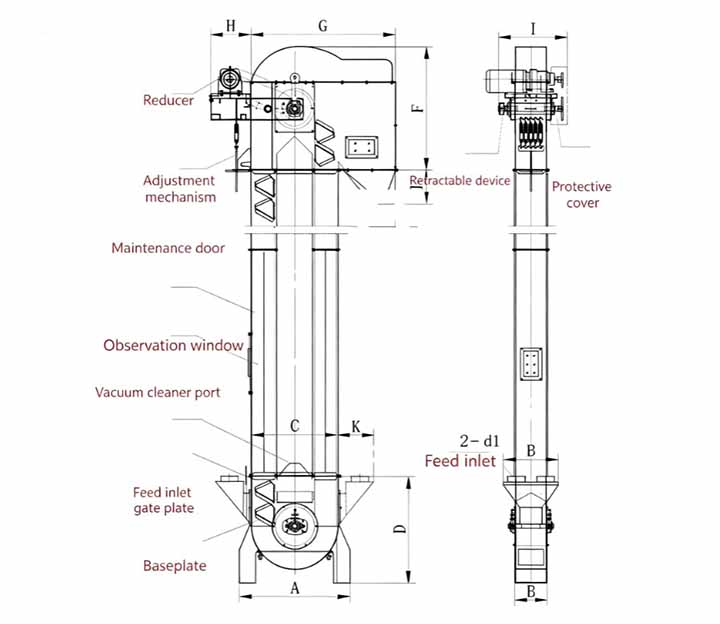
Standard Grain Elevator Dimensions & Specifications
Selecting the correct model requires alignment between throughput requirements, silo heights, and electrical infrastructure. The table below outlines standard technical configurations used across commercial agricultural grain facilities:
| Model Indicator | Throughput Capacity ($t/h$) | Maximum Vertical Lift ($m$) | Belt Speed ($m/s$) | Standard Bucket Width ($mm$) | Bucket Material | Belt Type | Explosion-proof Grade | Motor Power Rating ($kW$) | Casing Sheet Thickness ($mm$) |
|---|---|---|---|---|---|---|---|---|---|
| GSE-250 | $15 - 30$ | 20 | 2.2 | 250 | HDPE (High-Density Polyethylene) | Anti-Static, Flame-Retardant EP100 | Class II, Div 1, Group G / ATEX Zone 21 | $4.0 - 7.5$ | 2.5 |
| GSE-315 | $35 - 60$ | 28 | 2.4 | 315 | HDPE (High-Density Polyethylene) | Anti-Static, Flame-Retardant EP150 | Class II, Div 1, Group G / ATEX Zone 21 | $7.5 - 15.0$ | 3.0 |
| GSE-400 | $70 - 120$ | 35 | 2.5 | 400 | Heavy-Duty Polyurethane | Oil-Resistant, Anti-Static EP200 | Class II, Div 1, Group G / ATEX Zone 21 | $15.0 - 30.0$ | 3.0 |
| GSE-500 | $130 - 200$ | 40 | 2.6 | 500 | Heavy-Duty Polyurethane | Oil-Resistant, Anti-Static EP250 | Class II, Div 1, Group G / ATEX Zone 21 | $30.0 - 55.0$ | 4.0 |
| GSE-630 | $250 - 400$ | 45 | 2.8 | 630 | Reinforced Nylon 66 | Heavy-Duty Anti-Static Steel Cord | Class II, Div 1, Group G / ATEX Zone 21 | $55.0 - 110.0$ | 4.0 |
Classification of Vertical Grain Elevators by Discharge and Traction Mechanical Design
Industrial vertical bucket lifters are categorized based on their mechanical transport configurations and how they discharge grain at the head section:
Centrifugal Discharge Elevators
This is the configuration for bulk agricultural grains. Operating at higher belt speeds ($2.0 \sim 3.0\text{ m/s}$), this design relies on centrifugal force to fling the grain out of the buckets into the discharge chute as they pass over the head pulley. The buckets are spaced at intervals along the belt to allow clean ejection without interference from the preceding bucket.
Continuous Bucket Elevators
Operating at slower speeds ($0.5 \sim 1.2\text{ m/s}$), these elevators utilize closely spaced, continuous V-shaped buckets. As each bucket passes over the head pulley, the back of the preceding bucket acts as a moving chute to catch and guide the material into the discharge outlet. This gentle action is utilized for fragile seeds or large, easily damaged beans.
Chain-Driven vs. Belt-Driven Systems
While belt-driven setups dominate the grain sector due to quiet operation and high-speed capabilities, chain-driven systems replace them when handling heavy materials or extremely hot seeds from drying kilns. Chain systems utilize single or double strand hardened steel roller chains to pull the buckets, offering absolute slip resistance at the cost of higher lubrication needs.
Informative Technical FAQ for Plant Engineers
Q: What causes belt misalignment in a silo elevator, and how is it monitored?
A: Misalignment typically stems from uneven feeding into the boot, a loose take-up device, or material accumulation on the tail pulley. To monitor this, electronic alignment sensors are mounted on both sides of the head and boot casings. If the belt drifts laterally by more than $15\text{ mm}$, the belt edge presses against the sensor roller, sending an electrical signal to the control room to trigger a maintenance alert or halt the motor before friction damages the belt.
Q: How is the budgetary pricing calculated for a Grain Silo Bucket Elevator?
A: Capital investment figures vary based on structural dimensions and materials. A standard $20\text{ t/h}$ capacity carbon-steel galvanized elevator with a 15-meter lifting height carries a factory price starting around \$6,500 to \$9,000 USD. For high-capacity commercial terminals requiring a $200\text{ t/h}$ throughput at a 35-meter height, prices scale from \$24,000 to \$45,000 USD. Factors driving costs include motor specifications (explosion-proof certification grades), integrated service platforms, maintenance ladders, and the addition of specialized wear liners like polyurethane or ceramic tile backings in the head hood.
Q: What weekly maintenance routines prevent unexpected downtime during harvest season?
A: Weekly checks must focus on checking the tension of the mechanical take-up screws at the boot to prevent belt slippage. Operators must inspect the boot cleanout doors for dust leaks and check the lubrication levels on the spherical roller bearings supporting the head shaft. Checking the functional signal output of the electronic speed sensor and checking for any loose bucket bolts inside the inspection window prevents catastrophic bucket detachments.
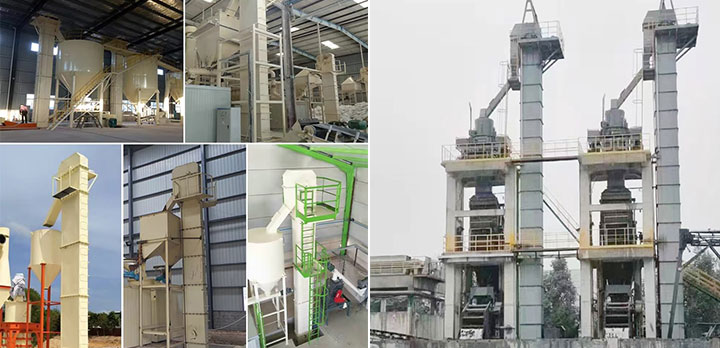
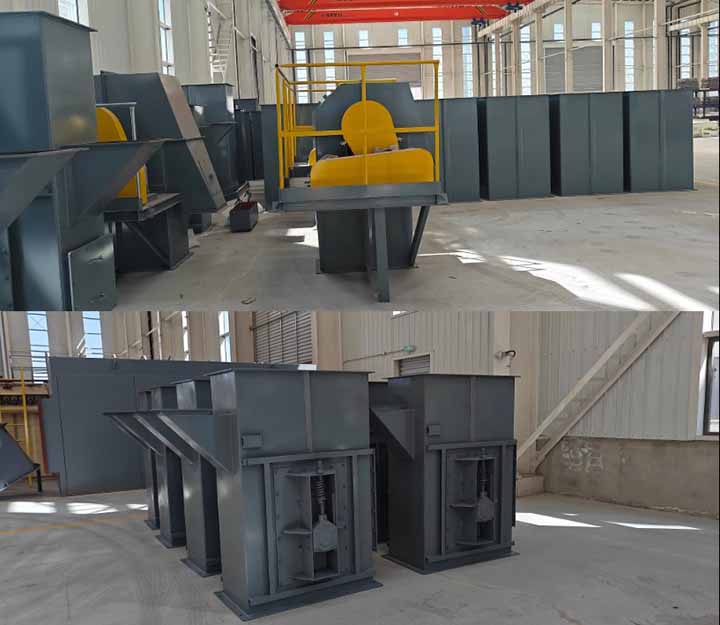
Grain Silo Bucket Elevator Factory Photos
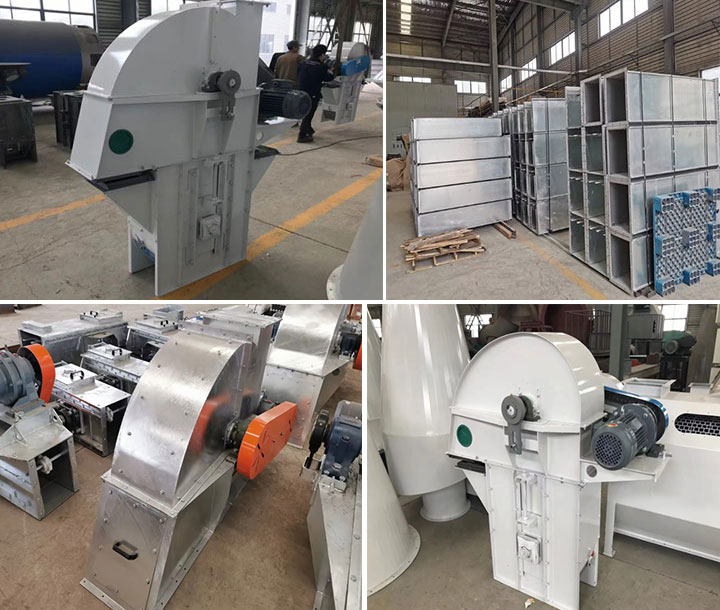
Grain Silo Bucket Elevator Transportation
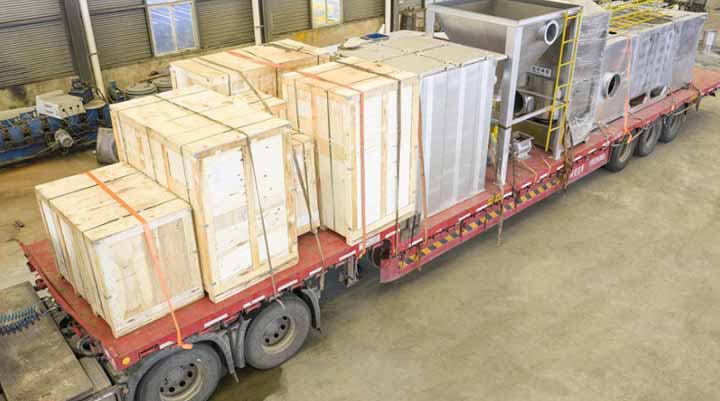
Integrating a robust Grain Silo Bucket Elevator into an agricultural storage facility solves the physical challenge of moving large crop volumes vertically while protecting grain quality and facility personnel. By choosing matching capacity ratings, utilizing non-sparking polymer components, and specifying heavy galvanized outer skins, operators establish an enduring handling node that withstands harsh weather conditions and continuous seasonal demands. For custom structural layouts, detailed engineering drawings, and exact plant pricing proposals tailored to your specific silo geometry, contact our engineering department with your target throughput and vertical lifting height parameters.