Inclined Hose Screw Conveyor
Wednesday December-24 2025 17:35:35
The Inclined Hose Screw Conveyor can convey powders, granules, or small lumps of material along curved and inclined paths. Its hose is made of polyurethane, rubber, or composite elastic materials, combining flexibility and durability, and can operate for extended periods under repeated bending and vibration without easily cracking. The auger is a flexible helical shaft made of spring steel or high-strength alloy steel, which can bend with the hose while maintaining sufficient axial stiffness. The maximum inclination angle of this design is typically 30° to 45°. Conveying capacity varies from 1–30 t/h, depending on the inclination angle and motor power, among other factors.
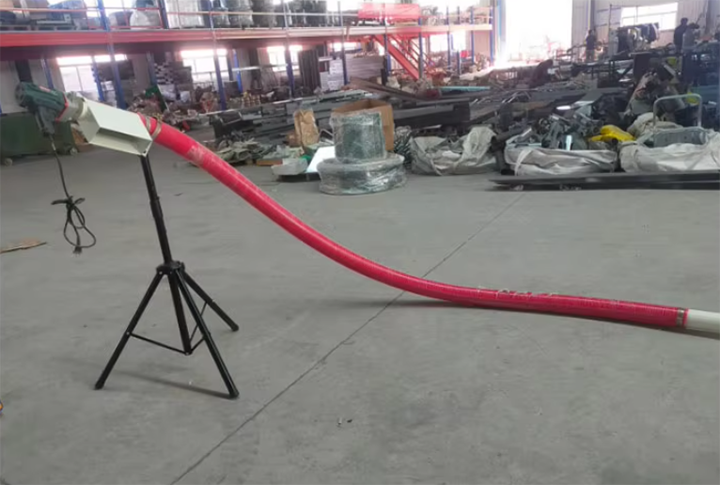
Inclined Hose Screw Conveyor Working Principle
When the drive unit is started, the flexible auger inside the Inclined Hose Screw Conveyor begins to rotate. Material enters the hose through the inlet and moves forward continuously under the rotation of the flexible auger until it exits from the outlet. The flexible hose provides a closed and deformable channel for the auger, maintaining a relatively stable gap between the auger and the hose wall even when bent or tilted, thus ensuring that material does not flow back or accumulate excessively.
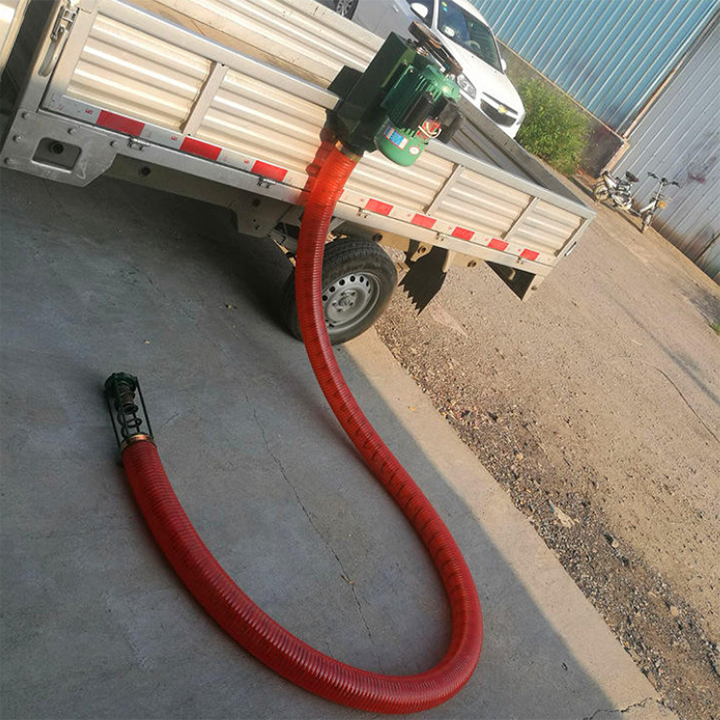
Advantages of Inclined Hose Screw Conveyor
The Inclined Hose Screw Conveyor overcomes the limitations of traditional trough screw conveyors in terms of tilt angle, allowing for direct material lifting at larger angles, saving space and transfer equipment. The flexible hose can bypass equipment, beams, columns, or walls, adapting to complex spatial layouts. Installation location and tilt angle are no longer limited by angle, and the installation path can be bent as needed, simplifying factory layout design. The flexible installation solves problems such as difficult installation of rigid equipment, the need for frequent transfer points, and material leakage due to poor sealing. The Inclined Hose Screw Conveyor does not damage the material shape during inclined material conveying, with a near-zero breakage rate.
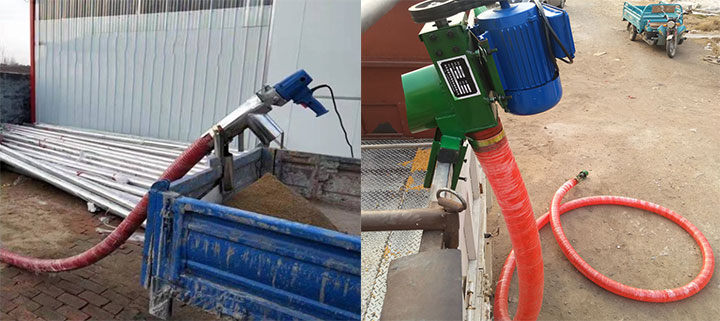
Inclined Hose Screw Conveyor Specifications
| Model | Hose Diameter (mm) | Conveying Capacity (m³/h) | Conveying Length (m) | Conveying Height (m) | Motor Power (kW) |
| HSC-50 | 50 | 0.5-1.5 | 5-10 | ≤3 | 0.37 |
| HSC-75 | 75 | 1-3 | 5-15 | ≤5 | 0.75 |
| HSC-100 | 100 | 2-5 | 10-20 | ≤7 | 1.5 |
| HSC-125 | 125 | 3-6 | 10-25 | ≤8 | 2.2 |
| HSC-150 | 150 | 4-8 | 15-30 | ≤10 | 3-4 |
| HSC-200 | 200 | 6-10 | 20-30 | ≤10 | 5-5.5 |
Note: Conveying capacity decreases when the tilt angle exceeds 30–45°.
Inclined Hose Screw Conveyor is suitable for conveying materials.
The Inclined Hose Screw Conveyor is suitable for conveying a variety of powdery, granular, small lump, and paste-like materials. Examples include flour, cement, plastic granules, feed, grains, chemical powders, coffee beans, snacks, and biomass pellets. It is particularly suitable for fragile, contamination-sensitive materials and materials requiring enclosed conveying.

Inclined Hose Screw Conveyor Usage Situations
In feed mills, the Inclined Hose Screw Conveyor continuously lifts soybean meal from an underground feed inlet at a 30-45 degree angle to a 6-meter-high mixing silo. In chemical plants, the Inclined Hose Screw Conveyor on the production line conveys PP granules at a 20-degree angle to the second-floor dryer. In dry-mix mortar plants, the conveyor at a large 60-degree angle rapidly pumps cement from ground-level tank trucks into the main silo 30 meters away on the roof. In waste plastic processing lines, machines use adjustable angles to convey crushed PET sheets from a lower level to the washing tank, with a completely enclosed, non-scattering process. In the construction and building materials industry, they are often used in conjunction with mixing plants to obliquely convey powdered building materials such as cement, gypsum powder, and dry mortar to the mixer inlet.
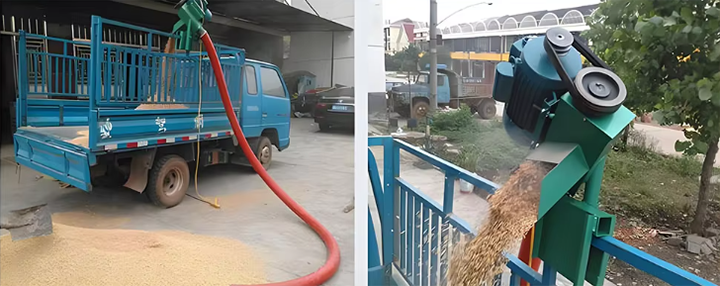
The Inclined Hose Screw Conveyor is less expensive than rigid conveying equipment, and its pipe diameter and length can be customized, increasing spatial flexibility. For example, in a chocolate factory renovation project, cocoa powder needed to be conveyed from a ground-floor warehouse to a three-story-high mixing tank. The space was narrow, and the path had to avoid existing pipelines. A wear-resistant polyurethane flexible hose screw conveyor with a 40° inclination angle was used, achieving a curved lifting route along the wall without dust leakage. It provides excellent conveying solutions in agricultural and industrial applications.