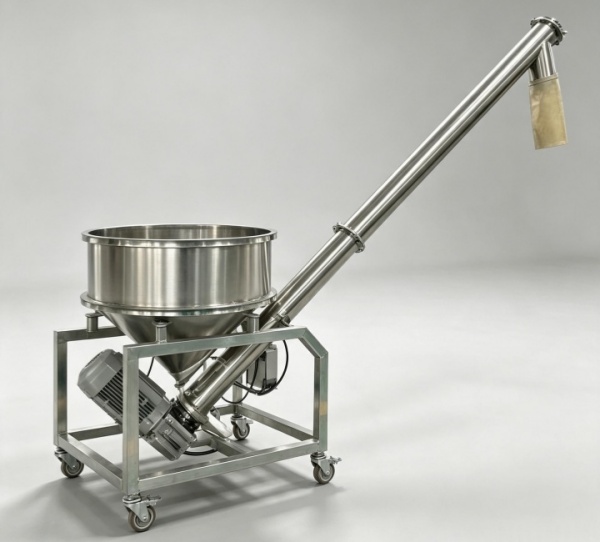
Portable Auger Conveyor with Hopper | Mobile Bulk Feeder
• Tube Diameter: 100 mm – 300 mm
• Hopper Volume: 50 L – 500 L
• Handling Capacity: 2 m³/h – 40 m³/h
• Incline Angle Range: 0° – 45° (Adjustable)
• Mobility Base: 4-Wheel Heavy-Duty Lockable Casters
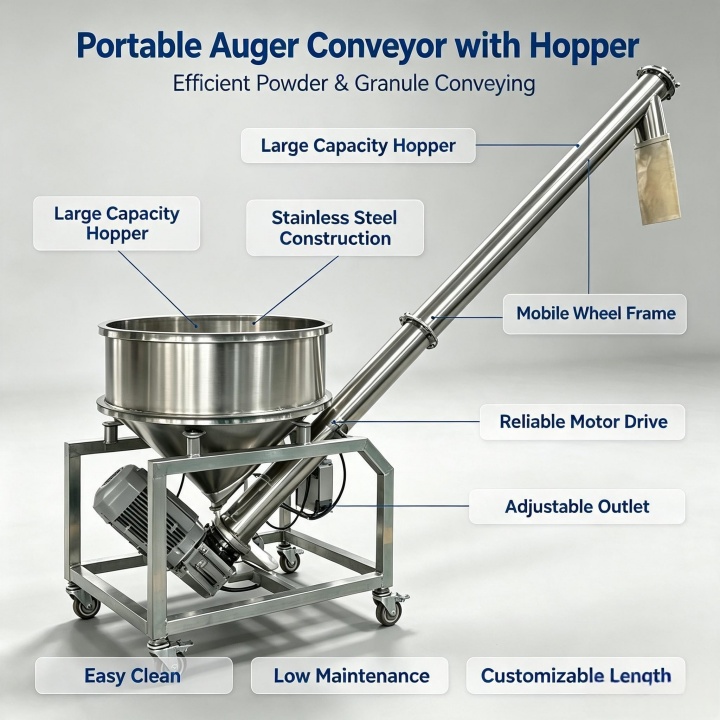
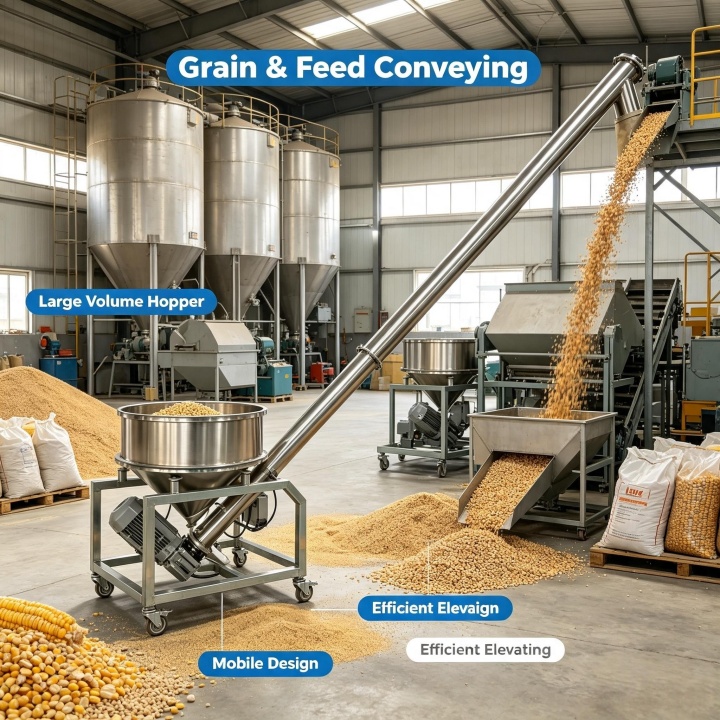
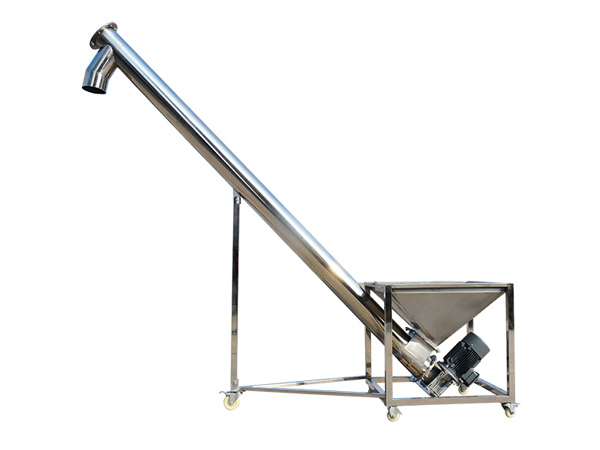
A Portable Auger Conveyor with Hopper is a tubular screw conveying device equipped with a mobile wheel frame, a dust-tight feed hopper, and an adjustable incline angle, engineered for continuous relocation, dumping, and elevated feeding of granular and powder materials across different workshops or storage yards.
Screw Conveyor vs. Auger Conveyor & Portable Advantages
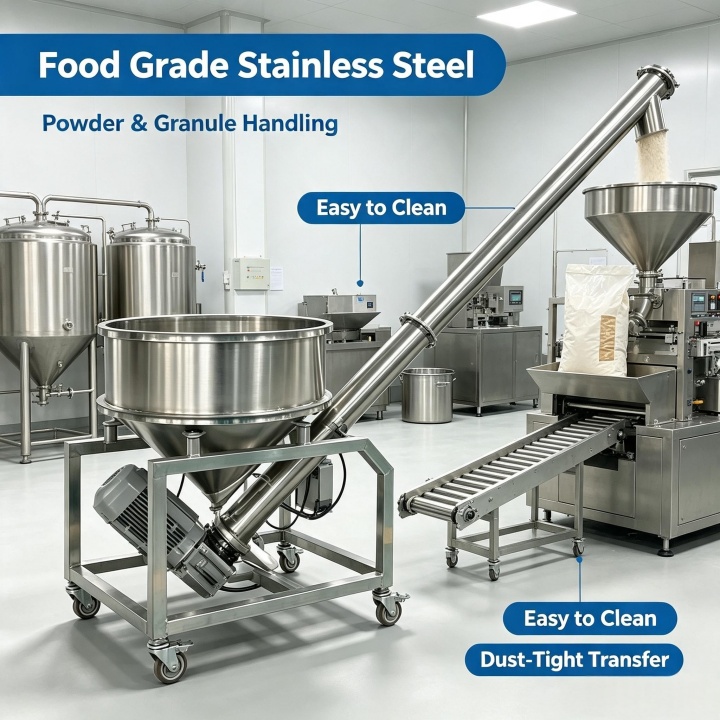
In the field of industrial bulk material handling, "Auger Conveyor" and "Screw Conveyor" refer to the same type of mechanical configuration that utilizes rotating helical blades to push and move materials, sharing interchangeable physical semantics in engineering design and drawing annotations. However, in specific operating conditions, a mobile configuration with a hopper provides greater site mobility and feeding convenience compared to stationary equipment.
| Comparison Dimension | Portable Auger Conveyor with Hopper | Stationary Screw Conveyor |
| Mobility & Site Adaptation | Equipped with lockable swivel casters at the base, allowing single-person pushing to different feed inlets. | Anchored to concrete foundations or steel structure frames with a fixed position. |
| Feed Inlet Configuration | Integrates an open-top dust-tight hopper to receive material dumping from trucks, bulk bags, or manual tipping. | Uses standard flange interfaces, requiring connection to upstream piping or valves. |
| Civil Infrastructure Requirement | Zero civil foundation expenses; ready to start upon power connection. | Requires embedded anchor bolts and a permanent mounting platform. |
| Footprint Flexibility | Can be pushed to corners for storage when idle, occupying minimal storage footprint. | Permanently occupies fixed aisles and workshop operational floor space. |
Tubular Architecture & Dust-Tight Hopper Design
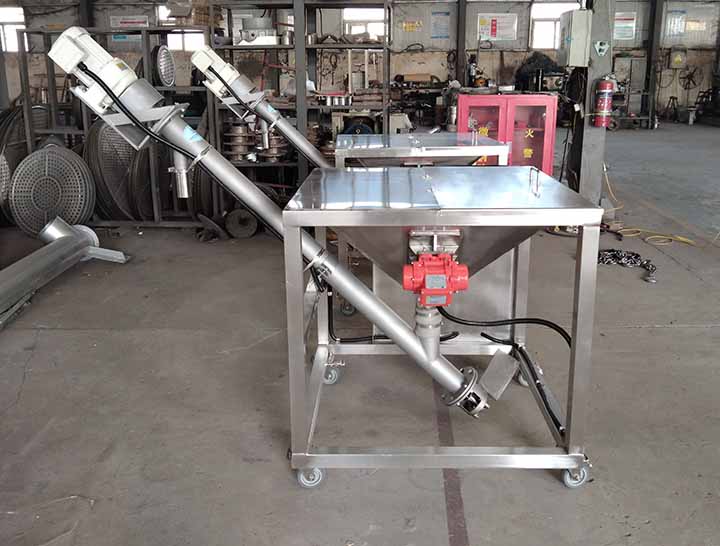
The conveyor casing is fabricated from seamless steel pipes or rolled stainless steel tubes to block powder leakage and dust dispersion during elevation. The feed hopper is installed at the bottom inlet, fitted internally with anti-caking grates and pneumatic or electric vibrators to prevent large debris from entering the tube cavity and to break up agglomerated materials. A flexible rubber sealing cover and a dust extraction port are provided along the upper edge of the hopper to contain dust generated during material tipping within the vessel. The screw shaft is suspended and supported by bearing housings at both ends inside the tube, featuring a quick-dismantle end cap at the tail that allows direct high-pressure water washing of the tube cavity and screw blades upon removal.
Compact & Foldable Configurations for Grain and Bulk Handling
To address grain depot turnover, bulk grain truck loading, and space-constrained warehouse environments, the system offers compact and foldable casing configurations. Compact units with tube diameters of 100–150 mm can pass through narrow doorways and receive materials beneath low-clearance equipment. Segmented or folding tube bodies are connected via central quick-assembly hinges and winch mechanisms, allowing the long tube to fold and reduce its length by 50% during transport. This design facilitates direct loading into truck beds, achieving rapid cross-site transportation in farm yards, grain depot transfers, and small-batch bulk material tipping scenarios.
Material Options: Stainless Steel vs. Carbon Steel
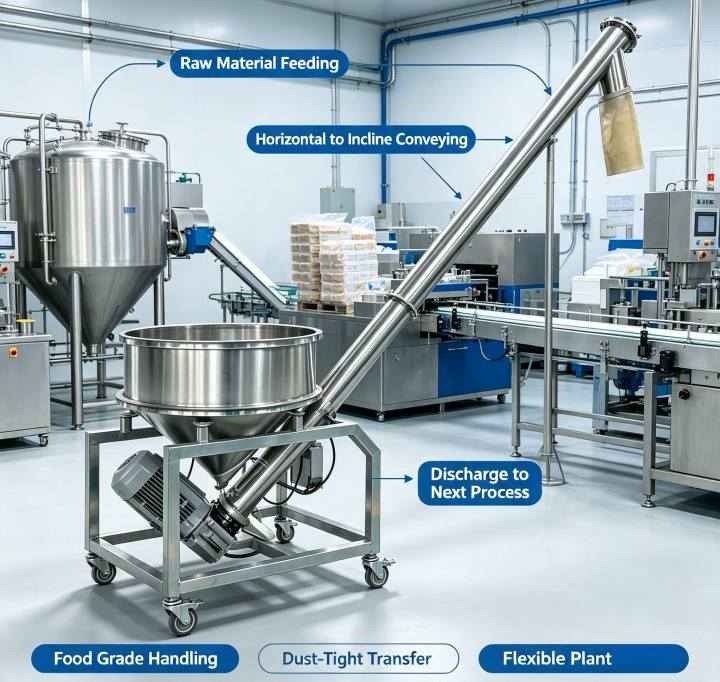
Material selection is determined according to the corrosive nature, abrasiveness, and cleanliness standards of the material. 304/316L stainless steel materials undergo surface mirror polishing or acid-pickling sandblasting treatments to resist acid and alkali corrosion, prevent material adhesion and contamination, and suit fine powders, fine chemicals, and wet granules. Carbon steel or 16Mn wear-resistant steel materials possess high yield strength and wear resistance, utilized for handling highly abrasive materials such as mineral powder, sand, and cement to reduce the wear rate on screw blade edges.
Engineering Selection & Incline-to-Capacity Calculation
Actual conveying capacity during inclined elevation experiences attenuation due to the incline angle. The engineering selection formula is as follows:
Q_i = Q_h · C_α
In the formula, Q_i represents the actual conveying capacity in the inclined state (m³/h), Q_h represents the theoretical conveying capacity in the horizontal state (m³/h), and C_α represents the incline angle correction factor. At 15°, C_α ≈ 0.90; at 30°, C_α ≈ 0.70; at 45°, C_α ≈ 0.50. When designing drive power, a starting power margin of 15%–20% must be added based on material bulk density ρ (t/m³) and elevation height H (m) to prevent motor overload upon restarting after full-load shutdown.
Technical Specifications & Model Matrix
| Model Code | Tube Dia. (mm) | Hopper Vol. (L) | Incline Range (°) | Horizontal Capacity (m³/h) | 45° Incline Capacity (m³/h) | Motor Power (kW) | Mobility Base Type |
| PAC-100 | 100 | 50 – 100 | 0° – 45° | 5 | 2.5 | 1.5 – 2.2 | 4-Wheel Lockable |
| PAC-150 | 150 | 100 – 200 | 0° – 45° | 12 | 6.0 | 3.0 – 4.0 | Swivel Casters |
| PAC-200 | 200 | 200 – 350 | 0° – 40° | 25 | 12.5 | 5.5 – 7.5 | Pneumatic Tires |
| PAC-250 | 250 | 350 – 500 | 0° – 35° | 40 | 20.0 | 9.0 – 15.0 | Heavy Towable Frame |
Technical FAQ Section
Q1: Is an auger conveyor the same as a screw conveyor?
Answer: Both terms serve as alternative names for the same category of conveying equipment. "Auger" typically designates tubular or small-scale screw conveying configurations, while "Screw Conveyor" refers to screw drive systems encompassing both trough and tubular types, with no substantive difference in mechanical structure or driving principle.
Q2: How do you adjust the discharge angle on a portable auger conveyor?
Answer: The system is equipped with a hand winch or hydraulic cylinder elevation mechanism between the base frame and tube body. Operators turn the winch handle or operate a manual hydraulic pump to move the support frame along a sliding track, adjusting the inclination angle of the tube body.
Q3: Can a small portable auger conveyor with hopper handle high-moisture materials?
Answer: Yes, but the screw configuration must be adapted. When handling high-moisture or sticky materials, the unit should be equipped with a shaftless screw or variable-pitch screw blades to prevent material from wrapping around a central shaft or forming blockages on tube walls.
Summary
A Portable Auger Conveyor with Hopper integrates the structural advantages of tubular sealed conveying with a mobile chassis. The seamless pipe body and dust-tight hopper prevent dust emission, while the hand-winch/hydraulic elevation mechanism provides incline adjustment capability. Foldable tube bodies and swivel caster bases adapt to multi-site turnover. Selecting 304 stainless steel or carbon steel based on material corrosiveness and abrasiveness, alongside setting conveying capacity according to the incline correction factor C_alpha, satisfies elevated feeding and relocated conveying needs for bulk grain, powder, and granular materials across diverse operational workshops.
Sugested Products
Portable Screw Conveyor