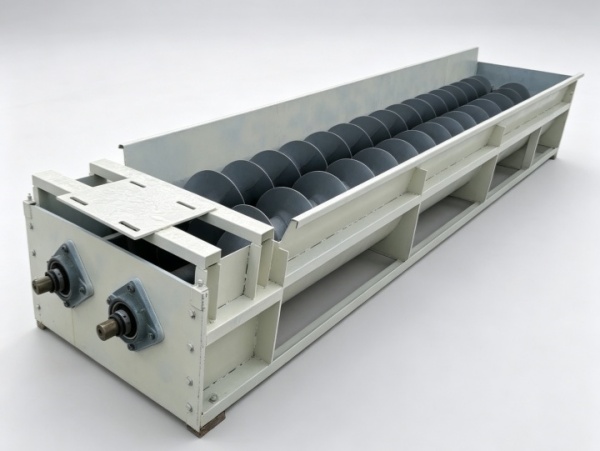
Twin Shaft Screw Conveyor for Flue Gas Desulfurization Gypsum
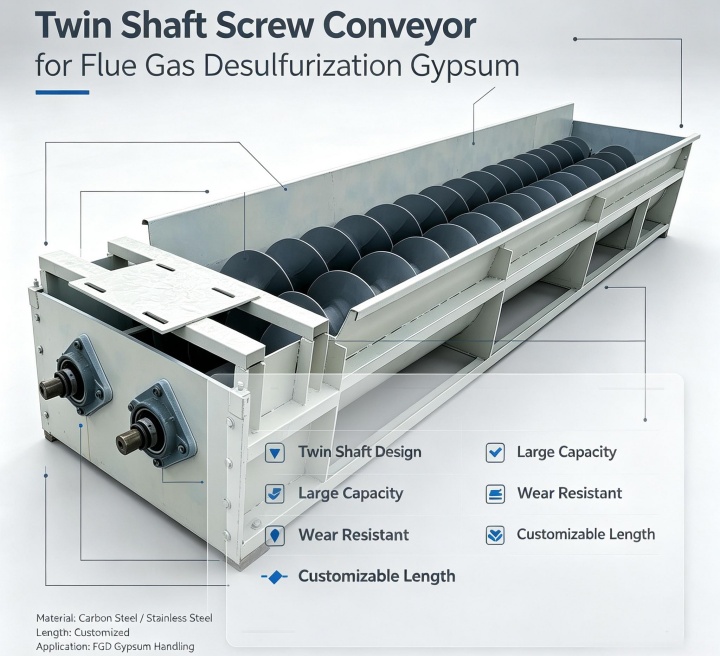
The equipment utilizes two intermeshing screw shafts rotating synchronously to complete continuous advancement and crushed material conveying of wet flue gas desulfurization gypsum inside an enclosed trough.
- Handling Capacity Range: 5 t/h – 150 t/h (calculated based on FGD gypsum bulk density of 1.2 – 1.5 t/m³)
- Allowable Material Moisture Content: 8% – 17% (wet gypsum at the outlet of vacuum belt dewaterer)
- Wet-End Contact Material: 316L Stainless Steel / 2205 Duplex Stainless Steel / Internal lining with NM400 wear-resistant plate
- Drive Reducer Type: Hardened helical parallel-shaft reducer (Power: 5.5 kW – 45 kW)
- Shaft Seal Structure: Multi-stage gland packing combined with air-purged positive pressure isolation system
Why Choose a Dedicated Design for the FGD Gypsum Process?
Gypsum crystals generated during wet flue gas desulfurization in coal-fired power plants carry over 10% free water. Strong inter-particle adhesion makes the material prone to wall sticking, shaft wrapping, and bridging in single-shaft screw troughs. In addition, residual chloride ions in FGD gypsum filtrate (Cl⁻ concentration often at 10,000 – 40,000 mg/L) combined with a slightly acidic environment induce pitting and crevice corrosion on metal structures.
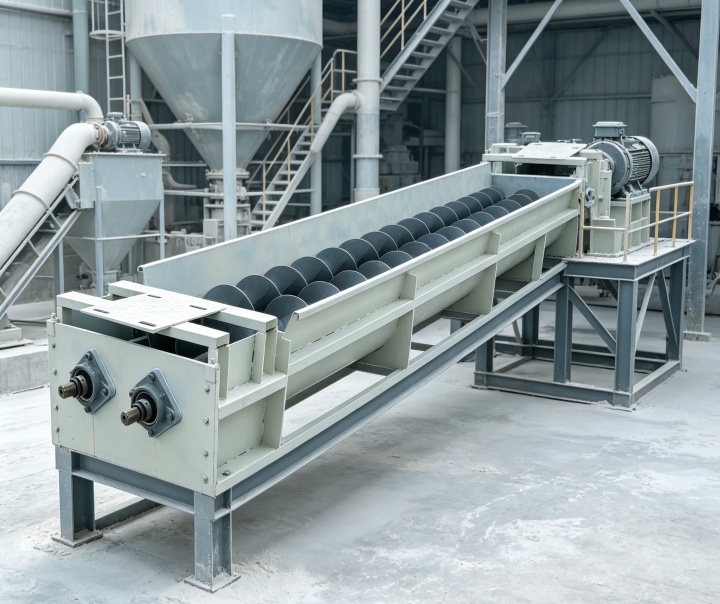
Intermeshing Self-Cleaning Twin Shaft Structure
Co-Rotating/Counter-Rotating Shear Advancement: The two screw shafts are arranged in an intermeshing cross-pattern with an operating clearance of 5 – 8 mm maintained between blade edges. Relative shear forces generated as the shafts rotate automatically strip off wet gypsum adhering to adjacent shaft bodies, breaking up material agglomeration.
Variable Pitch and Thickened Blades: The inlet section adopts a short-pitch design to prevent material surging and clogging; screw blade edge thickness is increased to 10 – 12 mm to resist abrasion from hard impurities in wet gypsum.
Corrosion Protection and Air-Purged Isolation
Chloride-Resistant Metallurgy Selection: The trough inner wall and screw blades are constructed entirely from 316L or 2205 duplex stainless steel, with weld seams picketed and passivated to reduce the risk of pitting corrosion from slightly acidic slurries.
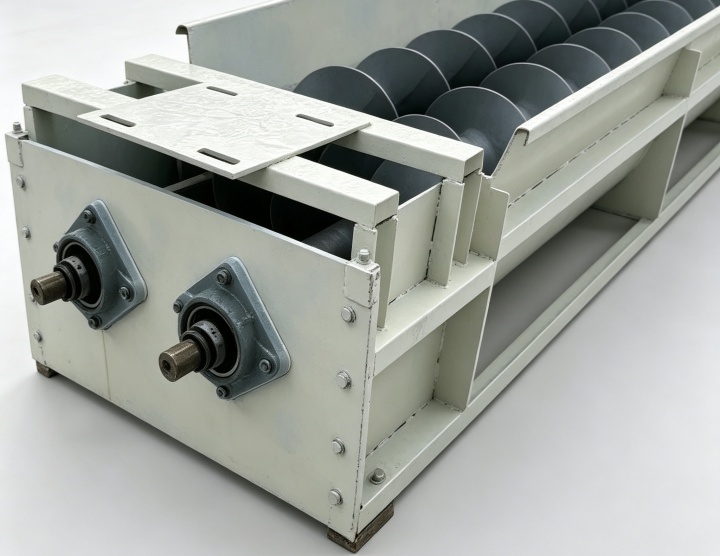
External Bearings and Positive-Pressure Air Seal: Bearing housings are separated from end cover plates with a 100 mm suspended clearance. Compressed air at 0.2 MPa is introduced into the end sealing box to form a positive-pressure barrier, blocking chloride-bearing wet gypsum dust from entering the bearings.
Technical Specifications
| Parameter Item | Model 2DS-250 | Model 2DS-315 | Model 2DS-400 | Model 2DS-500 |
| Handling Capacity (t/h) | 5 – 15 | 15 – 40 | 40 – 80 | 80 – 150 |
| Screw Diameter (mm) | 250 × 2 | 315 × 2 | 400 × 2 | 500 × 2 |
| Rotational Speed Range (rpm) | 20 – 35 | 20 – 35 | 15 – 30 | 12 – 25 |
| Applicable Moisture Content (%) | ≤ 17% | ≤ 17% | ≤ 17% | ≤ 17% |
| Motor Power (kW) | 5.5 – 7.5 | 11 – 15 | 18.5 – 22 | 30 – 45 |
| Trough Steel Plate Thickness (mm) | 6 | 8 | 10 | 12 |
Application in Flue Gas Gypsum Production Lines
Flue gas gypsum production processes include slurry absorption, gypsum dewatering, discharge conveying, and storage/loading. The twin shaft screw conveyor is positioned below dewatering equipment and upstream of storage silos to receive and transfer materials:
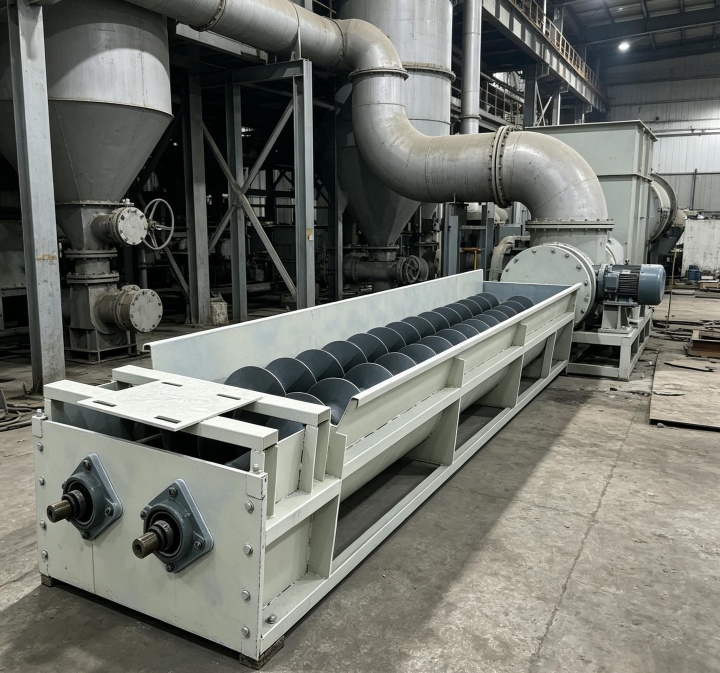
Receiving Below Vacuum Belt Dewaterers: Placed directly beneath the filter cake discharge port of vacuum belt filters, it directly receives 20 – 40 mm thick wet gypsum cakes and uses twin-shaft shear forces to break the filter cake into bulk materials below 15 mm particle size.
Transferring to Gypsum Silos or Drying Equipment: It elevates and pushes bulk gypsum into bucket elevator inlets or dryer feed chutes at an incline angle of 0° – 15°, maintaining quantitative continuous feeding. If operating conditions involve non-corrosive dry powder material conveying, reference can be made to standard double screw conveyor equipment systems.
Frequently Asked Questions
Q1: Why is a twin shaft screw conveyor preferred over a single shaft for wet FGD gypsum?
Answer: When handling FGD gypsum with a moisture content exceeding 10%, a single-shaft screw conveyor causes material to rotate together with the screw blades without moving forward, eventually filling the pitch space and leading to motor overload and shutdown. Interlocking double-shaft screw blades overlap each other; the blades of one shaft scrape off material adhering to the other shaft, generating positive propulsion forces that eliminate single-shaft slipping, clumping, and bridging issues.
Q2: How do you protect the conveyor from acidic corrosion in the flue gas gypsum process?
Answer: Anti-corrosion measures consist of three parts:
- Material-contact parts use 316L or 2205 duplex steel to resist chloride ions and slightly acidic environments.
- All internal weld seams undergo continuous double-sided welding, followed by polishing, pickling, and passivation to eliminate crevice corrosion hazards along welds.
- Anti-corrosive PTFE packing is installed at drive shaft wall penetrations, with compressed air supplied to isolate acidic liquids.
Q3: Can this double auger conveyor handle continuous 24/7 power plant operation?
Answer: Yes. Designed to power plant continuous operation standards, the equipment is fitted with heavy-duty industrial reducers, alloy steel drive gear sets, and external cast steel bearing housings. Bearings remain separated from internal trough materials to avoid lubricant contamination, allowing long-cycle uninterrupted operation in coordination with power plant desulfurization systems.
Get Technical Drawing & Quote
When submitting selection requirements, please provide the following on-site operating parameters to our technical department:
- Required hourly FGD gypsum handling capacity (t/h)
- Material moisture percentage at the dewaterer outlet (%)
- Conveying distance and inclined installation angle (meters / degrees)
- Specified metallic material requirements (316L / 2205 / carbon steel liner)
- On-site motor voltage and explosion-proof rating (e.g., 380V 50Hz / ExdIIBT4)
Sugested Products
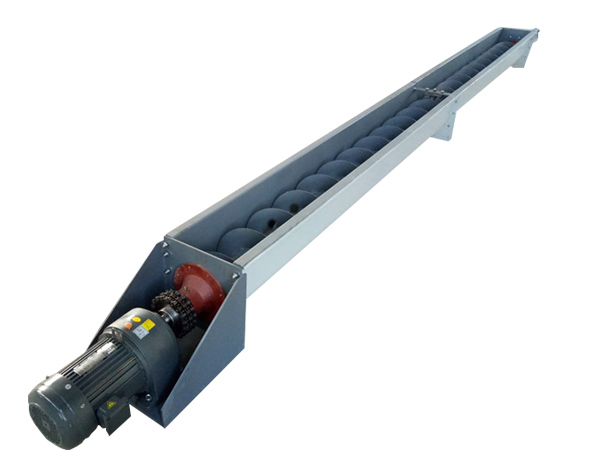
shaftless screw conveyor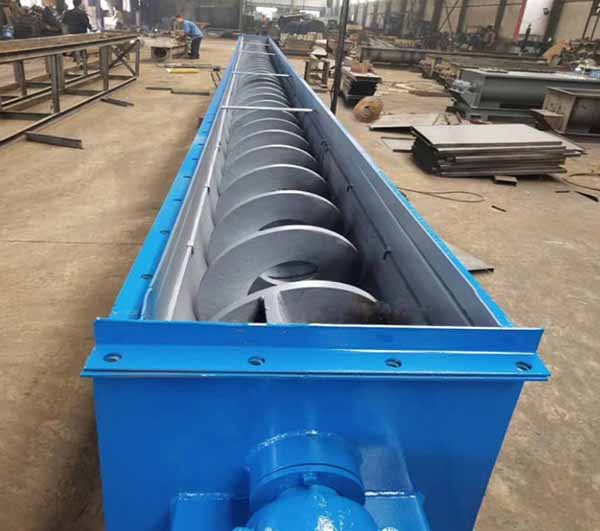
Heavy Duty U-Trough Screw Conveyor for Bulk Material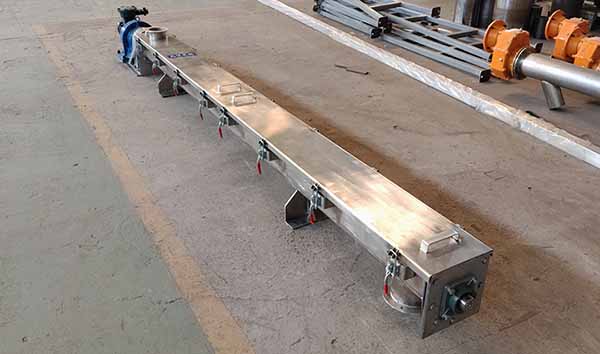
Fish Meal Screw Conveyor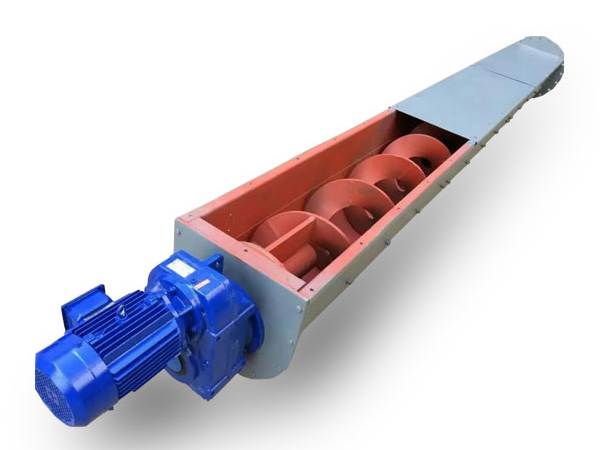
Auger Screw Conveyor