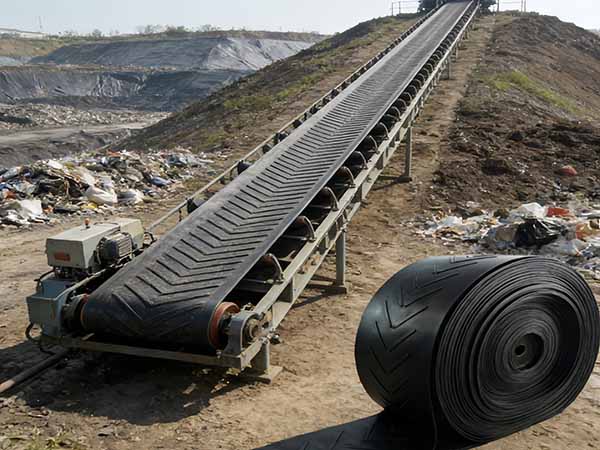
Chevron Industrial Conveyor Belt Manufacturer
One-piece molded pattern, won't peel off
Conveying angle up to 45 degrees
High wear-resistant rubber formula
Suitable for loose, lumpy, granular, and powdery materials
Chevron Industrial Conveyor Belts Overview
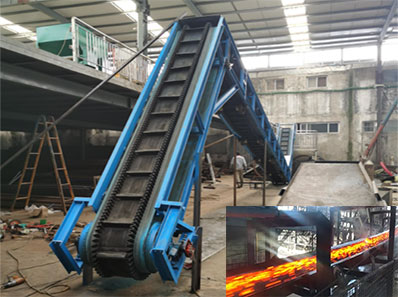
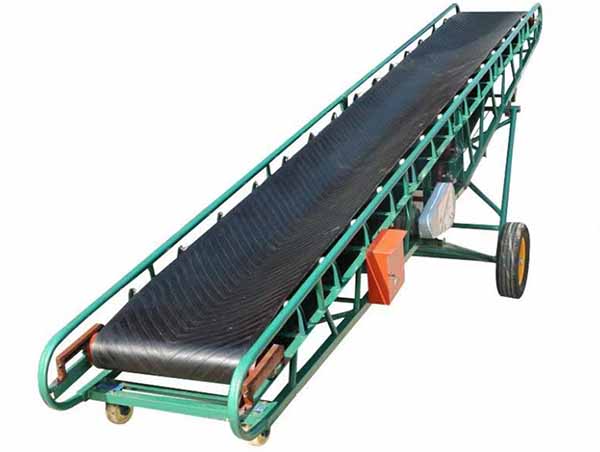
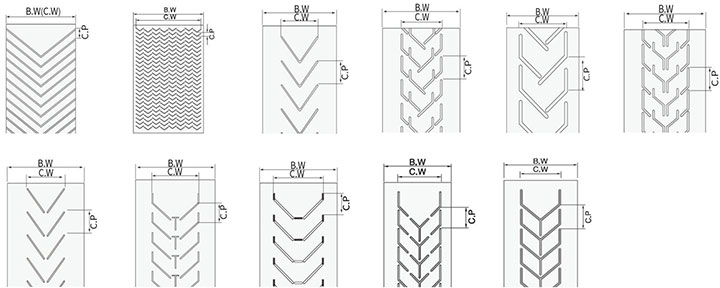
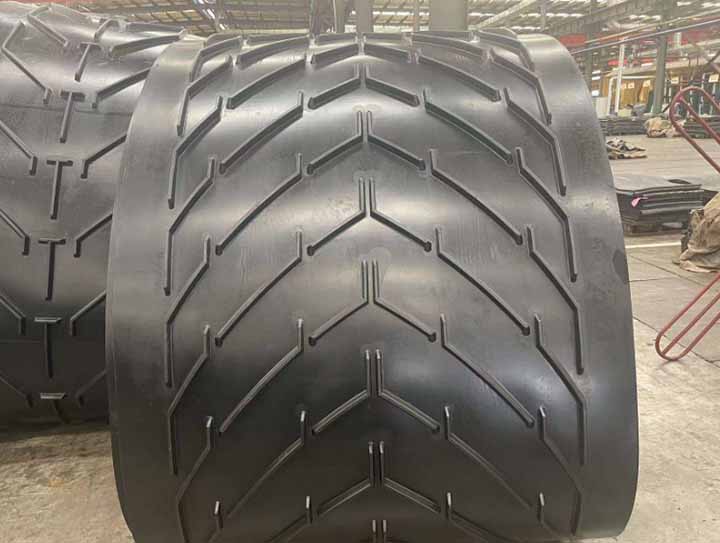
Chevron industrial conveyor belts employing herringbone patterns such as closed V-shapes and open V-shapes, prevent material slippage and scattering. This structure allows the equipment to carry ore or loose gravel even on continuous inclines of 16°-45°.
-
Base belt widths range from 300 mm to 2000 mm. At a standard belt speed of 2.5 m/s, the hourly transport capacity can reach 100 to 1200 tons, meeting the conveying needs of single-machine spans from 50 to 300 meters. For complex materials with high impact and abrasion characteristics, the outer frame is wrapped with a wear-resistant rubber covering layer to buffer the shear stress during material fall, supporting long-term stable operation of the equipment under harsh conditions.
Chevron industrial conveyor belt structure
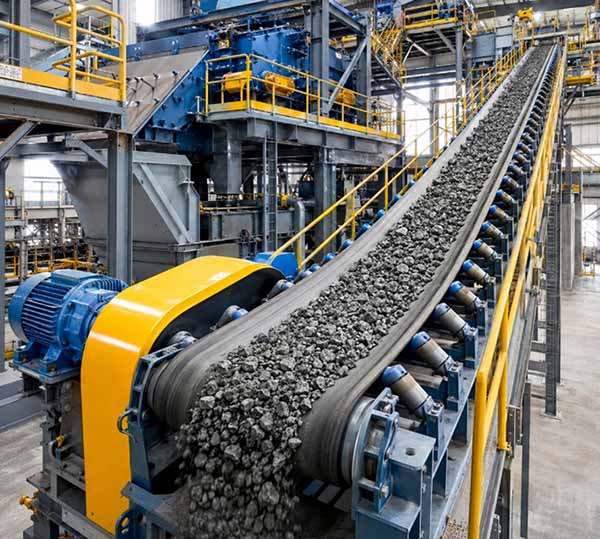
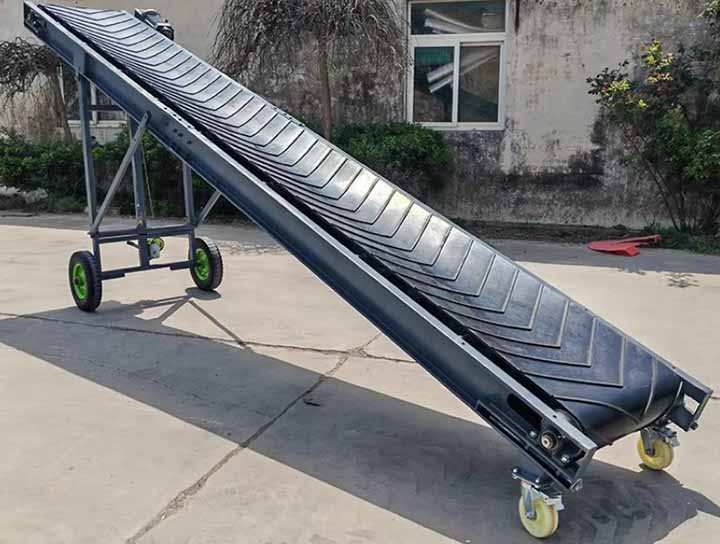
The Chevron conveyor belt system consists of main components such as a drive motor, reducer, rollers, idlers, and the conveyor belt. The conveyor belt is primarily formed by integral vulcanization of the pattern outline and base belt. Pattern shapes include closed V-shapes, open V-shapes, and Y-shapes, with pattern height typically ranging from 5mm to 32mm, determining the maximum conveying angle. The internal fabric layers of the base belt are mostly composed of 2-6 layers of high-tensile EP or NN canvas, providing core tensile strength. The rubber cover layer thickness is divided into upper and lower cover rubber, with standard thicknesses of 4+2mm or 6+1.5mm. The selection of wear-resistant and cut-resistant rubber materials protects the internal frame of the equipment.
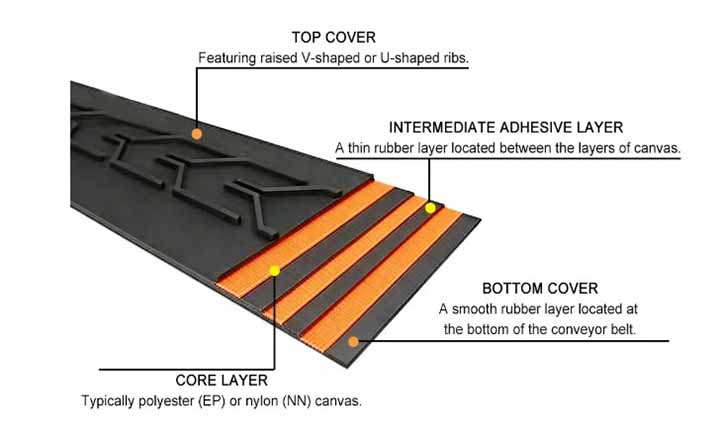
Image of different herringbone shapes
What are the benefits of Chevron industrial conveyor belts?
Using herringbone industrial conveyor belts offers advantages such as the ability to convey materials at different angles, high wear resistance, improved conveying efficiency, and self-cleaning properties.
Chevron industrial conveyor belts feature a herringbone pattern that is vulcanized and molded in a single process, ensuring the pattern and belt are integrated and won't detach or crack due to impact or friction from materials like ore during operation.
The equipment can convey materials within an angle range of 16°-45°, reducing the conveyor's horizontal footprint and saving factory space and steel costs.
The rubber material on the belt surface conforms to DIN 22102 standards, and belts with different wear resistance and tensile strengths (DIN-X, DIN-Y, DIN-W, DIN-Z, etc.) are available to suit the characteristics of the conveyed materials. When conveying sharp, hard materials such as sand and ore, the rubber material is sufficiently wear-resistant to prevent tearing.
The open-pattern design of the equipment provides self-cleaning properties, allowing adhering moisture or sand to drain smoothly and preventing accumulation. It also ensures a smoother, vibration-free passage through the return rollers and is compatible with electric brush cleaners to prevent material re-carrying.
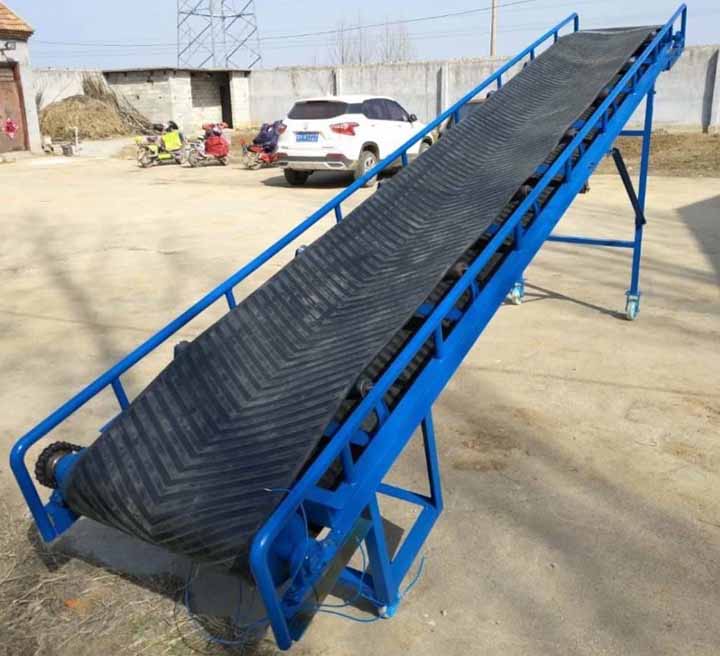
Chevron conveyor belt dimensions
Chevron industrial conveyor belts are primarily made with DIN-X and DIN-Y grade rubber to ensure resistance to cutting, tearing, and severe abrasion under steep incline conditions.
| Rubber Grade | Tensile Strength (Min.) | Elongation at Break (Min.) | Abrasion Loss (Max.) | Typical Applications & Material Types |
| DIN-W | 18 MPa | 400% | 90 mm³ | Super Abrasion Resistant: Highly abrasive and grinding materials like quartz, glass cullet, slag, taconite, and cement clinker. |
| DIN-X | 25 MPa | 450% | 120 mm³ | Heavy-Duty Cut & Gouge Resistant: Large, heavy, and sharp materials that easily cut the belt, such as metallic ores, sharp rocks, granite, and large-sized coal. |
| DIN-Y | 20 MPa | 400% | 150 mm³ | General Purpose / Standard Wear: Medium abrasive materials. Ideal for sand, gravel, limestone, crushed coal, grain, and bauxite. |
| DIN-Z | 15 MPa | 350% | 250 mm³ | Economical / Light-Duty: Low abrasive materials, agricultural products, or packaged goods with minimal wear impact. |
Herringbone industrial conveyor belt model parameter table
Please refer to the herringbone industrial conveyor belt specification table below to find the right conveyor belt for your steep incline conveying system.
| Pattern Type | Cleat Height | Belt Width | Max. Incline Angle | Min. Pulley Dia. | Carcass Material | Rubber Grade | Edge Type |
| Closed-V | 15 mm | 400 - 1200 mm | 25° ~ 30° | 250 mm | EP 100 - EP 300 | DIN-Y / DIN-Z | Molded Edge |
| Open-V | 16 / 25 mm | 500 - 1400 mm | 30° ~ 35° | 315 mm | EP 150 - EP 400 | DIN-X / DIN-Y | Molded Edge |
| Multi-V | 5 / 6 mm | 300 - 1000 mm | 16° ~ 25° | 200 mm | EP 100 / NN 100 | DIN-Y | Molded / Cut |
| Y-Type | 25 / 32 mm | 600 - 1600 mm | 35° ~ 45° | 400 mm | EP 200 - EP 500 | DIN-W / DIN-X | Molded Edge |
Note: Can't find the size you need? We can provide custom herringbone conveyor belts based on your drawings, including specific baffle spacing, top and bottom rubber thickness, and special heat/oil resistant rubber formulations.
How much do Chevron industrial conveyor belts cost?
The price of Chevron industrial conveyor belts is calculated based on the required length. For example, a lightweight patterned conveyor belt with a belt width of 600mm-1000mm, a pattern height of 5mm-6mm, and 2-3 layers of fabric costs USD 15–35 per meter. A high-wear-resistant chevron conveyor belt with a pattern height of 25mm-32mm, 4-5 layers of fabric, costs $85-$200 per meter. The price difference is due to variations in belt width and base thickness, number of reinforcing layers and tensile strength, pattern height and type, rubber abrasion resistance grade, and purchase quantity. When selecting a supplier, provide them with detailed requirements for the conveyor belt and they will provide a quote.
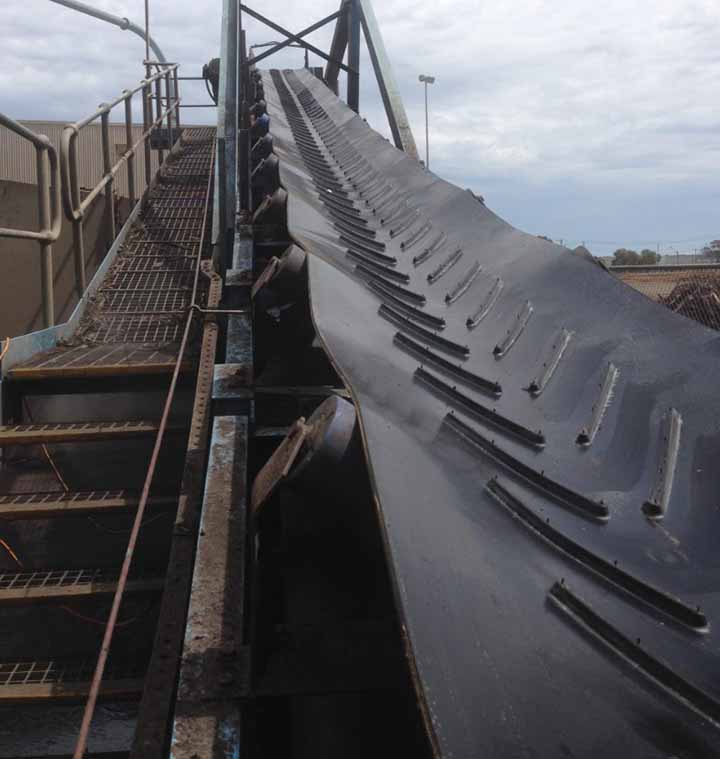
Chevron conveyor belt suppliers
Herringbone industrial conveyor belt manufacturers can customize different pattern shapes such as closed V-shape, open V-shape, Y-shape, and U-shape according to specific needs. They can also add configurations such as heat resistance, oil resistance, or flame retardancy to chevron belt conveyors based on the working environment. Dahan Machinery, as a source manufacturer, not only offers competitive prices among similar manufacturers but also provides customization based on provided drawings and specific requirements. Currently, Chevron industrial conveyor belts are sold to over 80 countries and regions, including India, Malaysia, Vietnam, Pakistan, and Russia, providing extensive production experience and case studies for reference.
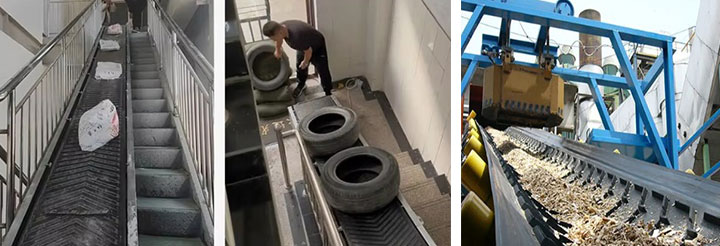
Chevron Industrial Conveyor Belt Applications
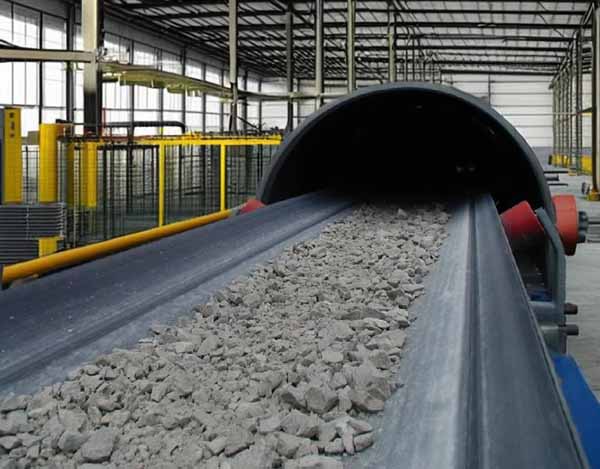
Chevron industrial conveyor belts can transport loose, lumpy, granular, and powdery materials, such as coal, ore, sand, cement, grain, and fertilizer. They can be used in mining, cement plants, quarries, docks, thermal power plants, construction sites, agriculture, and mobile screening and crushing plants.
FAQ
What is a Chevron industrial conveyor belt?
A Chevron industrial conveyor belt is a rubber belt with V-shaped cleats that prevent materials from sliding on inclined conveyors. It is widely used for transporting coal, ore, sand, gravel, grain, and other bulk materials at angles up to 45°.
What is the maximum incline angle for a Chevron conveyor belt?
Most Chevron conveyor belts are suitable for conveying materials at incline angles from 16° to 45°. The maximum angle depends on the cleat height, pattern, and material type.
How do I choose the right Chevron conveyor belt?
Choose a Chevron conveyor belt based on the material type, incline angle, belt width, tensile strength, and rubber grade. For highly abrasive materials, DIN-X or DIN-W rubber is recommended.
What industries use Chevron industrial conveyor belts?
Chevron industrial conveyor belts are widely used in mining, quarries, cement plants, agriculture, ports, recycling, and construction for conveying bulk materials on inclined conveyor systems.
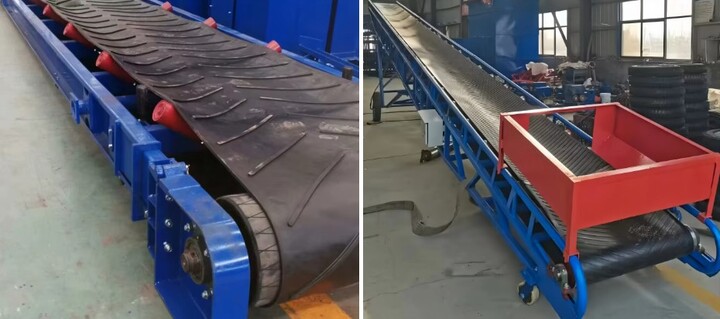
Chevron industrial conveyor belts feature an open-chevron pattern, forming a barrier on the belt surface that blocks the natural flow of material. Therefore, they can hold more material at high speeds, improving material conveying efficiency.