Electromagnetic Vibratory Feeder Machine
The Electromagnetic Vibratory Feeder Machine is an automated feeding device that utilizes an electromagnetic drive unit to generate high-frequency micro-amplitude vibrations, delivering bulk, granular, or powdered materials continuously and quantitatively to receiving equipment.
- Feeding Capacity: 1 t/h – 100 t/h
- Vibration Frequency: 3000 rpm (50Hz) / 3600 rpm (60Hz)
- Double Amplitude: 1.5 mm – 2.0 mm
- Trough Material: Carbon Steel / Stainless Steel 304/316L
- Input Voltage: 220V / 380V / 440V (50/60Hz)
Electromagnetic Vibratory Feeder Machine Overview
The Electromagnetic Vibratory Feeder Machine is designed for quantitative feeding, continuous batching under storage hoppers, and feeding operations in packaging lines. Utilizing electromagnetic excitation to achieve high-frequency feeding, the equipment supports stepless speed control with feed rates configured from 1 to 100 metric tons per hour.
Trough materials for electromagnetic vibrating feeders are constructed from Q235 carbon steel or SUS304/SUS316L stainless steel, with optional ultra-high-molecular-weight polyethylene (UHMW-PE) or wear-resistant steel liners. Material handling covers coal, ores, sand, gravel, cement, chemical powders, plastic granules, grains, and various dry bulk powders, accommodating material bulk densities between 0.5 and 2.5 t/m³ with maximum allowable particle sizes up to 100 mm.
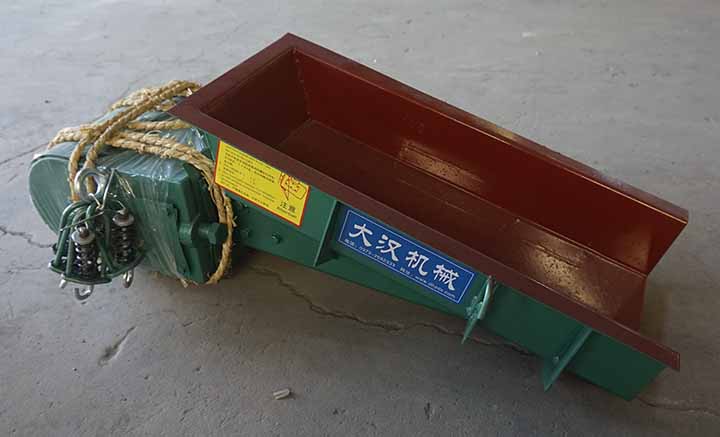
Technical Specifications of Electromagnetic Vibratory Feeder Machine
| Parameter | Value / Range | Engineering Detail |
| Feeding Capacity | 1 t/h – 100 t/h | Calculated with bulk density 1.6 t/m³ |
| Excitation Frequency | 3000 / 3600 Vibrations/min | Synchronized with AC power supply frequency |
| Double Amplitude | 1.5 mm – 2.0 mm | Stepless adjustment via voltage control |
| Trough Dimensions | Length: 500–1500 mm; Width: 100–600 mm | Custom open or enclosed trough designs |
| Trough Material | Carbon Steel / SUS304 / SUS316L | Optional 12mm NM400 wear-resistant liner |
| Protection Rating | IP65 / IP66 | Resin encapsulated drive unit |
Working Principle: Resonance & Electromagnetic Controller
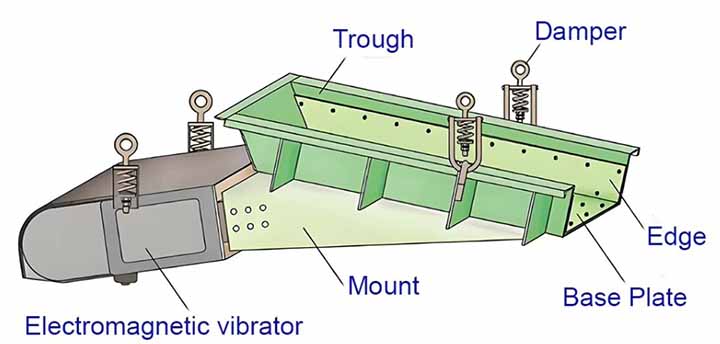
The operation of the Electromagnetic Vibratory Feeder Machine is based on the principle of a two-mass near-resonance system. When the control system is connected to alternating current, power is supplied to the electromagnetic vibrating coil via a half-wave rectifier circuit, generating a periodic impulse electromagnetic attraction force at 50 or 60 times per second. The electromagnet attracts the armature, causing elastic deformation and energy storage in the main leaf spring assembly; when the current decays, the magnetic force disappears, and the spring releases energy to push the trough to rebound.
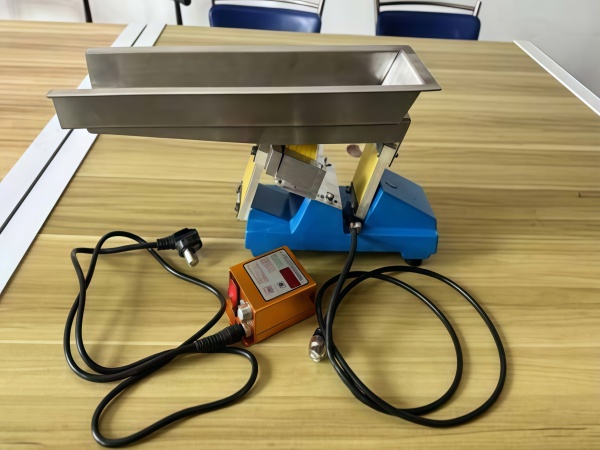
Integrated with an electromagnetic vibrator controller, the drive system alters the coil voltage by adjusting the thyristor conduction angle, fine-tuning the vibration amplitude and material transport velocity. The complete electromagnetic vibrating feeder operates near resonance (resonance ratio z=0.85–0.90), causing material to hop continuously forward in micro-parabolic trajectories inside the trough. This electromagnetic vibration feeder mechanism converts control signals directly into physical displacement, supporting 4–20mA analog signal integration with plant-wide PLC terminals.
Electromagnetic Vibratory Feeder vs. Motor-Driven Vibratory Conveyor
| Technical Aspect | Electromagnetic Vibratory Feeder | Motor-Driven Vibratory Conveyor |
| Drive Mechanism | Electromagnetic coil & spring leaf system | Unbalanced eccentric rotary motors |
| Rotary Friction | No Rotary Friction (No bearings, shafts, or belts) | Bearing friction & mechanical wear present |
| Maintenance Need | Lubrication-Free (Zero grease application needed) | Regular bearing relubrication required |
| Stopping Speed | Instantaneous Response for Automated Weighing (< 0.02s) | Inertial coast-down delay (2-5 seconds) |
| Capacity Adjustment | Electrical stepless tuning via thyristor controller | Mechanical eccentric block adjustment |
| Applicable Scope | electromagnetic vibratory conveyor dosing systems | Heavy-duty long-distance vibratory feeder conveyors |
| Equipment Type | Compact electromag vibrating feeder unit | Heavy structural frame conveyor |
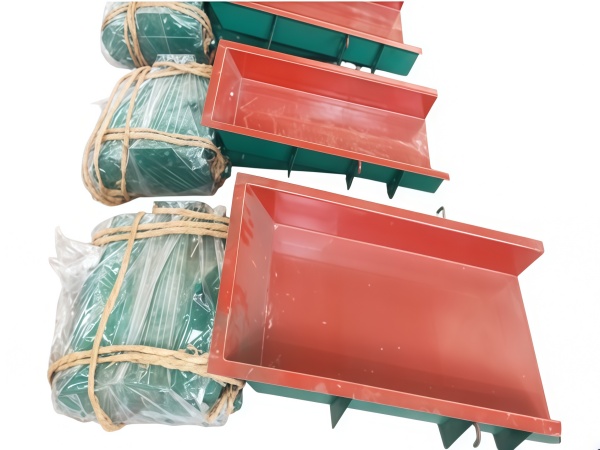
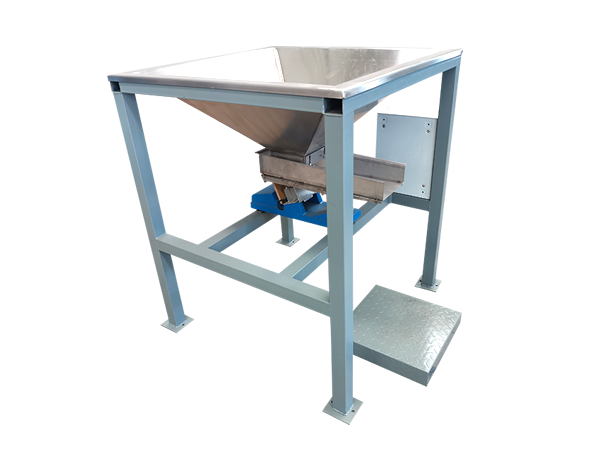
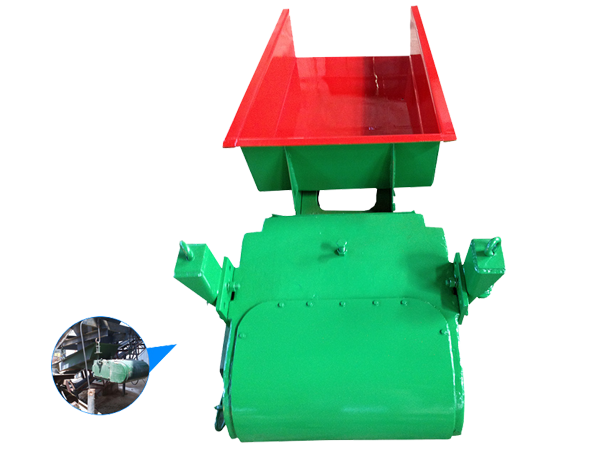
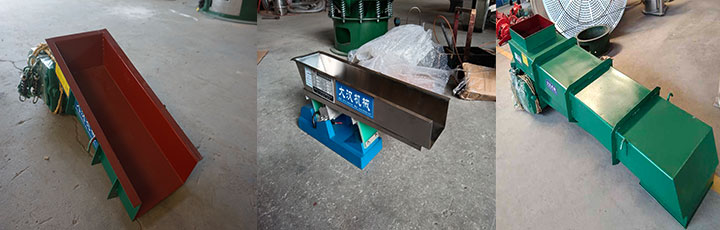
Different types of display
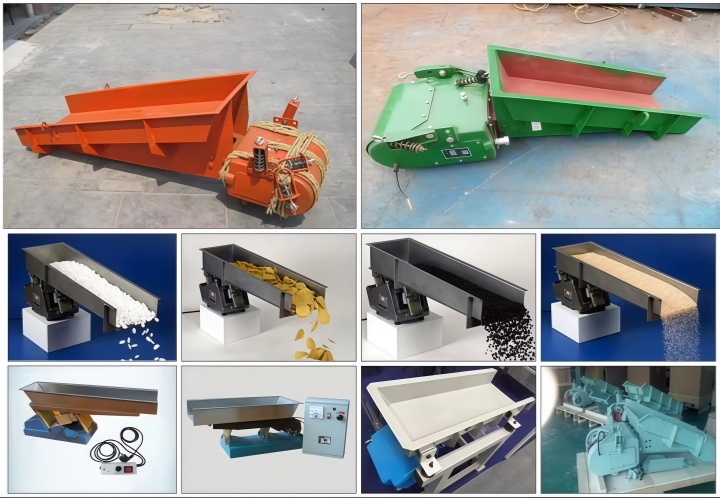
Manufacturing Quality & Custom Trough Options
The core drive component adopts a heavy-duty, fully sealed vacuum encapsulation process for the electromagnetic coil, with the outer housing cast and sealed using epoxy resin (resin encapsulated) to achieve IP65 and IP66 dustproof and waterproof ratings. The coil thermal insulation meets Class F (155°C) and Class H (180°C) standards, maintaining electrical insulation under continuous high-frequency oscillation.
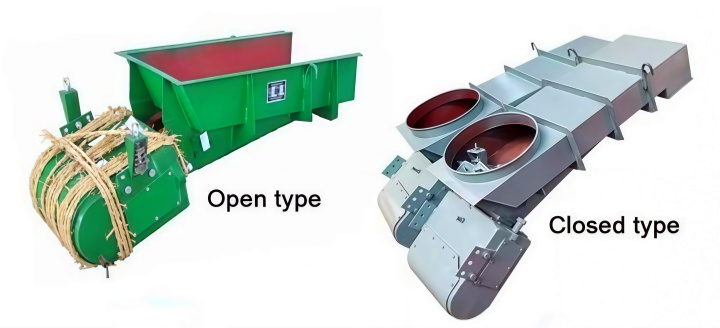
Trough manufacturing supports versatile customization. For high-dust materials, fully enclosed trough structures equipped with flange connections at the inlet and outlet are provided; for highly abrasive ores, the trough is fitted with bolt-on 8 mm to 12 mm wear-resistant steel liners, allowing independent removal and replacement upon wear.
Applications & Industrial Solutions

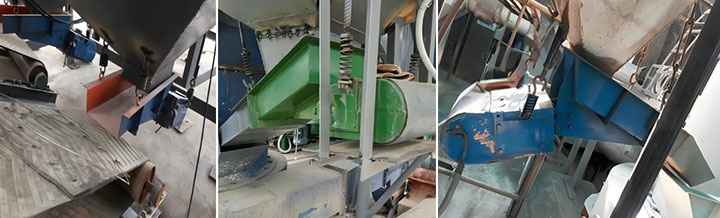
The equipment is applied in mining and beneficiation plants, cement clinker silo batching systems, thermal power plant coal handling lines, chemical micro-powder dosing, and packaging metering lines. In automated weighing and quantitative packaging operations, the electromagnetic vibro feeder provides high-frequency instant shut-off features, preventing material overshoot from compromising weighing accuracy. The unit can be suspended below storage hoppers or floor-mounted on steel platforms using base supports.
Frequently Asked Questions
Q: How does the electromagnetic vibrator controller regulate the material feed rate?
The controller regulates the RMS voltage of the alternating current supplied to the electromagnetic coil via internal thyristor circuitry. Increasing the voltage amplifies the magnetic attraction force on the armature, expanding the main spring amplitude from 0 mm up to 2.0 mm. This modifies the single-step distance and movement speed of the material within the trough, achieving stepless feed rate adjustment from 0% to 100%.
Q: What is the main difference between an electromagnetic vibrator and a vibratory feeder conveyor driven by motors?
Electromagnetic drive structures rely on magnetic attraction and spring rebound, operating without rotating parts such as bearings, belts, or eccentric blocks. This eliminates lubrication maintenance and stops vibration instantly when power is cut. Motor-driven units rely on rotating eccentric weights to generate centrifugal force, incurring mechanical friction losses and inertial coast-down delay after motor shutdown.
Q: How to prevent the electromagnetic vibrating coil from overheating during continuous operation?
The coil is encapsulated using epoxy resin to block external dust and provide thermal dissipation channels. During assembly, the air gap between main spring assemblies must be verified (e.g., 1.8–2.0 mm) to prevent excessive coil current caused by oversized gaps. Furthermore, the drive system is tuned near resonance, allowing the unit to maintain required amplitudes under low operating currents.
The Electromagnetic Vibratory Feeder Machine relies on electromagnetic resonance drive and stepless speed regulation to provide high-frequency quantitative feeding solutions for industrial bulk materials. The design without rotational friction components eliminates lubrication maintenance, while the resin-encapsulated coil structure combined with IP65/IP66 protection adapts to dusty and humid environments. Whether in heavy-duty mining feeding or chemical batching weighing, the equipment exhibits millisecond-level response times when integrated with automated PLC systems. Available in carbon steel, stainless steel, and wear-resistant liner configurations, it fulfills customized production requirements ranging from 1 to 100 metric tons per hour.