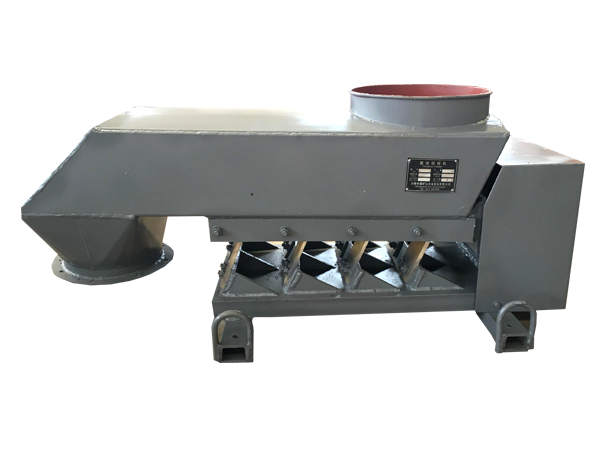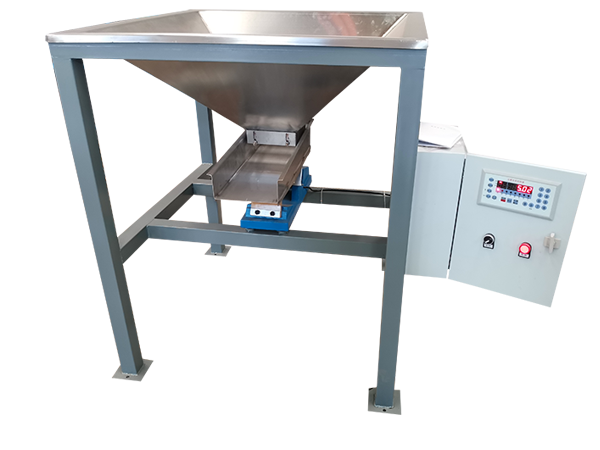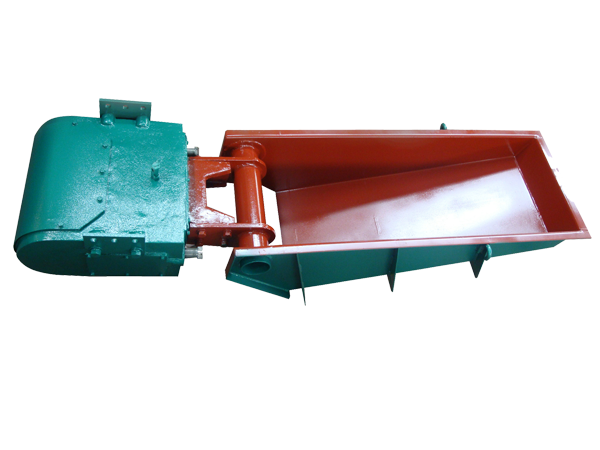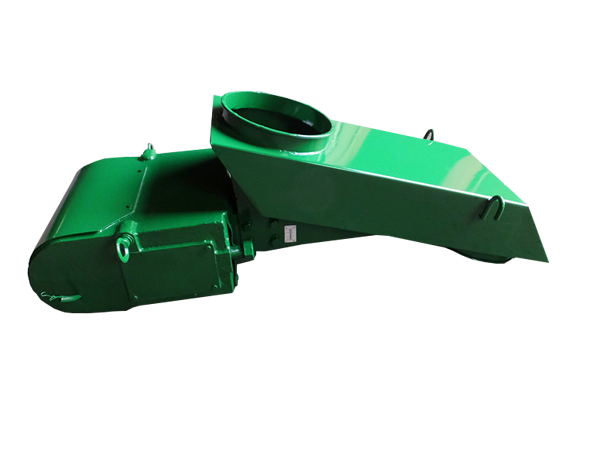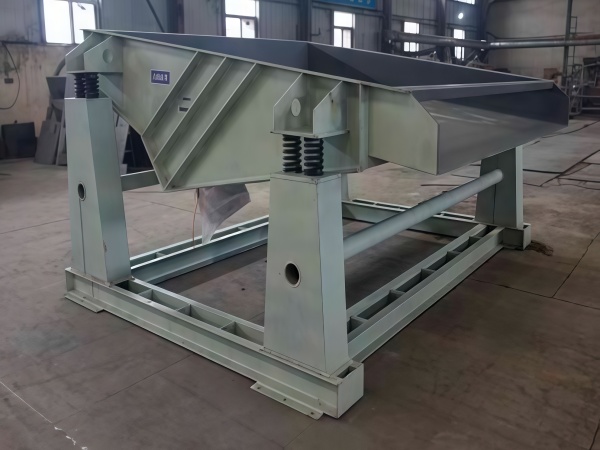
Iron ore vibrating feeder
Why is a Vibrating Feeder Needed in Iron Ore Processing?
Iron ore, a high-density, high-hardness, and highly abrasive material, poses a significant challenge to subsequent equipment if it directly enters the crushing stage after being unloaded from the ore truck into the hopper. Traditional plate feeders or gravity chutes suffer from drawbacks when handling large iron ore pieces, such as easy jamming, inability to adjust the feed rate, and rapid wear and perforation of the liner. Heavy-duty vibrating feeders overcome these problems.
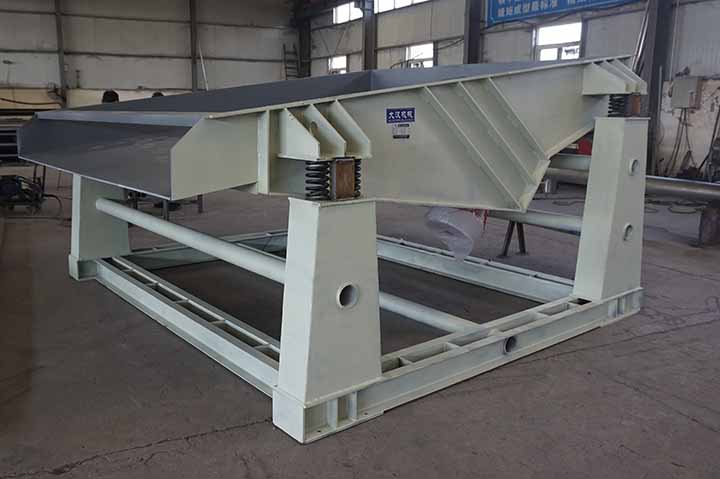
The feed rate of an Iron ore vibrating feeder can be continuously adjusted from 100 t/h to 1500 t/h according to production line requirements. Through the linear excitation force it generates, the material undergoes a micro-throwing motion within the trough, mitigating the direct impact of large ore pieces falling onto the trough. This makes it a crucial control point for material flow rate in the iron ore mining and processing equipment chain.
Technical Advantages of the Heavy-Duty Iron Ore Vibrating Feeder
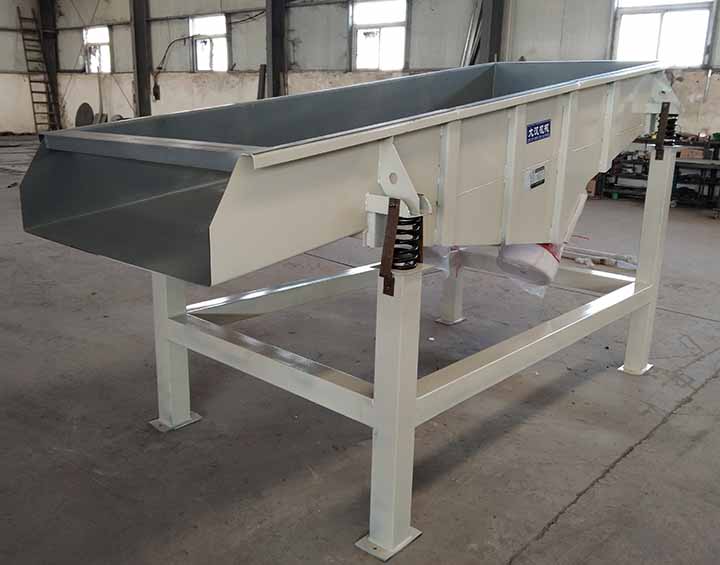
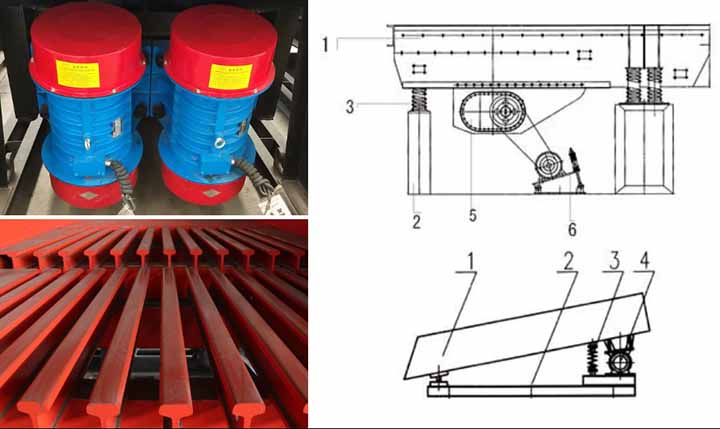
The iron ore vibrating feeder solves the high wear problem in iron ore conveying through specific structural configuration and material selection. In its multi-stage wear-resistant lining configuration, the feeder trough bottom plate abandons ordinary carbon steel and is instead paved with NM500-grade wear-resistant steel plates with a thickness exceeding 20mm and a hardness of HBW500 or higher, extending cutting life. Simultaneously, the tail section is equipped with adjustable-gap stepped alloy bars, allowing fine mud and gravel smaller than 80mm to leak out earlier, reducing the load on the next process. Furthermore, the equipment uses a dual-vibrator shaft drive, with the motor frequency directly adjustable within 0-50Hz via a frequency converter, flexibly changing the feed rate.
Video demonstration of iron ore vibrating feeder
How It Works & Integrated Mining Systems
In the production process of an iron ore beneficiation plant, the vibrating feeder acts as a material flow regulator. The entire material flow and upstream/downstream connection process is as follows: Raw ore from the mine -> Underground silo -> Vibrating feeder -> Discharge chute -> Jaw crusher -> Screw/belt conveyor -> Next grinding stage.
Raw ore is dumped from trucks into a heavy-duty silo, the lower end of which connects directly to the rear receiving area of the vibrating feeder. After the feeder is started, the double eccentric shaft vibrators rotate synchronously in opposite directions, and the resulting force forces the chute to continuously jump forward along the inclined direction, carrying the iron ore. At this time, the soil and fine particles mixed in with the raw ore pass through the gaps in the bars at the front of the feeder and directly enter the lower discharge chute; while large pieces of iron ore are pushed evenly and quantitatively into the feed inlet of the primary jaw crusher at a set speed. The crushed material can then be fed into a belt conveyor or into a sealed Auger Conveyor (screw conveyor) for fine ore powder transfer to prevent dust spillage.
Key Technical Specifications
The following is a comparison table of typical technical parameters to meet the needs of different scales of iron ore processing.
| Model | Max Feeding Particle Size (mm) | Processing Capacity (t/h) | Motor Power (kW) | Bar Gap (mm) | Application Scenario |
| ZGW-1200 | ≤ 550 | 120 - 250 | 2 × 11 | 50 - 80 | Suitable for feeding before primary jaw crusher in medium-sized iron ore dressing plant, matched with 50-ton unloading bin. |
| ZGW-1500 | ≤ 750 | 300 - 550 | 2 × 22 | 80 - 100 | Suitable for large open-pit iron ore mines and heavy-duty feeding working surfaces with high impact force. |
| ZGW-1800 | ≤ 950 | 600 - 900 | 2 × 37 | 100 - 150 | Suitable for discharging from underground main lifting centralized bins, directly connected to high-capacity heavy gyratory crushers. |
Price of Iron Ore Vibrating Feeders
The price of heavy-duty iron ore vibrating feeders ranges from US$9,500 to US$21,000. The main reason for the price difference lies in the technical configuration. First, the material of the liner: the material cost of high manganese steel is 1.5 times higher than that of imported Hardox 500 wear-resistant steel plate. Second, the excitation method: a built-in vibrating motor is cheaper, while an external motor driving a heavy-duty vibrator through a universal coupling is more expensive to manufacture, but has stronger impact resistance. Finally, there is the need for customized structures such as pneumatic gates, spring damping bases, and automated vibration monitoring.
Customized Production Solutions
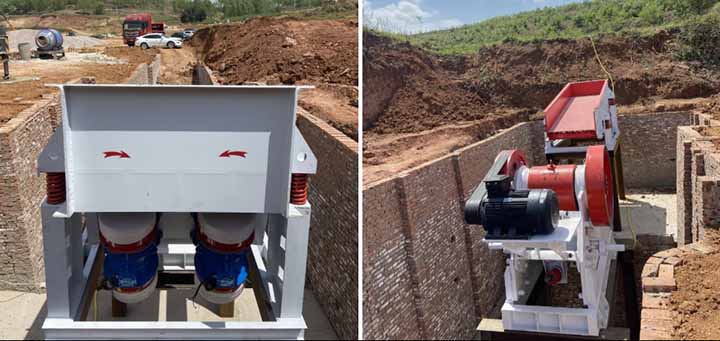
Dahan Machinery can provide customized configurations based on the user's site conditions. Users only need to provide the hopper outlet size, iron ore moisture content, maximum material particle size, and required hourly output. Engineering technicians will use 3D software to calculate the stress stiffness of the trough steel plates, design matching spring stiffness coefficients and excitation force magnitudes, and provide a complete set of CAD foundation drawings, including interference verification between the upstream silo interface and the downstream crusher.
Frequently Asked Questions
Q1: What is the difference between an iron ore vibrating feeder and a standard industrial sifter or vibratory screen?
A: Their design focuses are different. The iron ore vibrating feeder has a heavy structure, primarily designed to withstand the enormous gravitational impact of large pieces of material falling vertically from the silo; its function is "quantitative continuous conveying with coarse particle classification." In contrast, the industrial sifter or vibratory screen has a lighter trough structure and cannot withstand the impact of large pieces of raw ore; its function is to perform multi-layer screening of already crushed, smaller particles.
Q2: Can this feeder handle wet or sticky iron ore?
A: Yes. For sticky iron ore with a moisture content exceeding 8%, we change the downward inclination angle of the trough (increasing it from the standard 5 degrees to 10 or 12 degrees) and install Teflon anti-stick composite liners on the bottom plate of the trough, or change the bars to a stepped, divergent structure to prevent mud ore from accumulating in the trough.
Q3: How do you ensure the stability of the vibration plate machine during high-impact feeding?
A: The equipment uses heavy-duty, high-rigidity steel helical springs as shock-absorbing supports to convert and transmit the impact force of overload to the concrete foundation. Simultaneously, the lower frame of the feeder uses a heavy-duty frame structure welded from I-beams, limiting the lateral sway amplitude during operation to within ±2 mm.
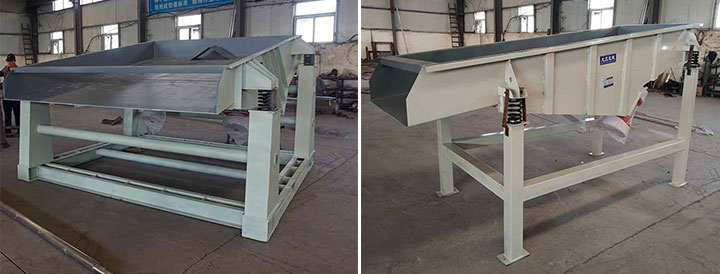
The iron ore vibrating feeder, relying on its wear-resistant structural design and controllable vibration force, solves the problem of feeding and screening large iron ore before primary crushing. Understanding the specific physical characteristics of materials and selecting corresponding model parameters and wear-resistant materials can not only reduce useless wear in downstream crushing systems, but also form the basis for ensuring the stable operation of mineral processing production lines.