Bucket Elevator Selection Guide: Capacity, Lift Height, and Material Properties
Thursday October-15 2026 13:48:23
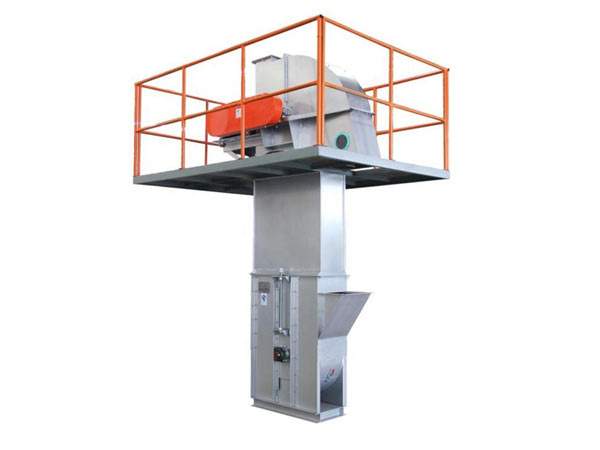
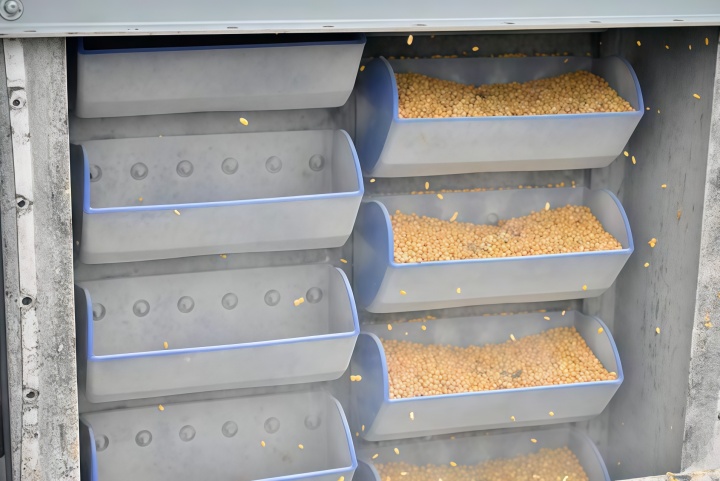
Bucket elevators are core equipment for vertical conveying of bulk materials. Inside an enclosed casing, a belt or chain carries a series of buckets in a continuous loop, loading at the bottom and discharging at the top. Industries such as cement, grain, chemicals and fertiliser all rely on them.
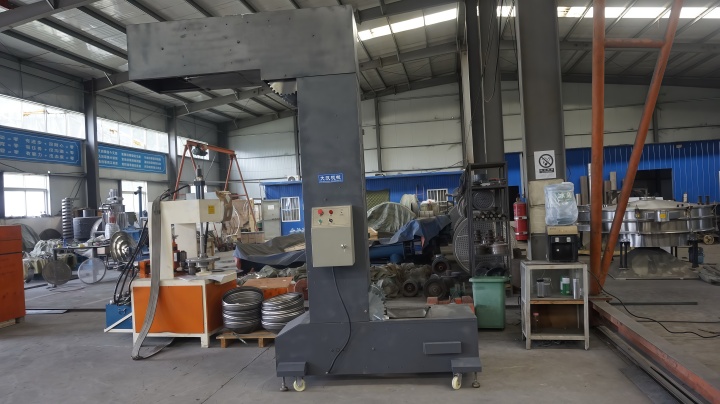
Whether the selection matches the application directly affects production line stability and operating costs. Deviations in bucket elevator selection usually do not lie in the choice of size, but in the match between material properties and discharge method. This article covers practical points from three dimensions: capacity, height and material properties. All parameters cited come from verifiable sources such as the CEMA design manual and BEUMER public technical information.
Quick Overview and Selection Reference Table
Start with a quick judgement framework. Suitable applications involve vertical lifting of bulk materials in compact spaces. Not suitable for sticky, wet or ultrafine powders. Belt type centre distance can reach 250 m, chain type typically over 70 m. Belt type is suitable for temperatures below 130 °C, chain type can operate at 250 °C, with short-term peaks of 350 °C.
| Material temperature | Bulk density | Abrasiveness | Recommended discharge method | Recommended traction element | Recommended bucket material |
| Below 130 °C | Below 0.5 t/m³ | Low | Continuous | Belt | Polyethylene |
| Below 130 °C | 0.5 to 1.2 t/m³ | Medium | Centrifugal | Belt | Carbon steel |
| Below 130 °C | Above 1.2 t/m³ | High | Centrifugal | Chain | Wear-resistant steel |
| Above 130 °C | Any | Any | Centrifugal or positive discharge | Chain | Wear-resistant steel |
Bucket Elevator Selection for Capacity Matching
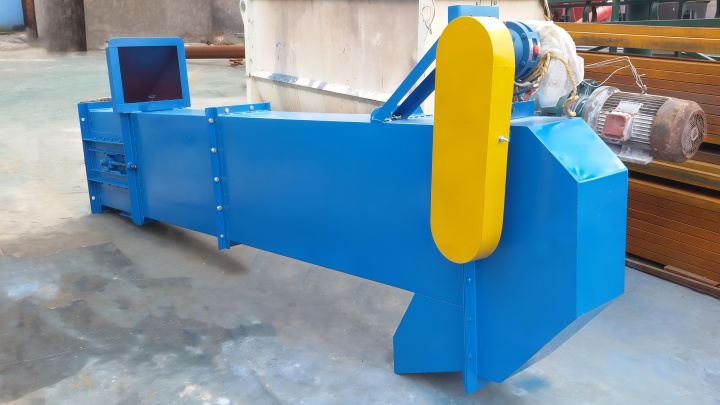
Capacity matching requires attention to both filling factor values and operating speed settings. The following two points are the core judgements.
Calculate capacity using actual filling factors rather than the nominal bucket volume. For free-flowing materials use 0.8 to 1.0, for medium flowability use 0.6 to 0.8, and for sticky materials use 0.4 to 0.6.
Do not try to make up for a capacity shortfall by increasing speed. Centrifugal belt speed is 1.5 to 3.5 m/s, continuous type 0.4 to 1.5 m/s. CEMA manual Chapter 3 notes that centrifugal type runs at high speed and should not handle fragile materials. A 10 percent increase in moisture content reduces effective capacity by about 15 percent.
Bucket Elevator Selection for Lift Height Considerations
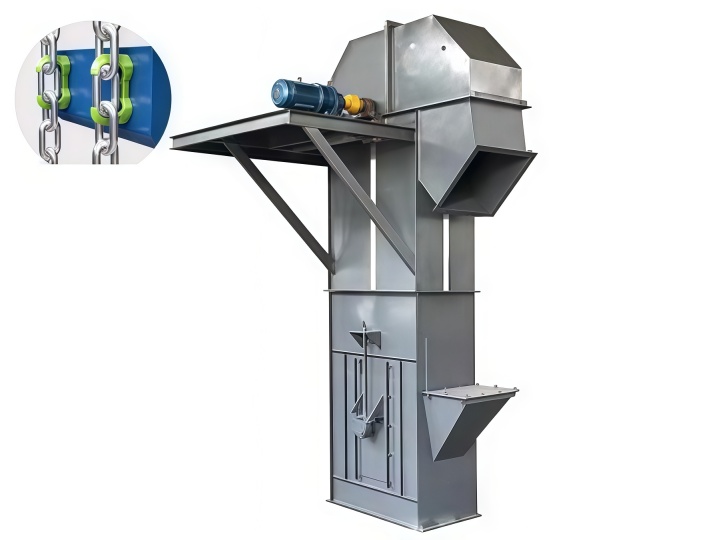
Lift height relates to structural form and traction elements. Attention should be paid to structural load-bearing capacity and the selection differences between belt and chain.
BEUMER public information shows its chain-type elevator centre distance can reach over 70 m, with a conveying capacity of 1900 m³/h. Belt type centre distance can reach 250 m, conveying capacity over 3000 m³/h, and lift height up to 200 m. Over 50 m, consult the manufacturer on chain link material and lubrication. Belt type initial purchase cost is lower than chain type, but under high temperature and high abrasiveness, chain type total maintenance cost should be assessed over a three-year cycle.
Bucket Elevator Selection for Material Property Analysis
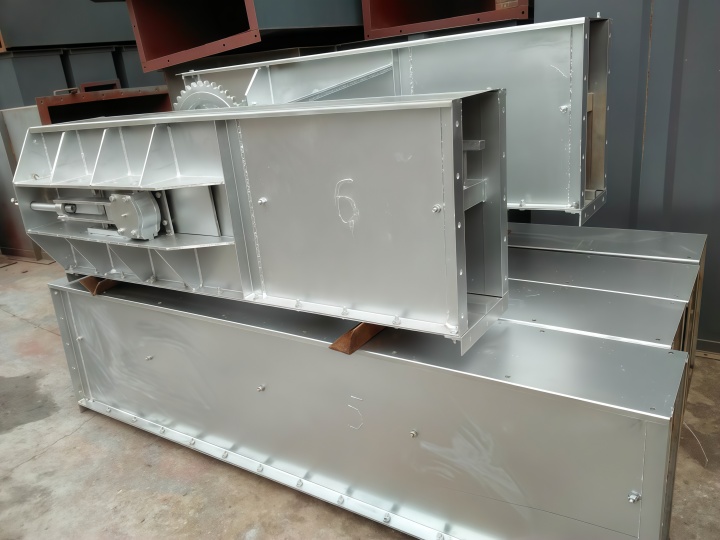
Material properties relate to discharge method, bucket material and traction elements. Among these, bulk density and particle size, temperature and abrasiveness, and moisture content and stickiness are key dimensions. CEMA manual Chapter 2 classifies abrasiveness, temperature, moisture content and degradability as core variables.
Light powders suit continuous discharge, while heavy lumps require centrifugal discharge with thicker buckets. When containing lumps over 50 mm, bucket projection size should be at least 25 percent larger than lump size, and head pulley diameter at least four to six times bucket projection.
Above 130 °C, chain type is preferred. Ordinary rubber belts age and crack at high temperatures. For highly abrasive materials, use wear-resistant steel or add liners.
Sticky materials tend to adhere to bucket walls in centrifugal discharge. Switch to continuous or positive discharge, and optionally use polyethylene or polyurethane for the inner walls.
Three Common Mistakes and Industry Data in Bucket Elevator Selection
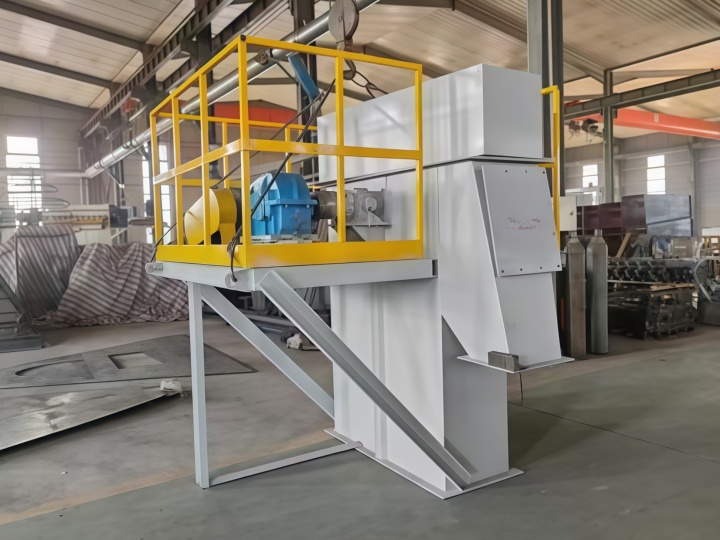
Selection mistakes often only become apparent after commissioning, and correction costs far exceed getting it right upfront. Common ones are missing material parameters, incorrect head pulley diameter matching, and inlet position deviation.
Reporting only tonnage without material parameters leads to a mismatch between discharge method and bucket material. Ignoring the relationship between head pulley diameter and bucket projection: for centrifugal type, head pulley diameter should be at least four to six times bucket projection. Ignoring inlet and bucket matching: a low inlet or uneven feed prevents buckets from filling properly.
BEUMER's 2024 published study on back-legging notes that in most applications the average back-legging rate is 8 to 10 percent, while in roller press or vertical mill circuits it often exceeds 20 percent, meaning actual efficiency is only 70 to 90 percent. The team reduced back-legging from 15 percent to 3 percent by redesigning the bucket body, fixing method and tipping point.
Troubleshooting and Information Preparation for Bucket Elevator Selection
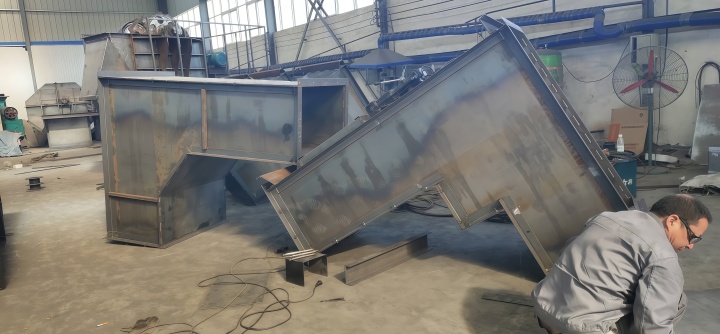
High-frequency problems after commissioning centre on back-legging, chain elongation, vibration and misalignment, and failure to start. Before selection, three groups of information need to be prepared: material parameters, operating parameters and site parameters.
For severe back-legging, first check speed, discharge opening size and filling factor. A missing or poorly adjusted throat plate is a main cause; the throat plate is usually made of rubber belt about 10 mm thick. Replace the chain when elongation exceeds 2 percent. Vibration and misalignment are mostly related to non-parallel head and boot pulleys, loose anchor bolts or bucket installation deviation. Over-tight tension accelerates bearing wear, while too loose causes slipping and misalignment. If the elevator fails to start, check electrical issues, motor or circuit breaker rating, bottom blockage and backstop installation.
Material parameters include bulk density, maximum particle size, temperature, moisture content and abrasiveness. Operating parameters include capacity, lift height, daily operating hours and whether operation is continuous. Site parameters include available space, inlet and outlet direction, and explosion-proof or food-grade requirements. For combustible dusts, confirm compliance with NFPA 61 or an equivalent standard.
FAQ
After Bucket Elevator Selection, what should be done if abnormal noise occurs at the bottom of the elevator?
First check whether there is material accumulation or foreign objects jamming the buckets. If the noise continues after cleaning, check the boot pulley bearings and chain tension.
In Bucket Elevator Selection, how do you determine when the bucket belt needs replacement?
Look for surface cracks, frayed edges and whether tension can be maintained. If it still slips frequently after tensioning, replacement is usually needed.
During Bucket Elevator Selection, what should be noted when material moisture content rises in the rainy season?
Prefer continuous discharge and smooth bucket walls. If necessary, add a drying or dehumidifying device at the inlet.
After Bucket Elevator Selection, is large current fluctuation during operation normal?
Small fluctuations are common. Continuous large fluctuations are mostly related to uneven feed or local blockage. Check feed stability and bottom material level.
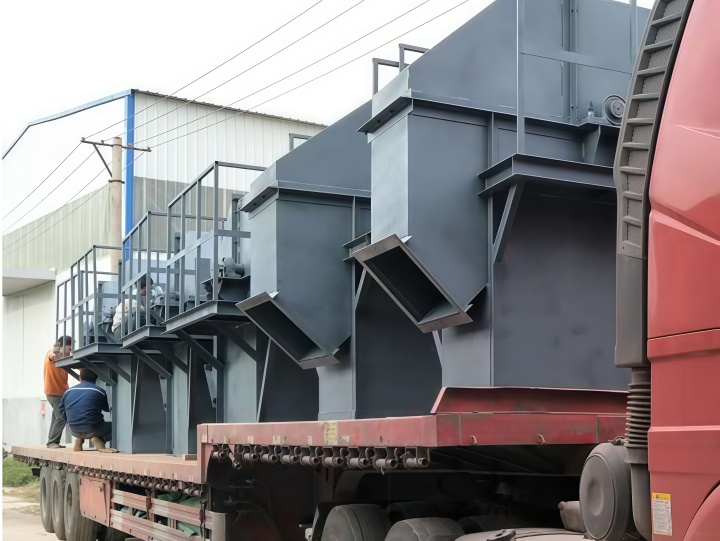
There is no uniform solution for bucket elevator selection. Capacity, height and material properties constrain each other. Once material parameters and operating conditions are clearly organised, matching discharge method, traction element and bucket material will make equipment operation more stable. If you are comparing selection options, listing the specific material and site conditions will help identify a suitable configuration more quickly.