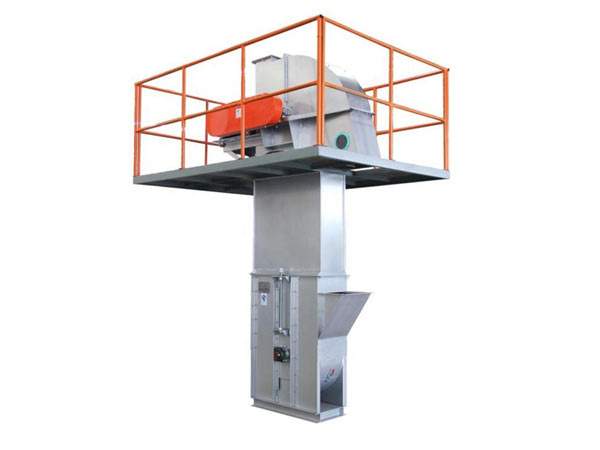
bucket elevator
Bucket elevators are vertical conveying equipment for continuous lifting of bulk granular, powdery and block materials, widely used in mining, cement, chemical, grain and building materials industries to achieve stable and high-efficiency material transportation. Prices typically range from $2,800 to $85,000.
Feed particle size: ≤80mm
Production capacity: 3-800 tons/hour
Lifting height: 3-40m
Running speed: 1.0-2.8 m/s
Motor power: 4-160kW
Product introduction of bucket elevator
Our Bucket elevator are manufactured with TD-series standard parameters, covering model ranges from TD160 to TD600. Belt-type units use rubber belts with plastic or nylon buckets for light materials like grain and feed, operating at speeds of 1.4-2.0 m/s. Chain-type units use plate chains with carbon steel or alloy steel buckets for heavy, abrasive, or high-temperature materials such as cement clinker, coal, and limestone. Bucket filling efficiency is rated at 0.75-0.85 depending on material flowability.
Types of bucket elevator
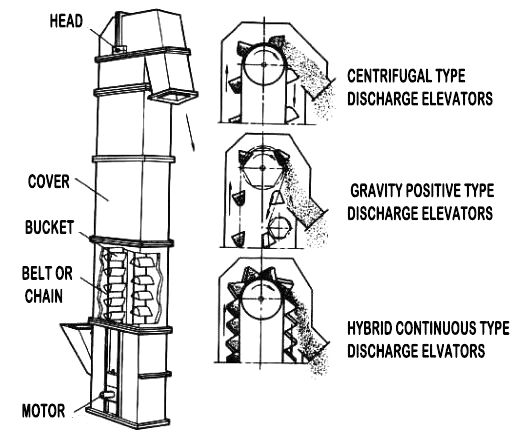
Centrifugal bucket elevator: This is the most common type and is ideal for handling heavy, abrasive materials. Centrifugal force is used to discharge the material from the bucket, making it suitable for smooth and fast processing.Suitable for cement clinker at capacities up to 500 T/H. Discharge is achieved by centrifugal force at belt speeds of 1.4-2.0 m/s.
Continuous bucket elevator: This type of elevator is designed for gentle handling of fragile materials. They operate at lower speeds and are often used in the food processing industry where material degradation is a concern.Ideal for fragile materials like grain and feed pellets. Operates at lower speeds (0.5-1.2 m/s) to minimize material breakage.
Positive discharge bucket elevator: Used for materials that tend to stick or are difficult to discharge. They are designed with features to prevent material buildup and ensure smooth discharge.Used for sticky materials such as wet fertilizer and clay. Buckets are designed with a scoop profile to prevent material buildup.
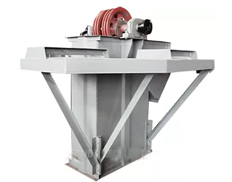
It uses belt as the transmission device, which is suitable for conveying light materials and granular materials, such as grain, feed, etc. It runs smoothly, has low noise and is relatively easy to maintain.
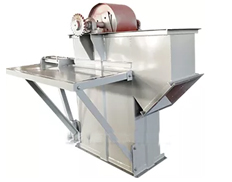
It uses plate chain or chain as the transmission device, which is suitable for conveying heavy materials, high-temperature materials or easily abrasive materials, such as cement, coal, limestone, etc. It has a strong and durable structure and is suitable for harsh environments.
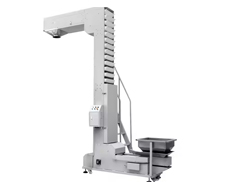
Arranged in a "Z" shape, it can realize horizontal and vertical transportation, with a low product damage rate. It can unload at a single point or multiple points, and is suitable for material supply for weighing/packaging lines/batch/color sorting.
How does the bucket elevator work?
A bucket elevator works on a simple principle of vertical transportation of bulk materials using buckets attached to a rotating chain or belt. Here is how it typically operates:
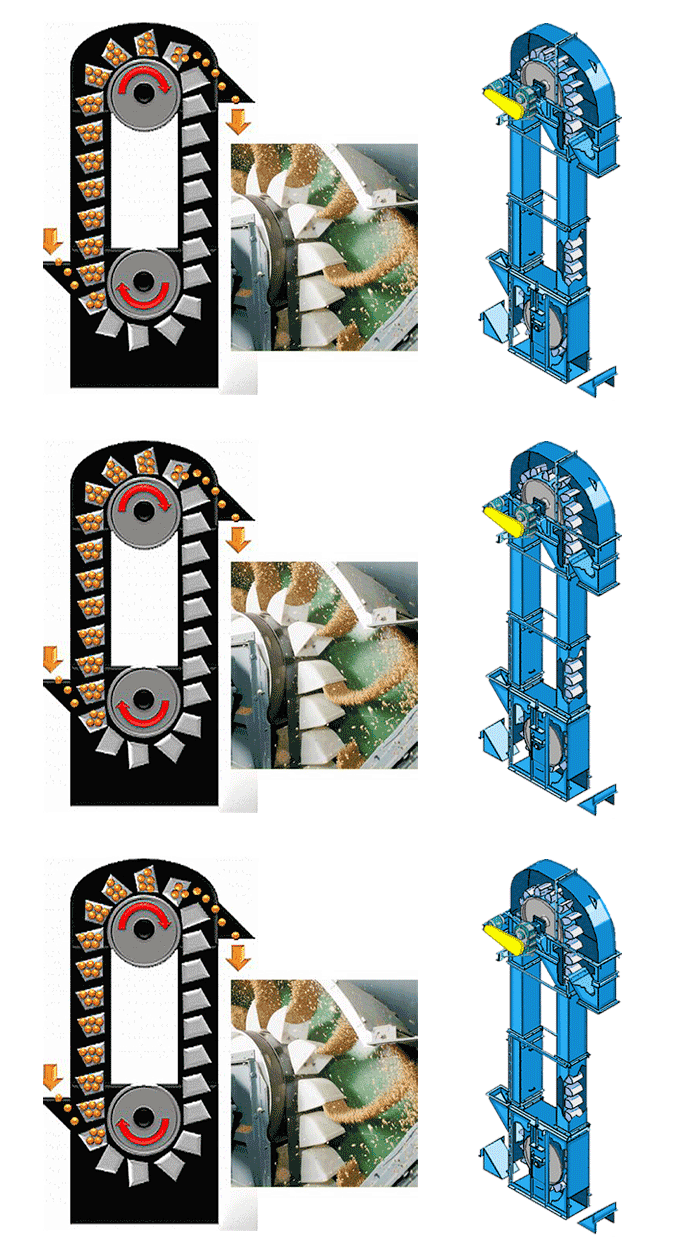
1.Material is fed into the loading shoe at the base. Maximum feed size: 25-70mm depending on model.
2.Buckets attached to the belt or chain are filled with material at the base. Filling efficiency: 75-85%.
3.The belt or chain moves vertically at speeds of 1.4-2.0 m/s (belt type) or 0.5-1.2 m/s (chain type for fragile materials).
4.At the head pulley, material is discharged by centrifugal force or positive discharge, depending on the bucket type.
5.Empty buckets return to the base to repeat the cycle.
Video
Advantage
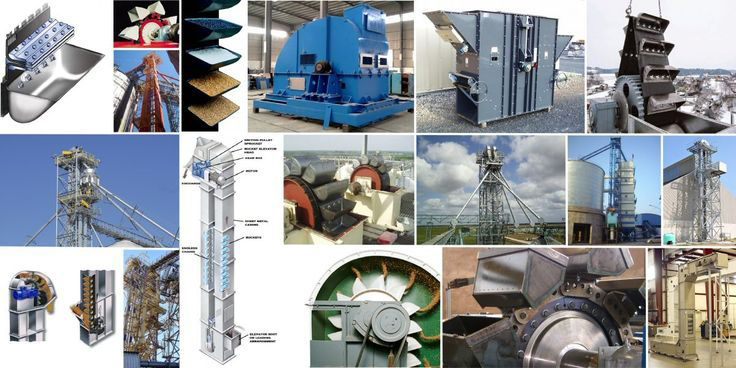
Bucket elevators are the preferred solution for vertical material transport when lift height exceeds 15 meters and capacity requirements are above 10 T/H. Compared to vertical screw feeders, these equipment handle higher capacities with less material degradation. Compared to inclined belt conveyors, they require approximately 60-70% less floor space for the same lift height.
| project | Vertical Screw Feeder | Vertical Bucket Elevator | Climbing Belt Conveyor |
|---|---|---|---|
| Floor area | the smallest | smaller | maximum |
| Delivery angle | 90° | 90° | Generally used for inclined conveying below 70° |
| Delivery capacity | good | excellent | good |
| Suitable material | granular or powdery material | Dry bulk material, no special requirements | Parcels and other large-volume products or fruit and vegetable foods, etc. |
| Advantage | Small footprint, no dust flying | Capable of substantial vertical lift of 40m | Simple structure, the least cost among similar lifting and conveying products |
| shortcoming | Stricter requirements on the materials to be transported | The price is higher, and high-value or large-volume production can achieve the best cost performance | Not suitable for conveying powder or fine particles, not recommended for vertical conveying |
| Installation cost | Low | Medium-High | Low |
| Energy consumption | Low | Medium | Medium |
Technical Parameters
| Model | Max feed size(mm) | Capacity(T/H) | Lifting speed(m/s) | Belt width(mm) | Lifting height(m) | Bucket material | Typical material |
|---|---|---|---|---|---|---|---|
| TD160 | 25 | 5.4-16 | 1.4 | 200 | <40 | Plastic / Nylon | Grain, feed |
| TD250 | 35 | 12-35 | 1.6 | 300 | <40 | Nylon / Carbon steel | Fertilizer, sand |
| TD315 | 45 | 17-40 | 1.6 | 400 | <40 | Carbon steel | Cement, limestone |
| TD400 | 55 | 24-66 | 1.8 | 500 | <40 | Alloy steel | Clinker, coal |
| TD500 | 60 | 38-92 | 1.8 | 600 | <40 | Alloy steel | Ore, slag |
| TD600 | 70 | 85-142 | 2 | 700 | <40 | Alloy steel | Heavy abrasive |
Bucket elevator structure
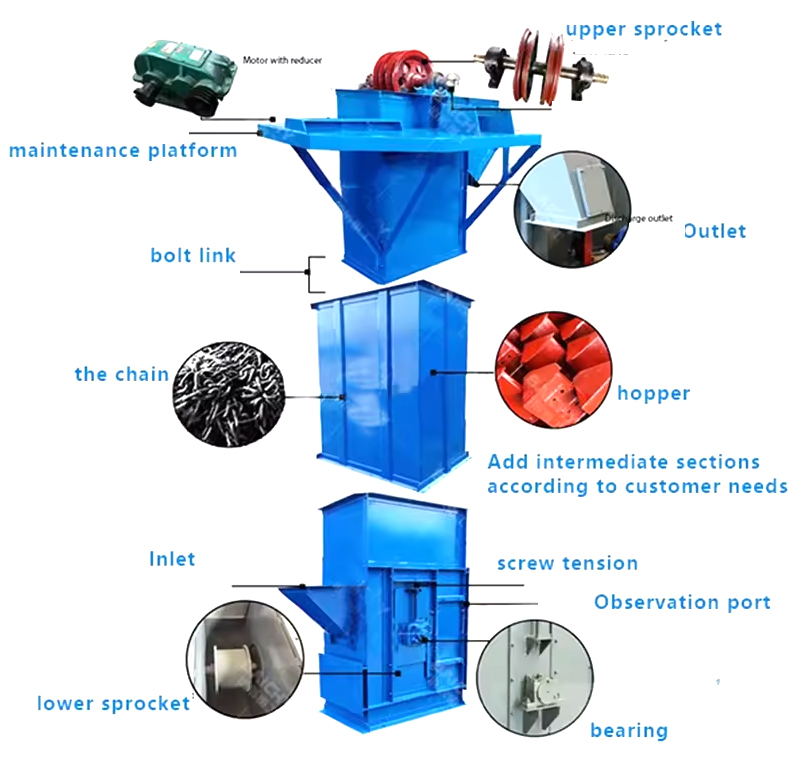
The structure of a bucket elevator includes a chain or belt, a head pulley or sprocket, a bottom pulley or sprocket, a drive motor, a loading shoe, and a discharge port. The chain or belt acts as the drive mechanism, moving the buckets up and down. Chains are typically used for heavy-duty applications (TD400–TD600), while belts are suitable for light-duty applications (TD160–TD250). The head pulley or sprocket guides the chain or belt to turn at the top of the elevator, while the bottom pulley or sprocket guides it to turn at the bottom. The drive assembly uses a Y-series motor paired with a gear reducer containing a mechanical backstop device. A hydraulic coupling is installed when motor power exceeds 18.5KW. The loading shoe is where material enters the bottom bucket of the elevator, and the discharge port is for material to exit from the top bucket.
How to Choose a Bucket Elevator
Selecting a bucket elevator requires configuring specific mechanical components based on material properties and site measurements.
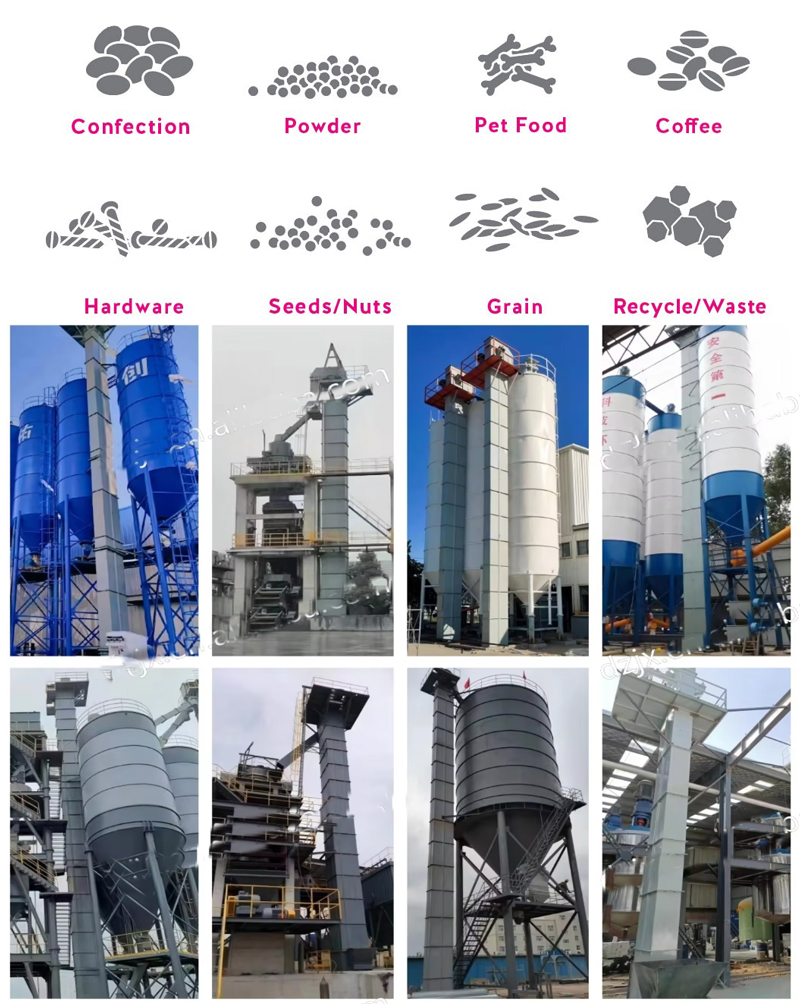
Traction Components: Select plate chains, ring chains, or rubber belts depending on material temperature, humidity, viscosity, particle size, bulk density, and abrasiveness.
Height Calculations: Determine the lifting height based on factory foundation conditions. Total equipment height equals the net lifting height plus the structural dimensions of the head section and base section.
Drive Assembly: Use a Y-series motor paired with a gear reducer containing a mechanical backstop device. Install a hydraulic coupling when the motor power exceeds 18.5KW.
Operating Speed: Set the bucket running speed below 0.3 m/s for high-temperature and abrasive materials. Maintain the speed between 0.5 m/s and 1.2 m/s for viscous materials.
Capacity Calculations: Calculate the actual lifting capacity by multiplying the horizontal bucket capacity by a filling efficiency factor of 0.75 to 0.85.
Application
Bucket elevators are used across a wide range of industries to handle granular, powdery, and abrasive bulk materials. Typical capacities range from 15 to 800 m³/h, with lift heights up to 40 m. The three most common applications—cement, grain, and chemical processing—are described below, followed by a brief list of other industries.
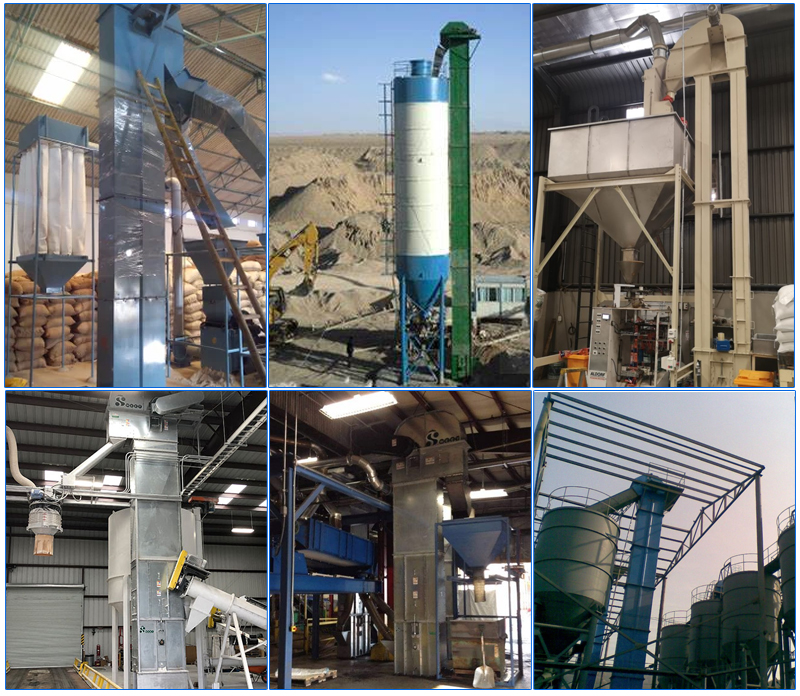
Cement: Chain-type euipment transports clinker, limestone, and gypsum at capacities up to 500 T/H. Alloy steel buckets with wear-resistant liners handle abrasive materials at temperatures up to 250°C.
Grain: Belt-type centrifugal discharge elevators handle wheat, corn, and soybean at speeds of 1.4–1.6 m/s. Plastic or nylon buckets minimize material breakage during discharge.
Chemical: For fertilizer, urea, and plastic granules, both belt and chain configurations are available depending on material temperature and abrasiveness. Stainless steel buckets are available for corrosive materials.
Other industries: mining, food processing, packaging, warehousing and logistics.
Solutions by Industry
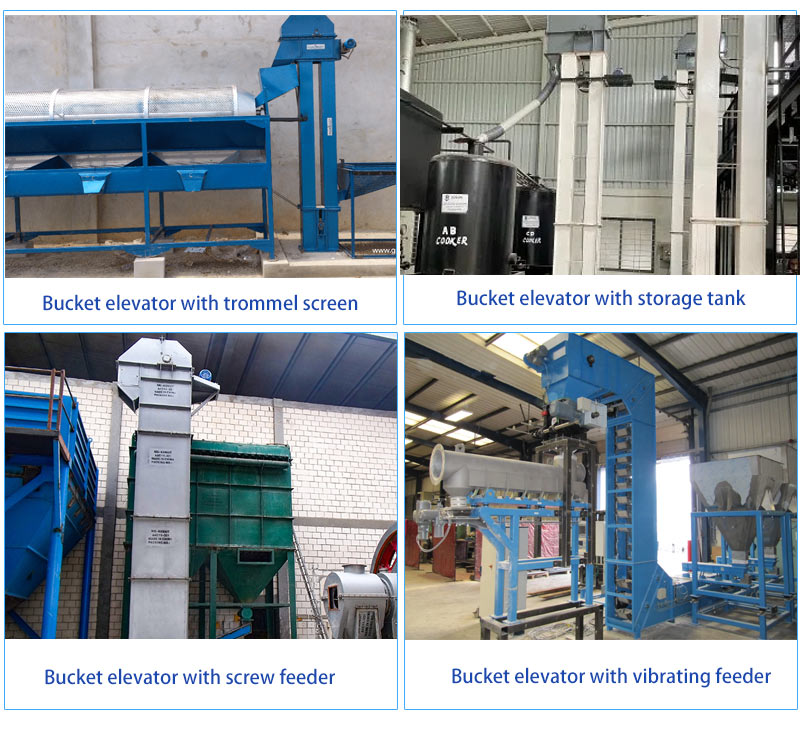
FAQ About Bucket Elevators
1. How do you calculate bucket elevator capacity?
Capacity is calculated using the formula: Capacity = (Bucket Volume × Buckets per Meter × Belt/Chain Speed × Material Density) × Efficiency (75%-85%). This calculation changes based on whether you transport 0.5 t/m³ grain or 1.5 t/m³ cement using TD series standard parameters.
2. What is the difference between belt and chain bucket elevators?
Belt bucket elevators use rubber belts to lift light, non-abrasive materials like corn and wheat up to 40 meters at high speeds. Chain type utilizes steel plate chains to lift high-temperature, heavy solids like cement clinker and coal in mine sites.
3. What are the common maintenance issues?
Operational issues include belt mistracking, chain elongation, bucket edge wear, and material back-feeding. Regular tension adjustments, choosing carbon steel or nylon buckets, and installing mechanical backstops prevent these specific mechanical faults.
4.What is the maximum lift height for a bucket elevator?
Standard centrifugal discharge elevators are recommended for lift heights up to 40 meters. For heights beyond 60 meters, a continuous discharge configuration is more suitable.
5.Can bucket elevators handle high-temperature materials?
Chain-type bucket elevators handle materials up to 250°C using carbon steel or alloy steel buckets. Belt-type elevators are limited to materials below 80°C.
Sugested Products
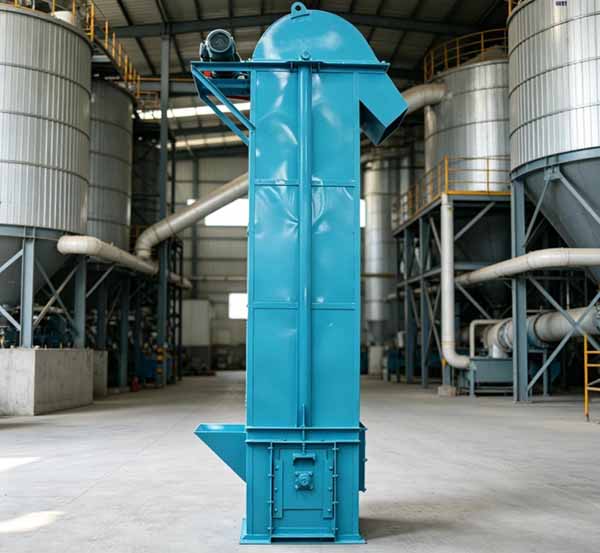
Industrial Vertical Bucket Elevator System Manufacturer & Supplier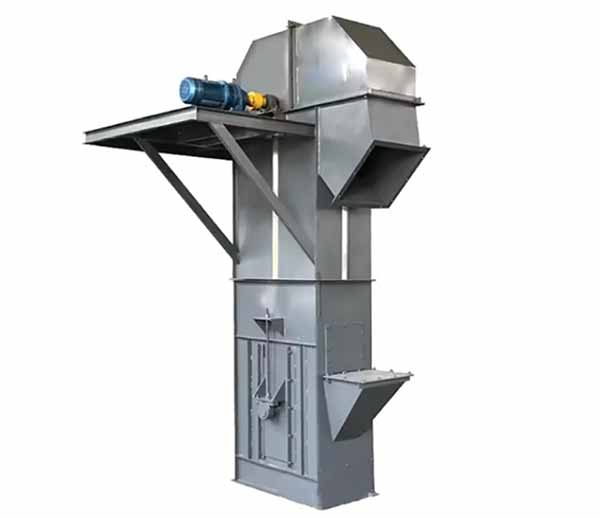
Grain Silo Bucket Elevator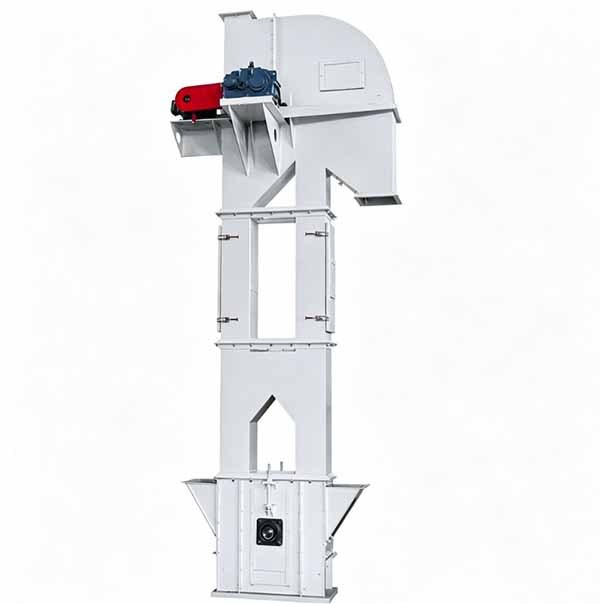
Industrial bucket elevator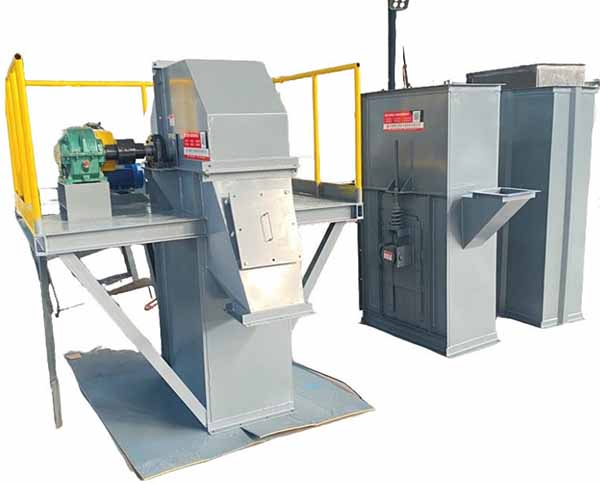
Soda ash bucket elevator