Industrial Vibrating Feeder Selection Guide
Saturday October-10 2026 10:12:39
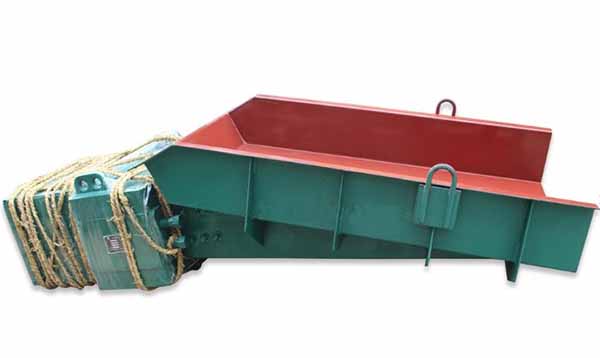
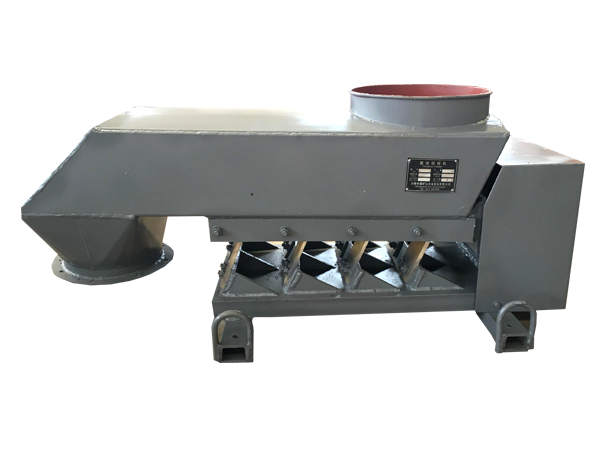
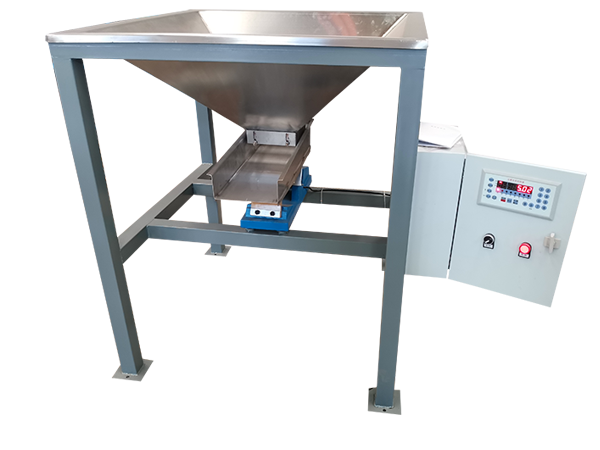
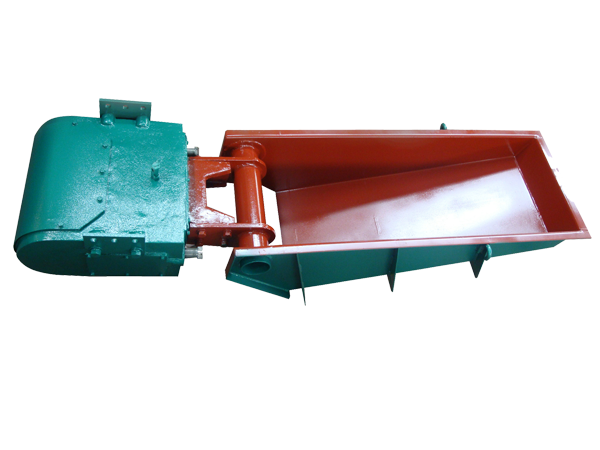
Industrial vibrating feeder Industrial vibrating feeders rely on excitation vibration to deliver material steadily to subsequent processes, widely adopted in overseas production lines for aggregate processing, building material manufacturing and solid waste treatment. Many overseas sites encounter inconsistent feeding, blockages and component wear, mostly stemming from mismatched equipment selection at early project stages. Industrial Vibrating Feeder Selection rejects simple comparison of single parameters. It integrates global field experience, material characteristics and site conditions for comprehensive evaluation. This article sorts out practical selection logic and breaks down judgment points from overseas project cases.
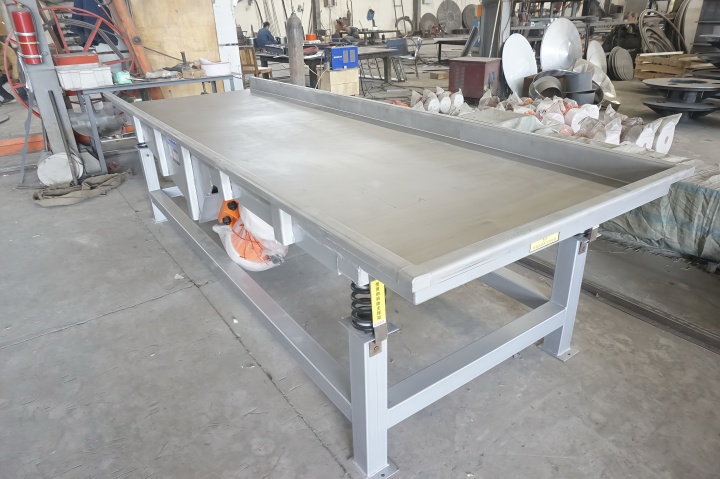
Influence of Material Properties on Industrial Vibrating Feeder Selection
Material parameters form the foundation of equipment selection and directly define trough structure, liner configuration and operational adaptability. Industrial Vibrating Feeder Selection requires checks on material particle size, bulk density, moisture content and abrasiveness. Field data from global mines shows limestone bulk density ranges from 1.4~1.6 t/m³, with lump sizes up to 300 mm. Clay materials tend to stick to trough walls once moisture content exceeds 12%.
Heavy ore can use bar structures to separate fine impurities. Large-angle troughs suit moist sticky materials, while thickened wear plates apply to highly abrasive feedstock. Neglecting measured material parameters may lead to material jams and disrupt normal equipment operation.
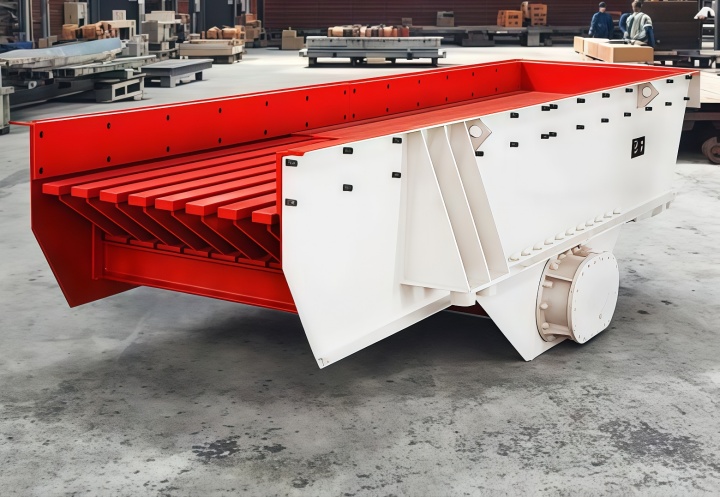
Matching Throughput with Production Lines, Core Criteria for Industrial Vibrating Feeder Selection
After gathering material data, feeder capacity should align with the whole production line’s material flow to avoid bottlenecks. Industrial Vibrating Feeder Selection should not rely solely on nameplate throughput. Instant material discharge from silos brings variable load conditions. The Stilfontein aggregate project in South Africa handled roughly 1000 tons daily before renovation. Sudden material impact caused unstable feeding, and reserved load margins ease such issues.
Feeding speed must match inlet load of crushers and screens. Excess feeding triggers downstream blockages, while insufficient supply slows overall material flow. For continuous operation, excitation components’ load capacity needs verification against daily running duration.
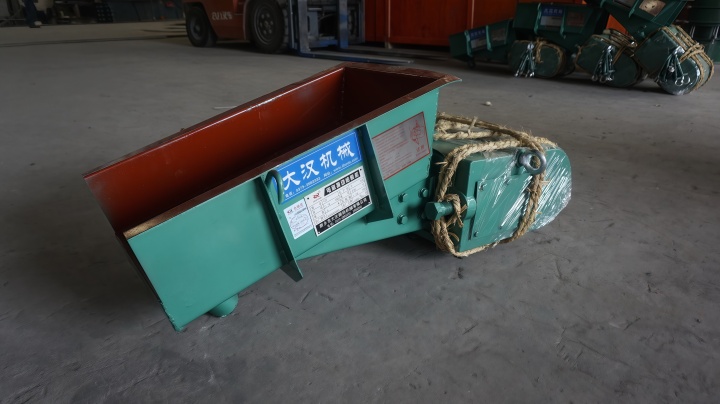
Installation Conditions and Structural Options, Refining the Workflow of Industrial Vibrating Feeder Selection
Available site space and mounting methods set hard constraints for equipment selection. Industrial Vibrating Feeder Selection picks structure and drive types based on layout. Electromagnetic feeders offer stable control for low-to-medium flow fine powder. Motor-driven vibrating feeders deliver higher load capacity for bulky heavy material. Cemex Dove Holes Cement Plant in the UK adopted electromagnetic feeders for steady powder feeding within compact space.
Floor mounting demands solid foundations, while suspended installation needs calculation for supporting structure load limits. Pre-measuring silo outlet height and available site space reduces on-site fitting failures and cuts rework workload.
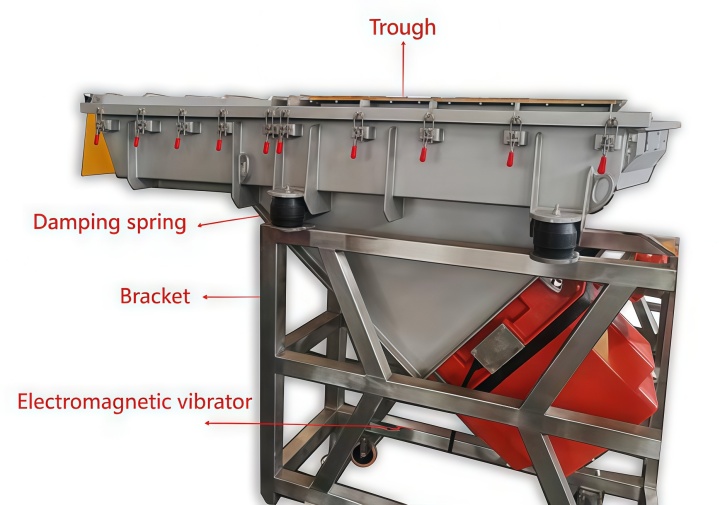
Environmental Protection Setup, Strengthening Adaptability in Industrial Vibrating Feeder Selection
Site conditions affect equipment performance, so protection schemes are defined during selection. Industrial Vibrating Feeder Selection investigates dust levels, temperature and corrosive media. High dust open-air environments prefer high-protection motors. Heat-resistant trough structures can be added for hot material conveying. At the Edw. C. Levy steel mill residue project in the US, stainless steel troughs were deployed to resist mild abrasion from trace metallic debris.
Stainless steel plates also work for mildly corrosive feed. For harsh operating environments, anti-fatigue spring assemblies reduce scheduled downtime and losses caused by unexpected line shutdowns.
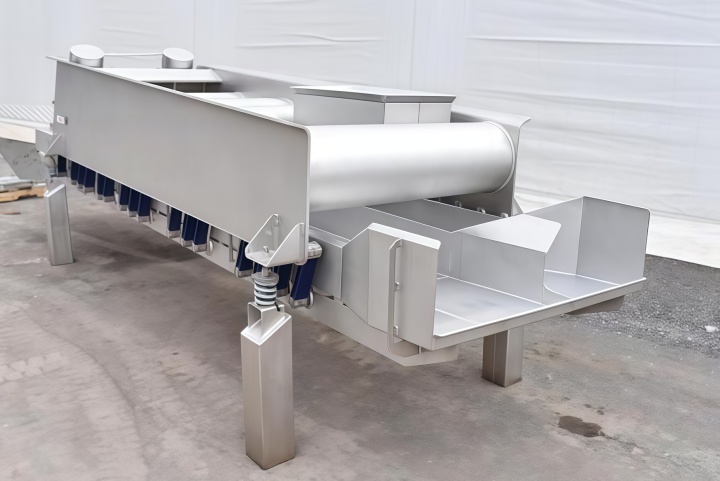
Working Condition Boundaries Across Industries, Supporting Accurate Matching in Industrial Vibrating Feeder Selection
Different sectors impose varied requirements, and each machine type carries application limits. Heavy bar feeders serve quarry sites to withstand large rock impact. Anti-jam structures for solid waste systems handle mixed complex feed, while sealed troughs control dust for building material powder. At a granite quarry in Texas, USA, bar pre-screening was added during selection to remove clay impurities brought by rainy seasons and lower crusher blockage risks.
Recognizing working boundaries reduces mismatched machine choices and later maintenance expenditure.
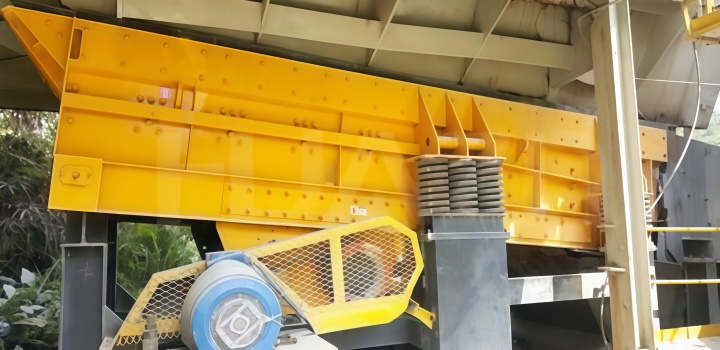
Pre-selection Checklist, Simplifying Practical Steps for Industrial Vibrating Feeder Selection
Complete working condition data collection before inquiry to avoid repeated communication from missing parameters. Incomplete data easily causes wrong selection. Refer to the table below to collect site parameters.
| Collection Item | Details to Confirm |
| Basic Material Parameters | Material type, maximum particle size, bulk density, moisture content, abrasiveness |
| Throughput Requirement | Rated hourly handling capacity, peak incoming material range |
| Site Installation Conditions | Floor or suspended mounting, silo outlet dimension, available site space |
| Ambient Conditions | Ambient temperature, dust level, presence of corrosive media |
| Production Mode | Intermittent or continuous operation |
Full data shortens technical evaluation cycles and lowers risks of improper selection.
Avoiding Common Selection Pitfalls, Optimizing Outcomes of Industrial Vibrating Feeder Selection
Many procurement teams only compare nameplate figures and ignore static pressure from stockpiled material inside silos, a frequent oversight in equipment selection. Material stacked in silos presses down on troughs, weakening vibration transfer and creating fluctuating feed volume. The original issue at South Africa’s Stilfontein project came from unaccounted silo pressure, leading to unstable discharge.
Oversized units are not recommended, as they raise procurement expenditure and no-load energy consumption. Confirm full site data before finalizing models and reduce commissioning difficulties.
Frequently Asked Questions (FAQ)
Below are common inquiries raised by engineers during selection and maintenance.
1. What causes unstable feeding of vibrating feeders?
Fluctuating feed usually arises from material bridging, abnormal silo pressure or shifted vibration parameters. The Stilfontein site in South Africa faced this issue before renovation.
Tuning vibration frequency and amplitude plus modifying silo outlet structure helps mitigate uneven feeding.
2. Will vibrating feeders suffer blockage with moist material?
Standard units tend to accumulate sticky material on trough walls when handling high-moisture feed. Clay mixed in raw material caused trough buildup at the Texas quarry during rainy periods.
Large-angle troughs with anti-stick treatment support smooth conveying for moist feed.
3. How to improve overall operating state of industrial vibrating feeders?
Equipment performance depends on working condition fit and component inspection frequency. The Edw. C. Levy residue project in the US maintained stable operation through regular liner and spring inspections.
Check wearable parts periodically and adjust operating parameters to cut failure chances.
4. How to quickly distinguish electromagnetic and motor-driven vibrating feeders for selection?
The two types differ in feeding controllability and load capacity. Cemex plant in the UK used electromagnetic feeders for micro powder supply. Motor-driven vibrating feeders are widely adopted for bulk rock transport at mines.
Electromagnetic types suit low-flow scenarios requiring precise feeding. Motor-driven units are preferred for high throughput and bulky heavy material.
To sum up, Industrial Vibrating Feeder Selection needs comprehensive assessment of material traits, throughput, site space, environmental protection and working boundaries. Judgement cannot rely on a single parameter alone. Collect full pre-project working data and sort information following the checklist, so you can pick units fitting production lines and running steadily.
You can carry out model evaluation once material parameters and site working data are ready.