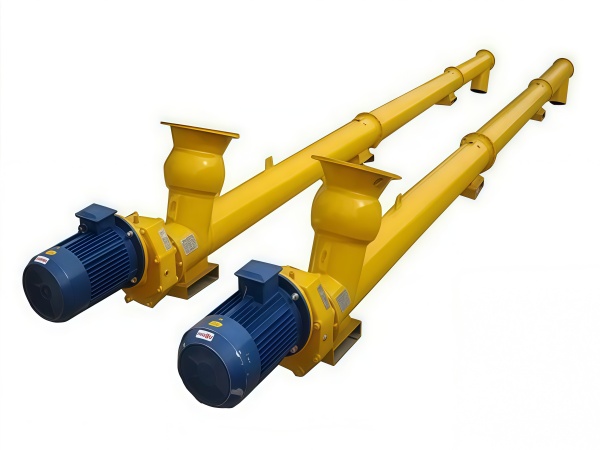
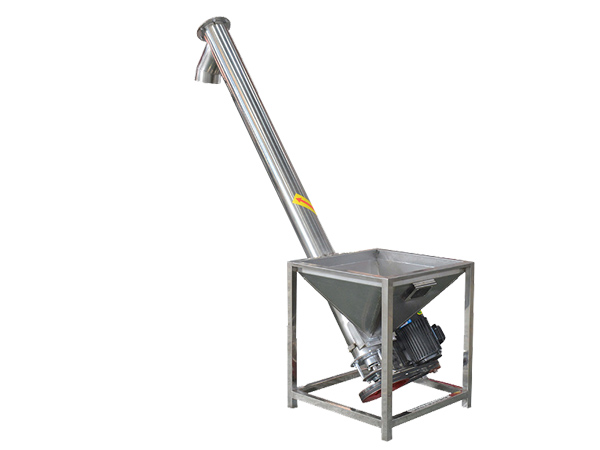
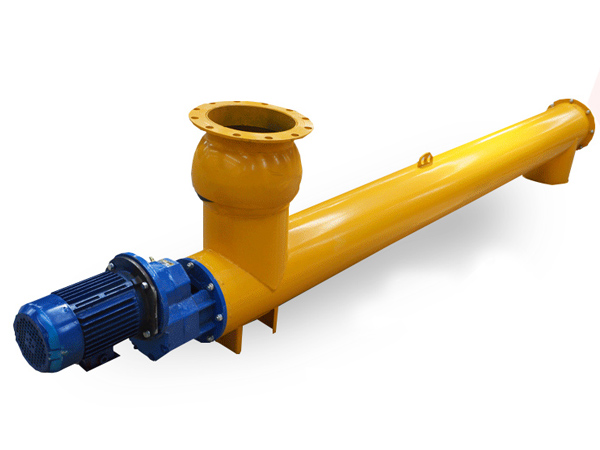
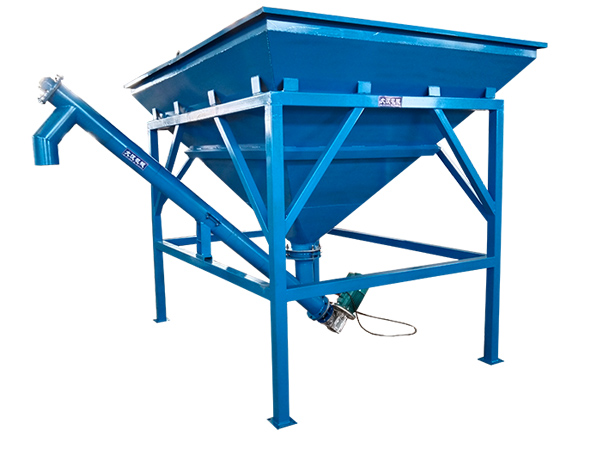
Tubular Screw Conveyor for Fly Ash in Concrete Batching Plant Selection
Tuesday September-29 2026 10:44:40
Tubular Screw Conveyor for Fly Ash in Concrete Batching Plant Selection is a part of the concrete batching plant fly ash handling system where problems are common. Choose a model that is too large and you waste power. Choose one that is too small and you get frequent blockages. Choose the wrong blade and it wears through in a few months.
Fly ash particles are mostly 10 to 50 microns, with a large specific surface area, good flowability but heavy dusting, and contain unburned carbon particles and glass microspheres. Its abrasiveness is higher than that of ordinary cement.
This article draws on measured data from a closed fly ash screw conveyor at the Vinh Tan Power Plant in Vietnam, hangar bearing replacement records from a UK power plant, and hardness comparison data for AR-400 wear-resistant material to break down the dimensions that affect success or failure in selection.
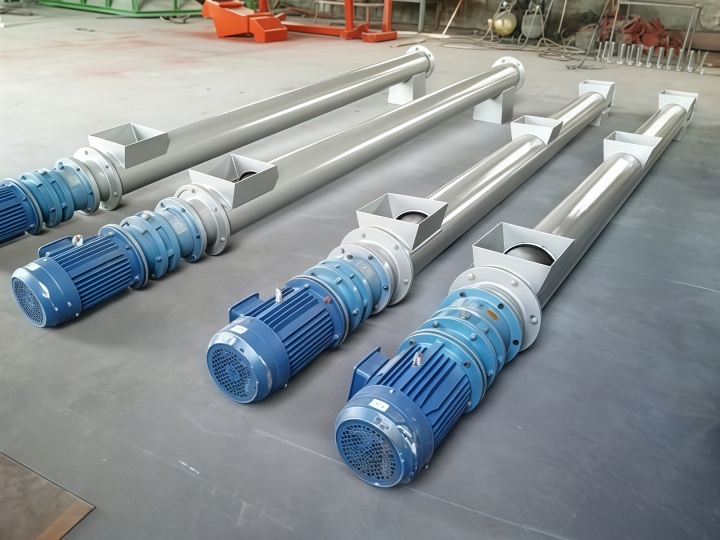
Tubular Screw Conveyor for Fly Ash in Concrete Batching Plant Selection for Model Matching Logic
When carrying out Tubular Screw Conveyor for Fly Ash in Concrete Batching Plant Selection, the basis for model selection is not the main mixer tonnage but the product of fly ash loose bulk density and conveying distance. Fly ash loose bulk density is about 0.9 to 1.0 tons per cubic meter. Over long distances, the return material volume is larger, and power demand may be higher than for cement in the same pipe diameter.
Researchers at the Vinh Tan Power Plant in Vietnam developed a VBA rapid calculation tool based on the Roberts calculation method and used EDEM simulation software to model particle behavior. They built a prototype according to optimized dimensions and tested it on site. The prototype had a pipe diameter of 273 mm, shaft diameter of 141 mm, pitch of 250 mm, and a speed range of 100 to 700 rpm.
The actual output capacity was about 65.7 tons per hour, with a deviation of 7 percentage points from the VBA calculation and 2 percentage points from the EDEM simulation. Discrete element simulation can noticeably reduce prediction error.
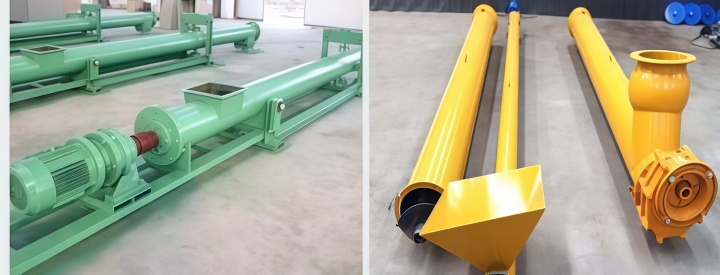
Tubular Screw Conveyor for Fly Ash in Concrete Batching Plant Selection for Shaft End Sealing and Anti-Blocking Design
Sealing failures are concentrated at the shaft ends and hangar bearings. Operating records from a large UK power plant show that standard hangar bearings in abrasive fly ash conditions had a replacement interval of every 3 months. After switching to hangar bearings with heavy-duty labyrinth protection, the replacement interval extended to every 18 months.
Field engineering data shows that about 70 to 80 percent of screw conveyor bearing failures are not due to the bearing itself but to upstream sealing design, lubrication, or operating condition decisions. Sealing failure and contamination was listed as the fourth major root cause.
The solution direction is to compress the lateral dimensions of the hangar bearing and install an adjustable gate valve at the inlet so that fly ash is fed in a thin, uniform layer.
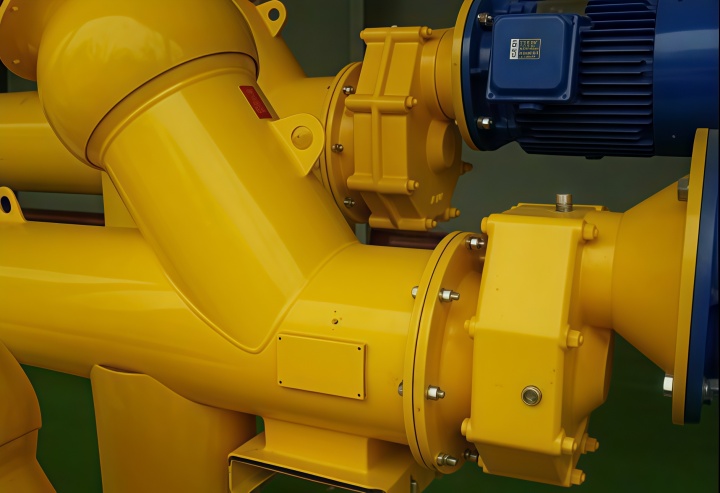
Tubular Screw Conveyor for Fly Ash in Concrete Batching Plant Selection for Wear Life and Blade Clearance Control
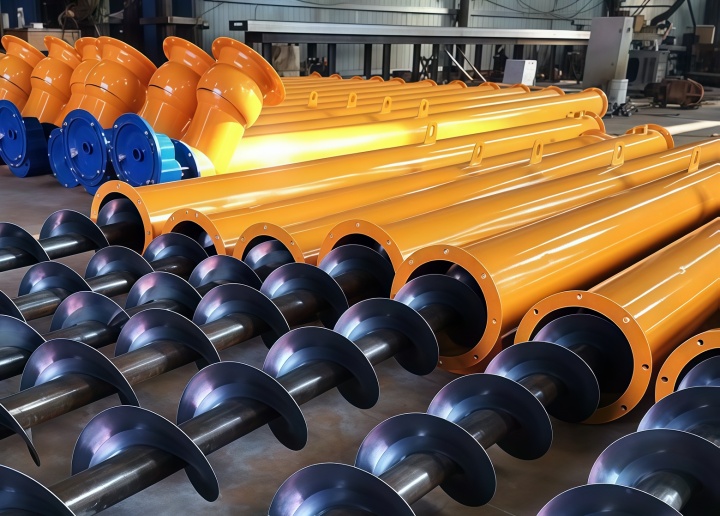
The abrasiveness of fly ash has engineering records in the power industry. A case from the US manufacturer KWS shows that a bottom ash screw conveyor using standard low-carbon steel blades wore out every 9 to 12 months. After switching to AR-400 wear-resistant steel blades, the service time extended to more than 5 years.
AR-400 has a Brinell hardness of 360 to 440, while A36 carbon steel is about 120. The former is 240 to 320 Brinell units higher.
During selection, radial clearance should be controlled within 1.5 to 2 mm. Blade material should preferably be AR-400 or 16Mn low-alloy steel.
Tubular Screw Conveyor for Fly Ash in Concrete Batching Plant Selection for Drive Speed Control and Cold Start Configuration
Motors selected for steady-state power are prone to tripping on cold start. It is advisable to increase power by one frame size. The reducer should be a hard-tooth-surface gear reducer rather than a cycloidal pinwheel reducer. Fly ash flow characteristics change with moisture content and temperature. Bottom-of-silo aged ash has noticeably higher startup resistance after absorbing moisture.
The value of variable frequency speed control is that during the initial feeding stage, low-frequency slow speed prevents fly ash from piling up and arching above the weighing hopper. Near the target weight, speed is reduced for fine adjustment. The weighing error can be controlled within plus or minus 0.5 percent.
Tubular Screw Conveyor for Fly Ash in Concrete Batching Plant Selection Quick Reference Table
The following data is based on fly ash loose bulk density of 0.95 tons per cubic meter and horizontal conveying conditions. For inclined installation, reduce conveying capacity by 15 percent for every 10 degrees of inclination.
| Pipe Diameter | Recommended Capacity | Suitable Batching Plant | Motor Power Reference | Maximum Horizontal Length |
| Φ165 | 20 to 35 t/h | HZS50 / HZS60 | 5.5 to 7.5 kW | 8 m |
| Φ219 | 35 to 60 t/h | HZS90 / HZS120 | 11 to 15 kW | 12 m |
| Φ273 | 60 to 90 t/h | HZS120 / HZS180 | 18.5 to 22 kW | 15 m |
| Φ323 | 90 to 120 t/h | HZS180 and above | 30 to 37 kW | 18 m |
Quick conclusion: If the horizontal distance from the fly ash silo to the weighing hopper is within 8 meters, Φ219 with an 11 kW motor can cover the normal requirements of HZS90 and HZS120 batching plants. If the distance is greater than 12 meters or there is an inclination above 15 degrees, consider Φ273 and increase motor power by one frame size.
Tubular Screw Conveyor for Fly Ash in Concrete Batching Plant Selection Frequently Asked Questions
The following frequently asked questions relate to Tubular Screw Conveyor for Fly Ash in Concrete Batching Plant Selection and cover several directions where user feedback is concentrated.
Fly ash silo discharge port arches frequently, the screw conveyor runs empty without discharging. How to handle it?
Arching is mostly caused by damp silo walls or fly ash being under pressure for too long. First check for condensation water and shorten the storage cycle. During selection, a silo bottom arch-breaking device can be required, but high-frequency vibration should not be used, otherwise the fly ash becomes more compacted.
The connection between the screw conveyor outlet and the weighing hopper has severe dust leakage. Is it a sealing failure?
Not necessarily a sealing failure. More often it is high positive pressure at the outlet causing dust-laden gas to squeeze out through gaps. During selection, keep the outlet at slight negative pressure or add a breathable filter bag. Dust leakage will be noticeably reduced.
The same equipment works well at another batching plant but blocks at my site. Why?
Fly ash from different sources has different particle size distribution and carbon content, which changes flowability. Dry-discharged ash from a power plant and aged ash at the bottom of a silo can behave completely opposite.Take a sample of the actual fly ash used and do a small-scale flow test. This is more reliable than looking only at equipment parameters.
Operating noise is getting louder. The blades have been checked and are not deformed. What is the problem?
Increasing noise usually comes from wear of the intermediate hangar bearing or deviation in pipe straightness. No problem with the blades does not mean no problem with the shaft system.Write the concentricity of pipe section flanges into the acceptance requirements and correct them section by section on site.
The core of selection is not finding a model that can be used, but substituting the physical properties of fly ash into the selection calculation. Pipe diameter and length affect conveying capacity. Sealing and hangar bearings affect stable operation. Blade material and clearance affect service time. Drive configuration affects cold start and weighing error.
The EDEM verification deviation at the Vinh Tan Power Plant in Vietnam was 2 percentage points. The UK power plant extended hangar bearing replacement from 3 months to 18 months. KWS AR-400 blades extended service time to more than 5 years. These three cases point to the same conclusion: the selection fault tolerance margin under fly ash conditions is far smaller than under cement conditions. Every step needs to be calibrated with measured data rather than sample book parameters.