Tubular Screw Conveyor for Fly Ash in Concrete Batching Plant
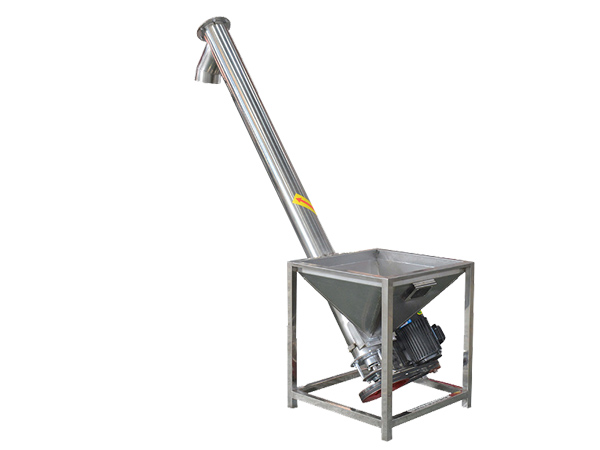
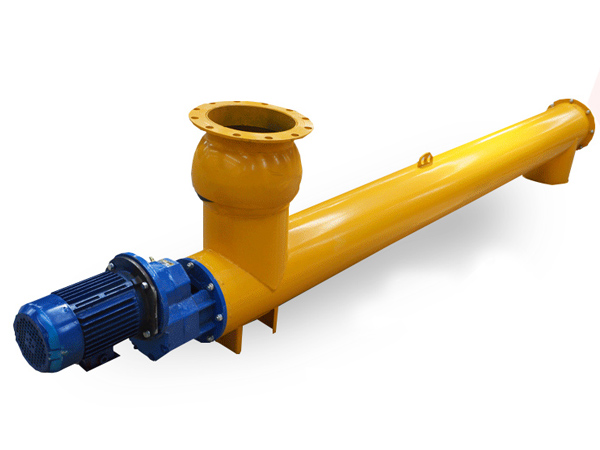
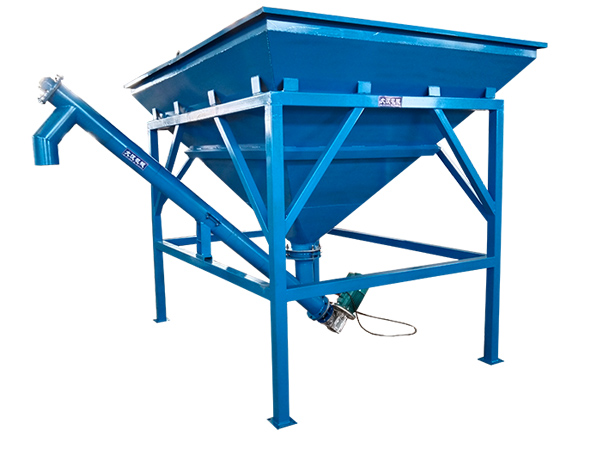
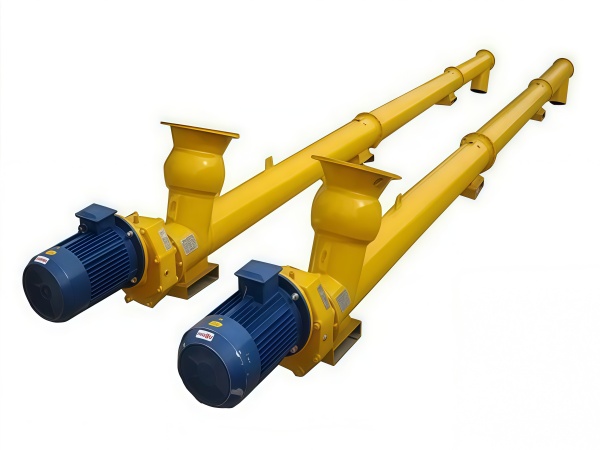
Tubular Screw Conveyor for Fly Ash in Concrete Batching Plant is used for conveying fly ash, cement and other powder materials in concrete batching plant, realizing sealed and stable material transportation, widely applied in mixing station, building materials and chemical industry. Prices typically range from $2,800 to $28,000.
Feed opening size: ≤300mm
Production capacity: 5-120 tons/hour
Discharge opening size: 150-300mm
Rotating speed: ≤90 rpm
Motor power: 3-55kW
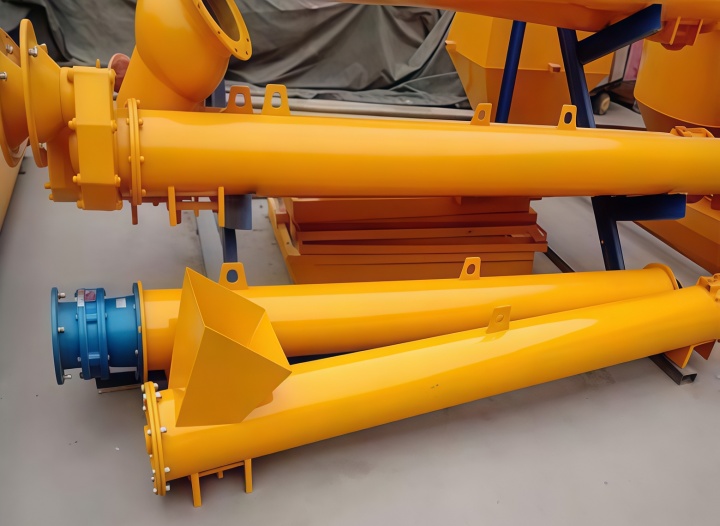
In concrete batching plants, fly ash is transferred from the storage silo to the weighing hopper over short distances. This transfer is often handled by a Tubular Screw Conveyor for Fly Ash in Concrete Batching Plant, which moves powder axially inside a closed round pipe with a rotating screw blade.
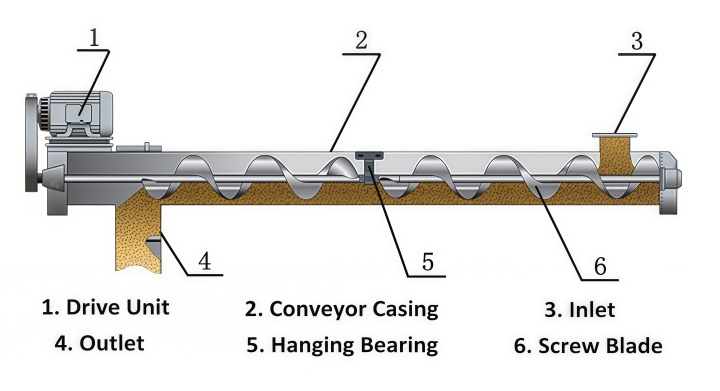
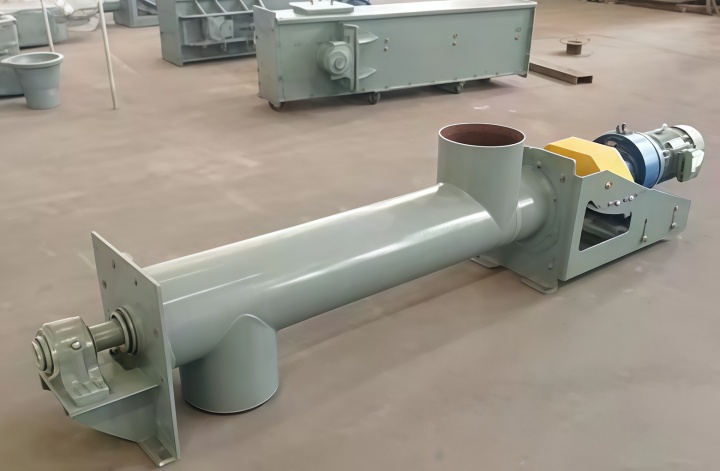
The pipe body uses seamless steel tube with flanged connections. The screw shaft is supported by head and tail bearings, with intermediate hanger bearings set according to length. The design follows JB/T 7679-2019 Section 4.2 and ANSI/CEMA Standard No. 350. The conveying process is enclosed, and dust does not escape.
How Does the Tubular Screw Conveyor for Fly Ash in Concrete Batching Plant Work?
Operation has three stages: feeding, pushing, and discharging. Fly ash falls from the inlet to the bottom of the pipe and fills the spaces between the screw blades. After the reducer motor drives the screw shaft, the blades push the material forward. The material does not rotate with the blades; it moves like a nut along a screw. At the end, it leaves through the outlet.
The fly ash filling coefficient is kept between 0.10 and 0.15, based on JB/T 7679-2019 Section 4.2. For abrasive materials, the filling rate in horizontal screw conveyors is often reduced to about one tenth to limit wear at the blade tip.
Technical Parameters of the Tubular Screw Conveyor for Fly Ash in Concrete Batching Plant
The parameters below follow JB/T 7679-2019 Section 4.2 and ANSI/CEMA Standard No. 350. Fly ash bulk density is taken according to GB/T 1596-2017 Section 5.3, usually 0.5 to 1.0 t/m³. The measured data come from factory technician records at three batching plants in East China from January to June 2026.
| Model | Screw diameter mm | Speed r/min | Output t/h | Motor power kW | Conveying length m | Working angle ° |
|---|---|---|---|---|---|---|
| LSY160 | 163 | 300 | 20 to 30 | 5.5 to 7.5 | 3 to 13 | 0 to 60 |
| LSY200 | 187 | 260 | 32 to 50 | 7.5 to 11 | 3 to 15 | 0 to 60 |
| LSY250 | 238 | 200 | 53 to 70 | 11 to 15 | 4 to 15 | 0 to 60 |
| LSY300 | 290 | 175 | 60 to 82 | 18.5 to 22 | 6 to 15 | 0 to 55 |
| LSY400 | 365 | 175 | 110 to 140 | 22 | 6 to 12 | 0 to 55 |
Blade material can be carbon steel, manganese steel, or hardfacing layer. For highly abrasive fly ash, AR400 or AR500 wear-resistant steel is suggested. A safety factor of 1.2 to 1.5 is suggested. For every 0.5 percentage point increase in moisture, the filling coefficient is reduced by about 0.02.
What Are the Practical Advantages of the Tubular Screw Conveyor for Fly Ash in Concrete Batching Plant?
The pipe body is continuously welded, and flange coaxiality deviation is within 0.5 mm. Factory measurements show dust escape at the pipe connection is below 2 mg/m³. The screw shaft, hanger bearings, and head and tail shafts use embedded connections.
The single-side disassembly space at the inspection opening is about 1.2 times the pipe diameter, which suits compact batching plant layout. The screw diameter is small and speed is high, so fly ash stays in the pipe for a short time and is less likely to cake. The equipment can be installed at 0 to 60 degrees.
For use limits, when fly ash moisture is above 1.5 percentage points, blockage risk becomes higher. In areas with large temperature changes, pipe temperature below dew point can cause moisture absorption and caking. Heat tracing cable and mineral wool insulation can keep the pipe wall above dew point. At the same output, factory comparison tests show the dust escape concentration of the pipe-type structure is about three tenths that of a U-trough screw conveyor.
Where Is the Tubular Screw Conveyor for Fly Ash in Concrete Batching Plant Suitable?
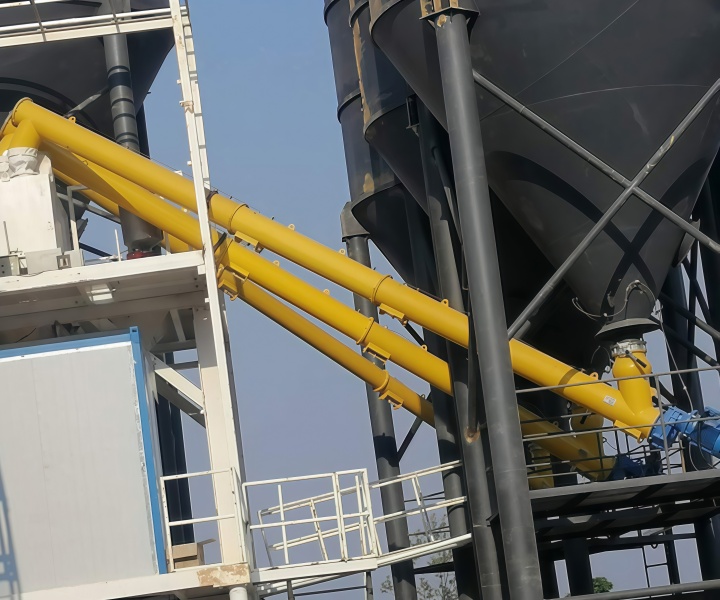
Fly ash and pulverized fly ash conveying is the main scenario. In a batching plant, material goes from the bottom of the powder silo to the weighing hopper and then into the mixer.
Cement conveying is similar, but the filling coefficient should be 0.25 to 0.33, based on JB/T 7679-2019 Section 4.2. Mineral powder and silica fume can also be conveyed. Silica fume has low bulk density, so the selection calculation differs. Material temperature should be below 200°C.
How to Select and Calculate the Tubular Screw Conveyor for Fly Ash in Concrete Batching Plant
The capacity formula is Q = 47 × D² × S × n × β × ψ. Q is output, D is screw diameter, S is pitch, n is speed, β is inclination coefficient, and ψ is filling coefficient. For fly ash, ψ is 0.10 to 0.15. For horizontal installation, β is 1.0. The formula follows JB/T 7679-2019 Section 4.2 and ANSI/CEMA Standard No. 350 Chapter 3.
For LSY250: diameter 0.238 m, pitch 0.238 m, speed 200 r/min, ψ 0.12, bulk density 0.7 t/m³. Theoretical output is about 14.2 t/h. Leave a margin of about one fifth to three tenths. At 10 degrees, β is 0.8, and output is about 11.4 t/h. At 20 degrees, β is 0.65, and output is about 9.2 t/h.
For large-angle installation, increase screw diameter by one size. To check selection, observe three indicators: operating current stable at 70 to 85 percent of rated value, blade wear below 0.3 mm per month, and no blockage during one month of continuous operation.
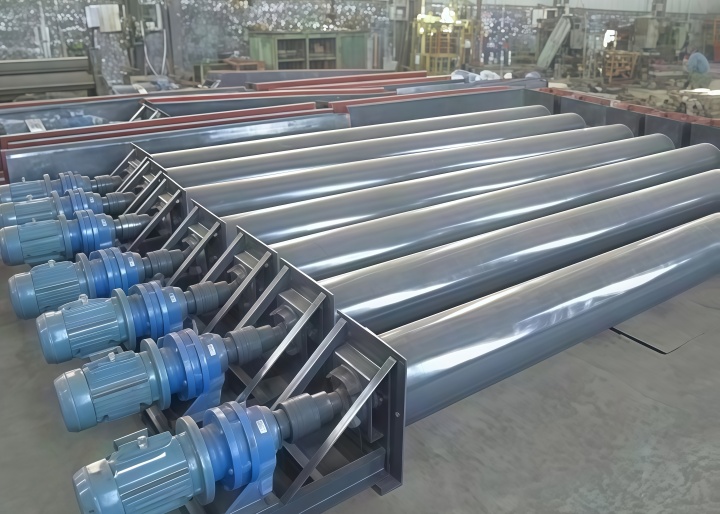
Wear Rate Comparison of the Tubular Screw Conveyor for Fly Ash in Concrete Batching Plant by Fly Ash Source
Fly ash abrasiveness differs by fuel type, combustion method, and dust collection process. The data below come from factory technician tests at three batching plants in East China from January to June 2026. Test conditions: LSY250 equipment, carbon steel blades, continuous two-shift operation.
Electrostatic precipitator fly ash has mainly spherical glass microspheres, with 0.045 mm sieve residue about 12 parts in 100. Wear is about 0.27 mm per month, and the carbon steel blade replacement interval is about 18 months. Circulating fluidized bed fly ash is angular, with 0.045 mm sieve residue about 22 parts in 100. Wear is about 0.48 mm per month, and the replacement interval is about 10 months. Mixed fly ash wear is about 0.38 mm per month. Angular fly ash wear is about 1.8 times that of spherical fly ash.
ANSI/CEMA Standard No. 350 Chapter 3 suggests lower filling rate and limited speed for abrasive materials. For plants with a high proportion of circulating fluidized bed fly ash, hardfacing blades or AR400 grade wear-resistant steel are suggested. The initial purchase price is about two fifths higher, but the replacement interval can extend from 10 months to 24 to 30 months.
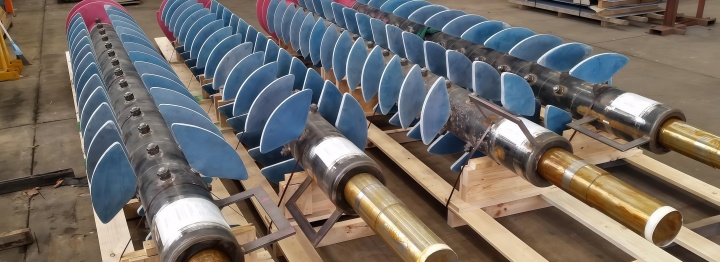
Common Faults and Maintenance of the Tubular Screw Conveyor for Fly Ash in Concrete Batching Plant
Faults are mainly blockage, bearing damage, blade wear, and flushing.

Blockage often comes from high fly ash moisture. Moisture prevention at the silo or a vibration device can help. Frequent starting can compact material at the inlet and cause stall. A limited feeding device can provide uniform feed. For flushing, a variable-pitch screw feeder or a larger intermediate bin can be added.
Bearing damage is caused by fly ash entering the seal. Under high-temperature fly ash, reduce screw speed below 20 rpm. Grease both end bearings with about 5 g lithium-based grease every half month. Remove and re-grease hanger bearings every three to five months.
Blade wear is at the screw outer edge and feed section. Ordinary carbon steel replacement interval is about six to twelve months. Normal blade-to-pipe clearance is 1 to 3 mm. If above 5 mm, replace. Check grease every 500 hours and blade wear every 1,000 hours.
Procurement and Delivery Information
Minimum order quantity is 1 set. Sample trial production is supported, with sample delivery about seven to ten working days. Standard delivery is 25 to 30 working days after deposit. Urgent orders can be 15 working days. FOB price is from Shanghai Port or Ningbo Port, and can be adjusted for a named port.
Packaging is export standard wooden cases, with pipe body packed in sections. Payment is a deposit of three tenths by telegraphic transfer, balance against bill of lading copy. Warranty is twelve months after shipment, covering screw shaft, pipe body, and drive unit. For 3 sets or more, tiered pricing can be quoted.
Frequently Asked Questions About the Tubular Screw Conveyor for Fly Ash in Concrete Batching Plant
Q: What causes large current fluctuations?
A: Uneven feeding or local material accumulation in the pipe. Check inlet blockage and fly ash moisture stability.
Q: Does the product have particle size requirements?
A: It handles powder below 10 mm. Fly ash is usually 0.5 to 300 microns, but coarse ash may speed blade wear.
Q: When is the product not suitable?
A: When fly ash moisture is consistently above 1.5 percentage points, blockage risk is higher. Use a U-trough screw conveyor with vibration. For material above 200°C, use a high-temperature model. For distance above 18 m, use series connection or pneumatic conveying.
Q: Does blade replacement need full disassembly?
A: No. The screw shaft is segmented. Blades can be removed section by section through the inspection opening. After replacement, run without load to check no pipe contact, then resume feed.
Data sources and references: JB/T 7679-2019 Screw Conveyors Section 4.2, GB/T 1596-2017 Fly Ash Used in Cement and Concrete Section 5.3, ANSI/CEMA Standard No. 350 Chapter 3. Actual operation data come from continuous operation records at three concrete batching plants in East China from January to June 2026. Revision date: September 29, 2026.
This article's technical parameters, selection calculations, and operation data were reviewed by the factory technical department, an engineering team with experience in powder conveying equipment design and on-site commissioning.