Screw Conveyor vs. Belt Conveyor: Best Selection Guide for Cement Plants
Monday August-03 2026 09:02:41
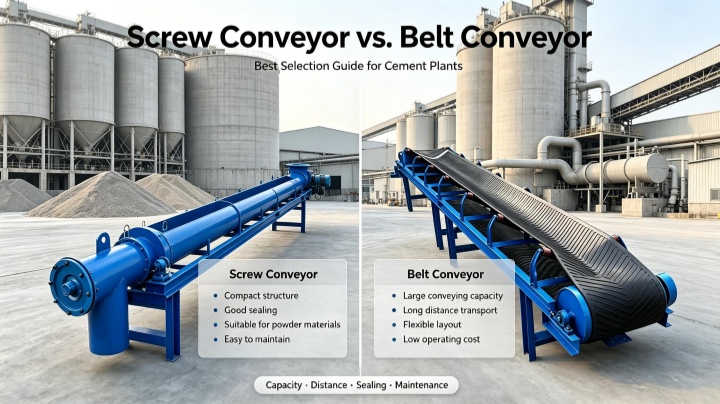
The choice of material handling equipment in cement plants depends on balancing high-throughput long-distance transfer with fully enclosed dust-free short-distance leak prevention. During the continuous transportation of limestone, raw meal, high-temperature clinker, and finished cement, selecting the wrong conveying form leads to severe dust emissions, equipment wear, and rising maintenance downtime costs.
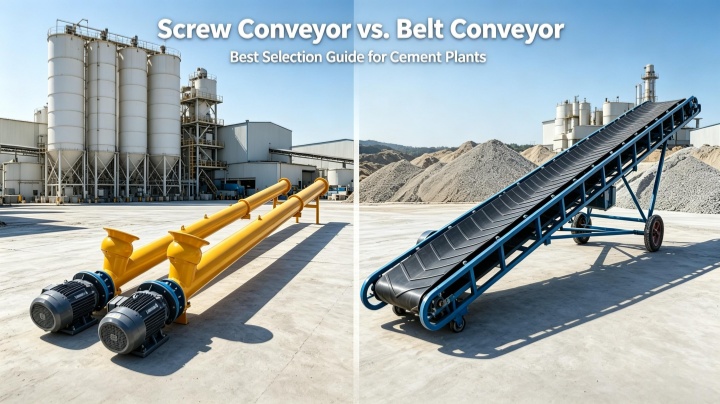
Quick Comparison Table
| Evaluation Metric | Screw Conveyor | Belt Conveyor |
| Conveying Capacity | 5 t/h – 150 t/h | 100 t/h – 3000+ t/h |
| Conveying Distance | Single unit usually ≤ 30 meters | Single unit up to hundreds of meters or several kilometers |
| Dust Sealing | 100% sealed metal pipe/trough, no dust spillage | Open-type or with protective covers, requires negative pressure dust collection at transfer points |
| Material Temperature | Can withstand 200°C – 800°C (with water-cooling jacket) | Standard belt ≤ 80°C, heat-resistant belt ≤ 180°C |
| Installation Incline | 0° – 90° (Horizontal, inclined, and vertical lifting) | Usually ≤ 18° (up to 90° with corrugated sidewall belts) |
| Power Consumption & Wear | Rotation speed 20–80 rpm, sliding friction leads to higher power consumption | Supported by rolling bearings, lower power consumption per ton of transferred material |
Cement Production Line Process Mapping
The vast differences in physical characteristics (particle size, temperature, moisture content, flowability) of materials across cement plant sections dictate the specific layout of conveying equipment:
- Limestone Quarry Crushing & Stockyard (Limestone Handling): For large limestone chunks (particle size 0–300 mm) with conveying capacities reaching above 1000 t/h, wide rubber belt conveyors are utilized, relying on idlers for support to achieve high-speed continuous transfer.
- Raw Mill & Kiln Tail Feeding (Raw Meal Dosing): Raw meal powder features fine particle sizes (80-micron sieve residue < 12%) and high flowability, making it prone to flushing. Tubular sealed screw conveyors are selected to deliver raw meal into preheaters under sealed conditions via fixed-volume pitch control.
- Cooler Discharge & Clinker Silo (Clinker Transport): Clinker exiting the kiln typically ranges between 150°C and 250°C, possessing high abrasiveness in lump form. Heavy-duty trough screw conveyors (equipped with thick-walled manganese steel flights) or heat-resistant steel apron conveyors are predominantly used to avoid belt burn-through.
- Cement Mill Dosing & Gypsum/Fly Ash Addition (Additive Dosing): Additives like gypsum and desulfurization ash require precise metering. Variable-frequency speed-regulated screw feeders are employed to control material addition ratios by tracking screw rotation cycles.
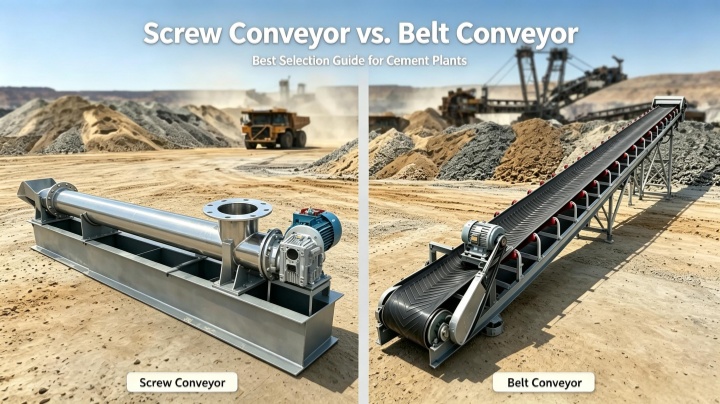
Deep Dive: Screw Conveyors in Cement Manufacturing
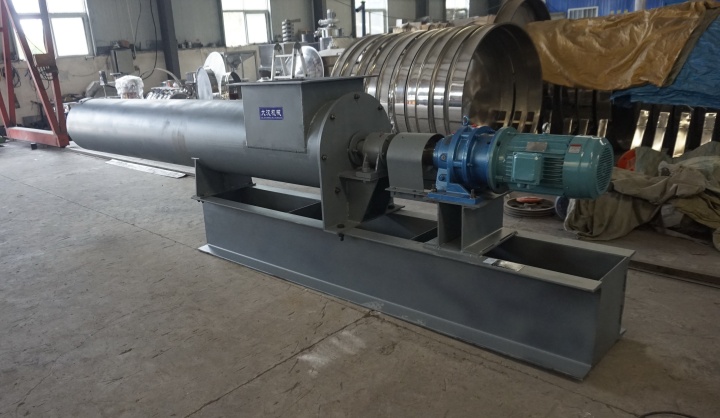
Screw conveyors in cement plants mainly handle sealed powder transportation and quantitative dosing. The structure comprises a drive unit, heavy-duty bearing housings, thick-walled seamless steel pipes (or U-shaped steel troughs), and wear-resistant helical blades.
In process sections requiring extreme airtightness, screw conveyors block dust from escaping into the workshop via flange sealing gaskets and shaft-end air/packing seals, eliminating the need for extra dust hoods and ductwork layouts. The equipment supports multi-point feeding and discharging, distributing powder into different storage bins via pneumatic gates mounted over bottom discharge openings.
However, direct sliding friction occurs between the blades and materials as the screw rotates, causing high operational resistance. When transporting highly abrasive clinker, mechanical wear occurs between the screw outer edge and liners, requiring periodic replacement of wear-resistant alloy liners.
Deep Dive: Belt Conveyors in Cement Manufacturing
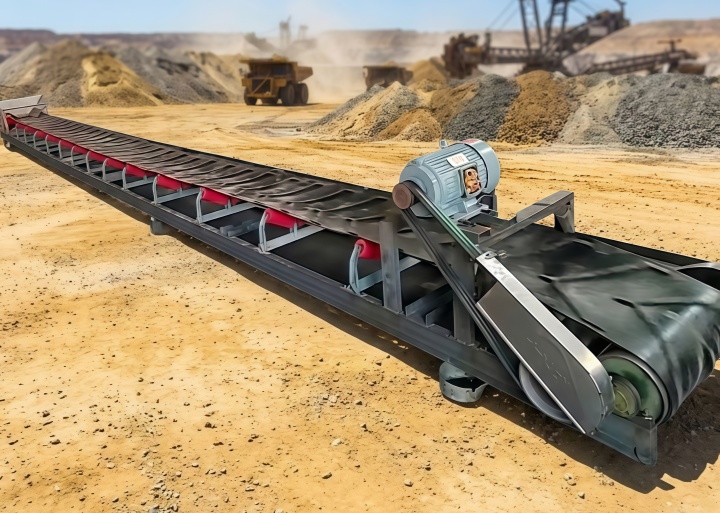
Conveyors Belt serve as the primary equipment for handling bulk raw materials in cement plants. The system consists of a steel structural frame, rubber conveyor belt, drive pulley, tail pulley, and upper/lower idler sets.
In long-distance, large-tonnage transfer scenarios, the rolling friction coefficient of belt conveyors is low, resulting in higher motor power utilization compared to screw equipment. The flat belt surface maintains virtually no relative movement with the material, yielding low particle breakage rates and belt service lives spanning several years.
The main technical limitation lies in dust control. At material drop transfer hoods and tail loading chutes where significant fall heights induce draft air, dust spillage occurs easily, requiring spray dust suppression or baghouse dust collectors. Furthermore, restricted by the physical properties of rubber, materials exceeding 180°C cause cover rubber delamination and vulcanization failure.
5 Key Selection Factors for Cement Engineers
When planning conveying schemes, cement plant engineers need to evaluate based on the following physical parameters and engineering indicators:
- Capacity & Distance: For throughput exceeding 200 t/h and distances over 30 meters, belt conveyors are preferred; for powder sections below 50 t/h and distances under 20 meters, screw conveyors take priority.
- Dust Emission Standards: In areas with strict atmospheric particulate matter (PM) concentration controls within the plant, 100% enclosed screw pipelines are selected to reduce investment in dust collection networks.
- Material Temperature: When transporting high-temperature kiln slag or clinker above 200°C, screw conveyors equipped with circulating water-cooling jackets and heat-resistant alloy steel screws are specified.
- Plant Layout & Incline: When workshops contain numerous columns, tight spaces, or require steep-angle material lifting between 30°–90°, screw conveyors occupy minimal footprint without angle limitations; belt conveyor layouts require long inclined gallery spaces.
- Capex vs. Opex: Screw conveyors have lower initial procurement and installation costs but higher energy consumption per ton; belt conveyors require higher initial investments in steel structures and belting but yield lower long-term continuous operating electricity costs.
Frequently Asked Questions
Q1: Can a screw conveyor handle high-temperature cement clinker?
Yes. When conveying high-temperature cement clinker, the screw conveyor requires blades made of wear-resistant alloy steel (such as NM400 or HARDOX) with a thickness of 12–16 mm, external pedestal bearings to isolate heat sources, and an external cooling water jacket for temperature reduction protection.
Q2: Which conveyor is more energy-efficient for long-distance transport in cement plants?
Belt conveyors are more energy-efficient. Belt conveyors rely on rolling element bearings on idlers to support load, with friction resistance coefficients typically between 0.02–0.03; screw conveyors rely on sliding friction between material and steel trough walls to push material, with resistance coefficients reaching 0.5–0.8, significantly increasing power consumption over long distances.
Q3: How to prevent dust leakage in cement belt conveyors?
Preventing dust in belt conveyors requires three engineering measures: installing dual-layer polyurethane dust skirts at loading chutes, deploying pulse-jet baghouse dust collectors atop discharge hoods, and installing fully enclosed color steel plate protective covers along the entire conveyor gallery.
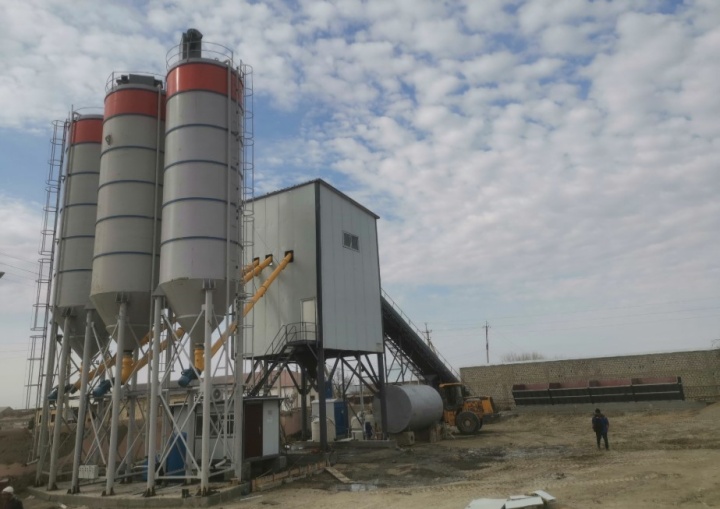
The core of equipment selection in cement production lines lies in matching material physical forms with mechanical transfer mechanisms. Belt conveyors dominate limestone mining, slag stockyards, and long-distance plant transport sections with low friction, high belt speeds, and large tonnage capacities; screw conveyors occupy process points such as raw meal dosing, cement grinding, fly ash addition, and high-temperature material processing through compact structures, fully sealed piping, and multi-point quantitative feeding. Engineers must integrate plant CAD layouts, material temperatures, and environmental standards to conduct comprehensive technical and economic evaluations.
Request a Custom Cement Plant Conveying System Design
Need an engineering evaluation for your cement plant upgrade or raw material handling line? Send us your material bulk density, throughput requirements, and plant elevation drawings. Our engineering team will supply full CAD layout designs and equipment specifications within 24 hours.
Submit Your Engineering Layout →
Sugested Products
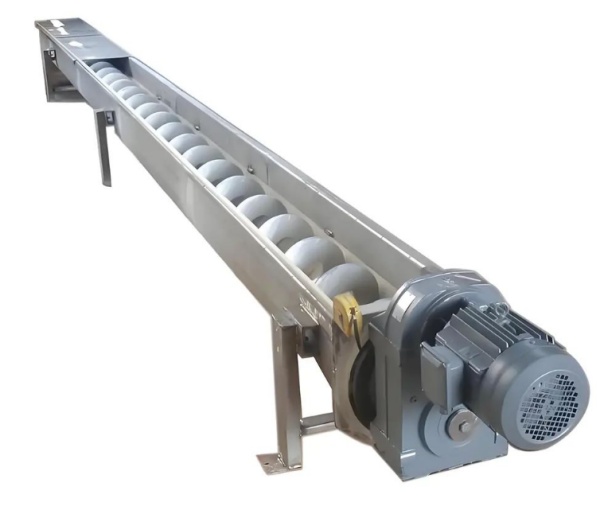
Modular Trough Screw Conveyor | Sectional Industrial Auger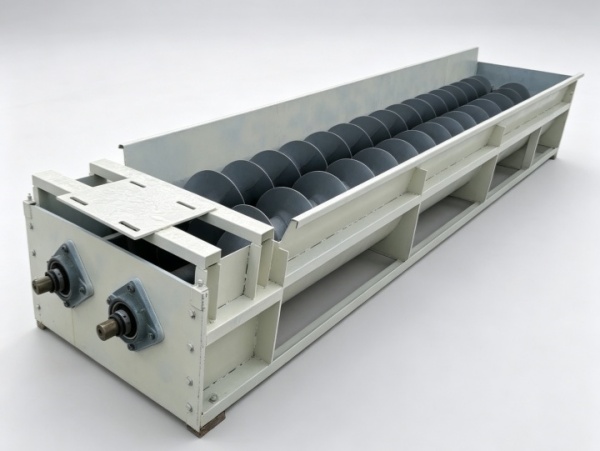
Twin Shaft Screw Conveyor for Flue Gas Desulfurization Gypsum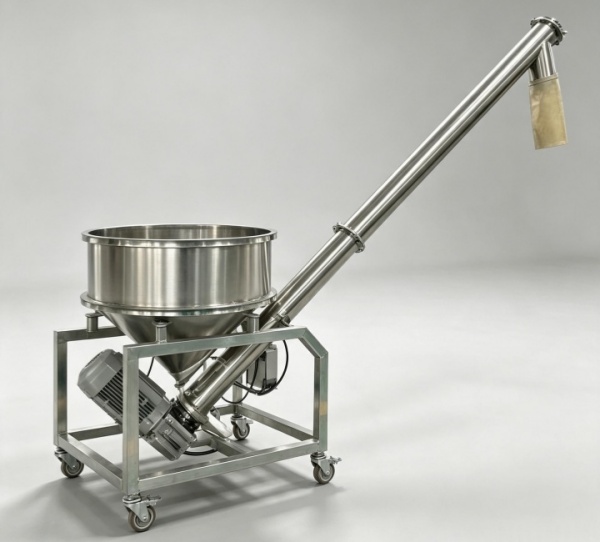
Portable Auger Conveyor with Hopper | Mobile Bulk Feeder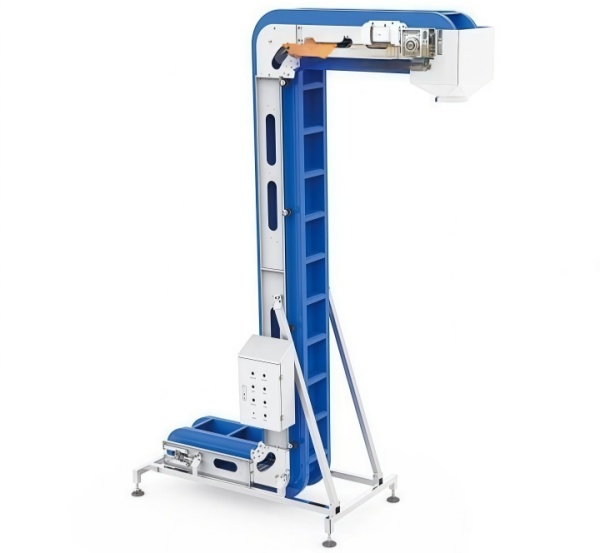
Vertical Belt Conveyor System | 90° Space-Saving Lifting