Heavy Duty Belt Conveyor Selection Guide
Wednesday October-14 2026 09:44:18
Summary answer:Heavy Duty Belt Conveyor Selection Guide is a comprehensive guide to heavy-duty belt conveyor selection. Heavy Duty Belt Conveyor heavy duty belt conveyor Selection focuses on how material properties influence belt compound, how capacity influences belt speed and drive power, how path geometry influences structure type, and how environment influences protection level. Allow a margin of 15 to 20 per hundred during selection, and use CEMA or DIN 22101 as a unified calculation basis.
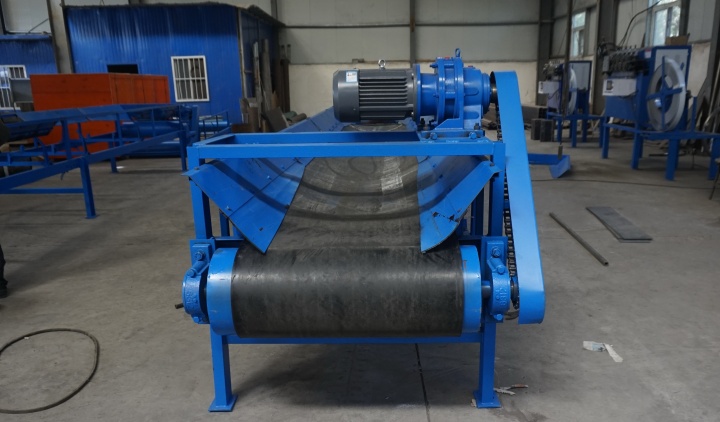
Its core is not about comparing quotes, but about locking material properties, operating conditions, and system parameters together in one decision. A correctly selected heavy-duty belt conveyor typically runs continuously for 8 to 10 years, with annual maintenance cost within 5 per hundred of the purchase price. A selection error can lead to downtime losses reaching 3 to 5 times the equipment price.
Selection difference comparison table
| Item | Correct selection | Incorrect selection |
|---|---|---|
| Belt service cycle | 3 – 8 years | 12 – 24 months |
| Annual maintenance cost as share of purchase price | Not more than 5 per hundred | 15 – 25 per hundred |
| Unplanned downtime frequency | 1 – 2 times per year | 1 – 2 times per quarter |
| Five-year total cost of ownership | 150 – 200 per hundred of purchase price | 300 – 500 per hundred of purchase price |
Key parameter quick reference table, listed by material type
| Parameter | Typical value for copper mine | Typical value for coal mine | Typical value for iron ore |
|---|---|---|---|
| Belt speed | 1.3 – 2.5 m/s | 5.0 – 7.0 m/s | 2.0 – 3.5 m/s |
| Cover rubber thickness | 12 – 15 mm | 8 – 12 mm | 10 – 14 mm |
| Idler diameter | ≥159 mm | 133 – 159 mm | ≥159 mm |
| Design standard | DIN 22101 | CEMA | DIN 22101 |
How Material Properties Affect Heavy Duty Belt Conveyor Selection
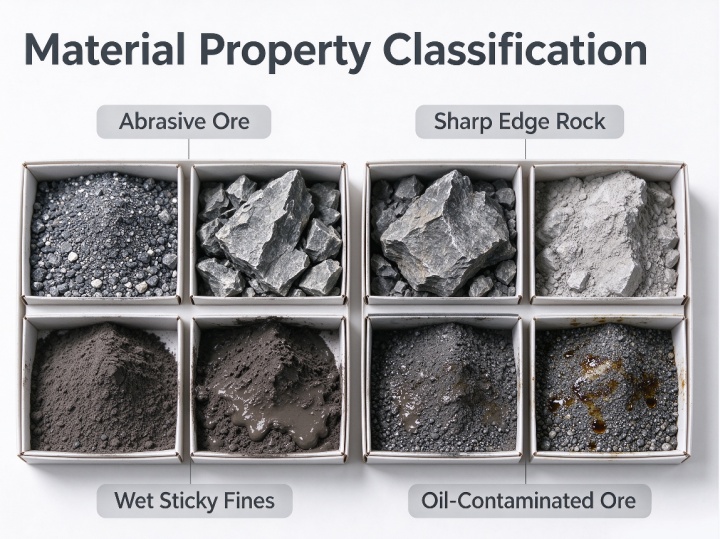
Material properties are the first decision variable. First confirm whether the material temperature is above 80°C, whether it contains sharp edges, and whether it carries oil or acid-alkali components. High-temperature materials require rubber belts with a heat resistance rating above 120°C. Materials with sharp edges require a cover rubber thickness of not less than 10 mm. Materials containing oil or acid-alkali require oil-resistant or corrosion-resistant compounds. Belt width is generally 3 to 5 times the upper particle size limit. Moisture content is often underestimated. Wet and sticky materials tend to adhere to the belt and chute, causing return material buildup and belt misalignment.
Key fact:Zambia copper mine project. A 12 mm standard cover rubber was replaced with an abrasion-resistant compound. Belt service cycle extended from 14 months to 39 months. Abrasion-resistant belt purchase premium was 18 per hundred. Source: Certain Company, Copper Ore Belt Conveyor Selection and Design Guide, 2025.
Matching Capacity and Belt Speed in Heavy Duty Belt Conveyor Selection
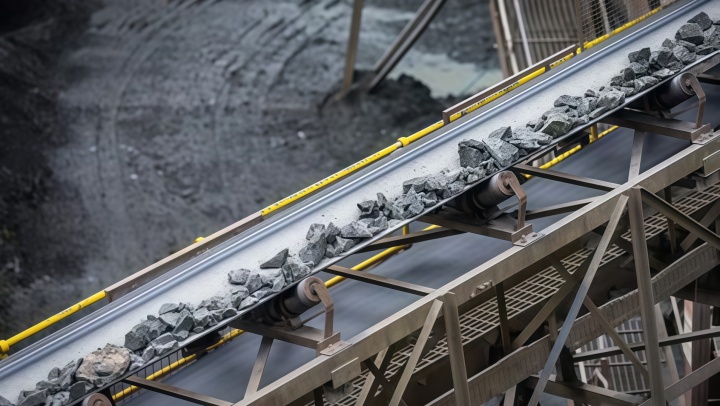
Conveying capacity is approximately belt width multiplied by belt speed multiplied by material bulk density multiplied by loading factor. The loading factor is usually between 0.7 and 0.9. Powdered materials above 3.5 m/s tend to generate dust. Brittle materials require low-speed operation. When copper ore contains large lumps, belt speed should be controlled between 1.3 and 2.5 m/s, because impact and wear at the transfer point increase exponentially with speed. Allow a design margin of 15 to 20 per hundred during selection.
Key fact: A Ghana concentrator increased throughput from 800 t/h. The conveyor experienced spillage when throughput exceeded 850 t/h. After modifying the loading zone, transfer point, and tensioning system, throughput stabilized at 940 t/h. Source: Ghana Mining Journal, Vol. 9, 2007.
Hard Constraints of Path and Incline on Heavy Duty Belt Conveyor Selection
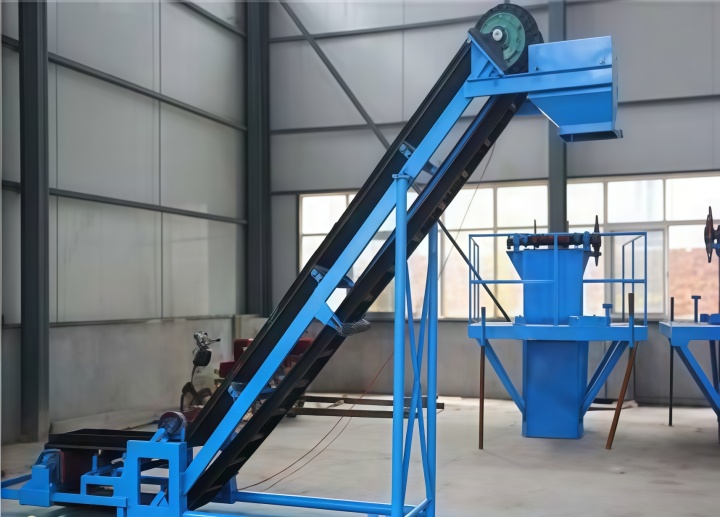
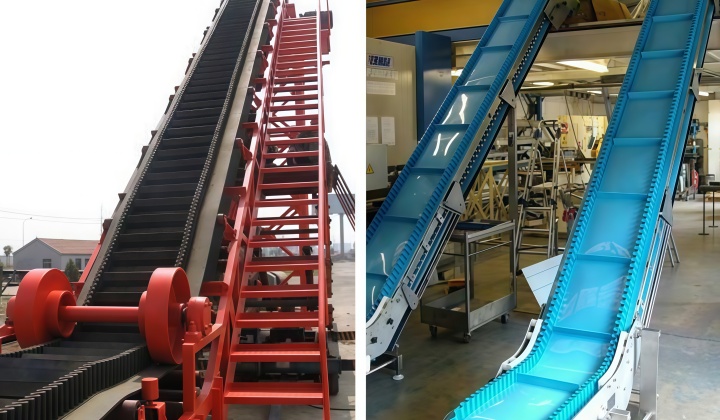
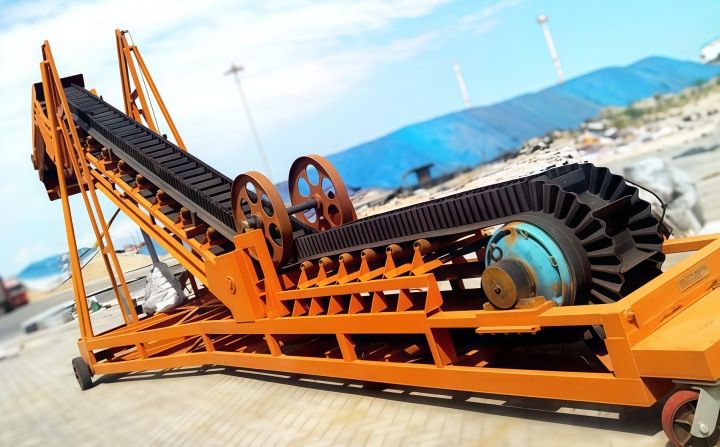
When the incline is above 18 to 20 degrees, a smooth belt will experience material sliding. A belt with cleats or patterned surface must be used. Curved paths require arc belts or corner pulley mechanisms. The cost is 30 to 50 per hundred higher than a straight-line solution. The clear height and clear width of the installation space determine whether the equipment is floor-mounted, suspended, or mobile. During site survey, the clearance height and turning radius limits at each transition point need to be marked.
CEMA and DIN 22101 standard comparison
CEMA uses itemized friction coefficients. DIN 22101 uses a global friction coefficient. Under the same operating conditions, the effective tension calculation result of CEMA is about 7,940 N higher than that of DIN. Copper and iron ore projects usually use DIN 22101. Coal and North American projects generally use CEMA. For cross-border projects, it is advisable to specify the design standard in the technical annex of the contract.
Hidden Influence of Environment on Heavy Duty Belt Conveyor Selection
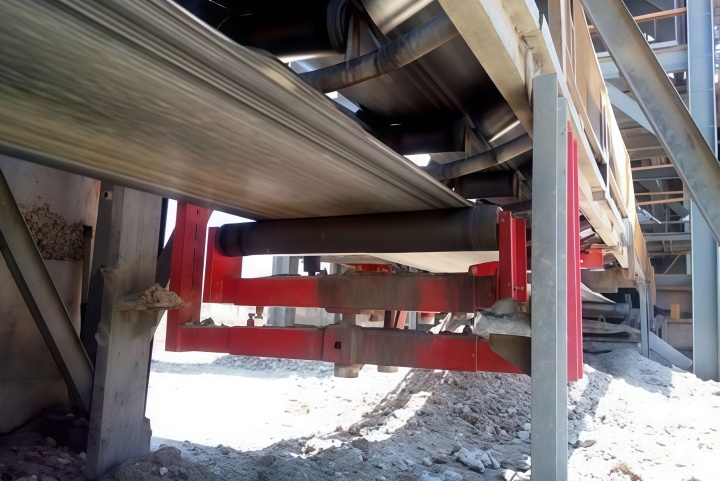
High-dust environments require fully enclosed motors and bearings, plus explosion-proof and emergency stop devices. Acid-alkali corrosive environments require 316 stainless steel frames or heavy-duty anti-corrosion coatings. Low-temperature environments require low-temperature rubber compounds. Idler diameter should be not less than 159 mm, wall thickness not less than 4 mm, and sealing should combine labyrinth and contact seals. A 159 mm idler costs about 40 per hundred more than a 133 mm idler, but in copper mine conditions its service cycle is 3 to 4 times that of a 133 mm idler.
High-altitude mines provide a set of design constraints not encountered at low altitude. Above 4,000 meters, air density decreases, and the actual motor output power is only 80 to 85 per hundred of the nameplate value. Drive system selection needs to be multiplied by a derating factor. In an Andean copper mine project, a certain copper company replaced a 5-layer nylon-polyester carcass with a Kevlar fiber carcass at an altitude of 3,000 to 4,200 meters. Kevlar has no glass transition temperature, so it does not become brittle at low temperatures like polyester or steel.
Key fact: Saraji coal mine. Original belt service cycle was 15 to 23 months. After switching to a tear-resistant carcass with abrasion-resistant cover rubber, service cycle extended to 389 per hundred of the original. A 400 mm metal gouge did not cause downtime. The belt has run for 62 months. Source: Certain Company, Tear-Resistant Conveyor Belt Case Study, 2025.
Fields That a Heavy Duty Belt Conveyor Selection Worksheet Should Cover
The four dimensions above involve dozens of parameters. Relying on memory alone makes omissions easy. A standardized selection worksheet can concentrate these scattered decision points onto one page. The worksheet should include five categories of fields: material parameters, capacity parameters, path parameters, environment parameters, and drive parameters. After filling in the table, selection changes from experience-based judgment to parameter comparison, and there is a common language when communicating with suppliers.
Several large copper mine projects in South America provide a decision reference for long-distance conveying. The Quellaveco copper mine in Peru has an overland conveyor 4,700 meters long, 1,830 mm wide, with dual 5.5 MW gearless drives, and a design capacity approaching 11,000 tons per hour. The Chuquicamata underground mine in Chile has a conveyor system 7 kilometers long, overcoming about 1 kilometer of vertical drop, with total installed power of 58 MW. The Cuajone copper mine in Peru has an overland conveyor 6.514 kilometers long, 1,829 mm wide, steel cord belt tensile strength 6,800 N/mm, and drive power 12,000 kW.
The common point of these projects is that path geometry influences structure type, and structure type in turn constrains the choice of drive scheme. Long-distance conveying tends toward gearless drives, because eliminating the gearbox reduces maintenance points and improves system energy efficiency. In this process, path parameters are a prerequisite for drive scheme and structure type.
How to Verify the Completeness of Heavy Duty Belt Conveyor Selection
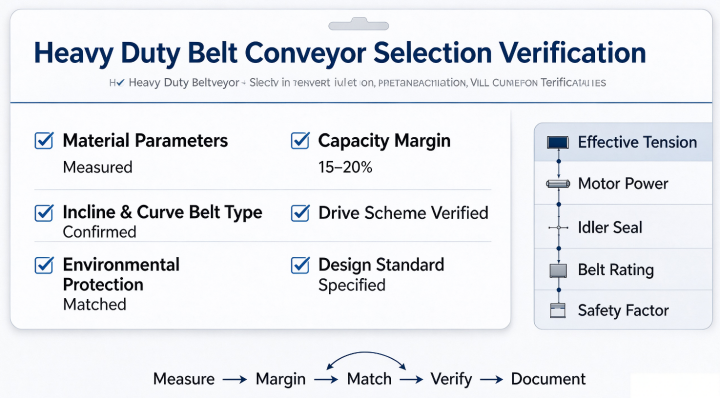
After completing the five steps above, use a set of self-check questions to close the decision. Are material parameters measured rather than estimated? Is the capacity margin left at 15 to 20 per hundred? Are there corresponding belt types for inclines and curved sections? Does the environmental protection level match site conditions? Does the drive scheme consider both starting torque and full-load conditions? Does the installation altitude require motor derating verification? And is the design standard on which the selection is based specified in the contract? The quality of selection does not depend on how many parameters were selected, but on which parameters were omitted.
This selection logic is essentially the process of translating operating conditions into engineering language. Material influences belt compound and thickness. Capacity influences belt speed and drive power. Path influences structure type. Environment influences protection configuration and altitude derating verification. The worksheet helps complete parameters. Self-check confirms there are no blind spots.
Heavy Duty Belt Conveyor Selection FAQ
Q: After the equipment arrives on site, what is the most easily overlooked but critical step in installation?
A: Frame alignment and pulley parallelism. Before tightening anchor bolts, control horizontal deviation within 2 mm and head-tail pulley axis parallelism within 1 mm. Otherwise subsequent belt misalignment is difficult to correct.
Q: For the same specification of heavy-duty belt conveyor, quotes from different suppliers vary widely. What should the judgment be based on?
A: Look at total cost of ownership, not just purchase unit price. Idlers and belts usually account for only 30 to 40 per hundred. Installation, splicing, tensioning, and five-year replacement costs are often two to three times the purchase price.
Q: The belt shifts to one side during operation. I adjusted the idlers, but it shifts back after a few days. What is the root cause?
A: The root cause is usually not the idlers themselves. First check whether the loading point is off-center, whether the chute liner is unevenly worn, and whether the frame has settled. After these three checks, look at the idlers again.
Sugested Products
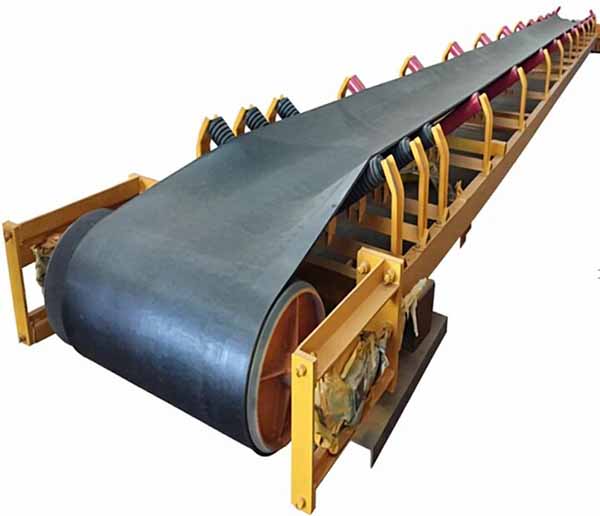
heavy duty belt conveyor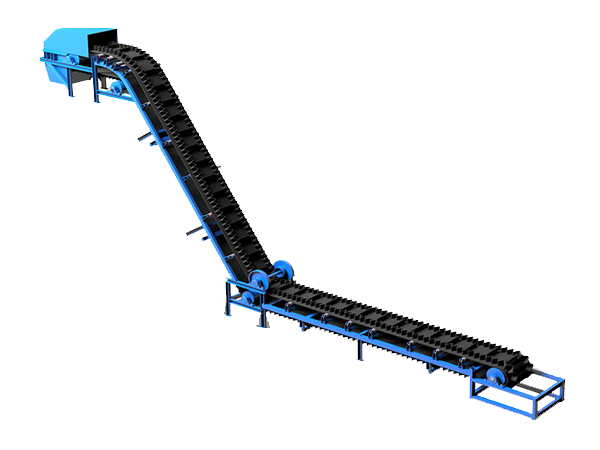
inclined belt conveyor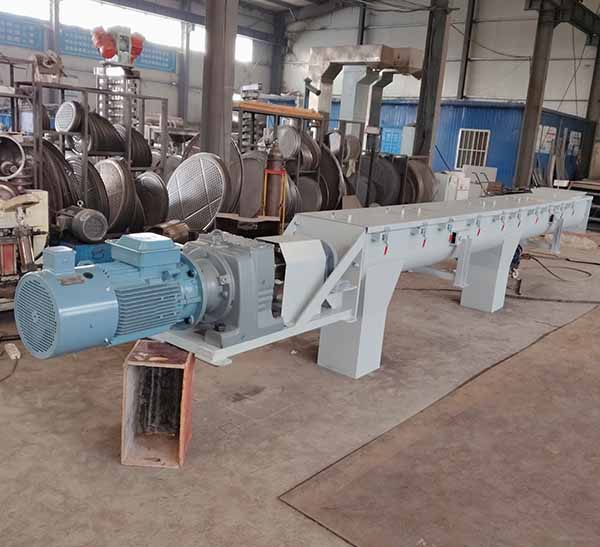
Poultry Litter Auger Conveyor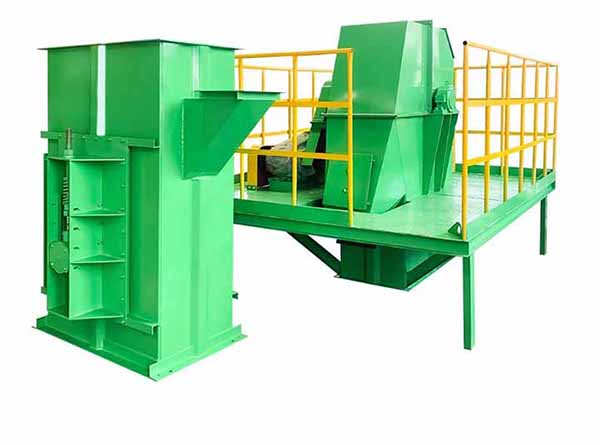
Sulfur bucket elevator