How to Choose the Right Belt Conveyor System for Your Material Handling Needs
Thursday September-03 2026 14:11:09
The direct loss from choosing the wrong Belt Conveyors System is typically 3 to 5 times its purchase price, while a properly selected one can last 8 to 10 years with annual maintenance costs below 5% of the purchase price. The difference lies not in price but in the selection logic. This article draws on CEMA standards and ISO 5048, offering five core decision-making dimensions, a side-by-side comparison guide, a self-check checklist, and a material selection quick-reference table to help you choose the right equipment.
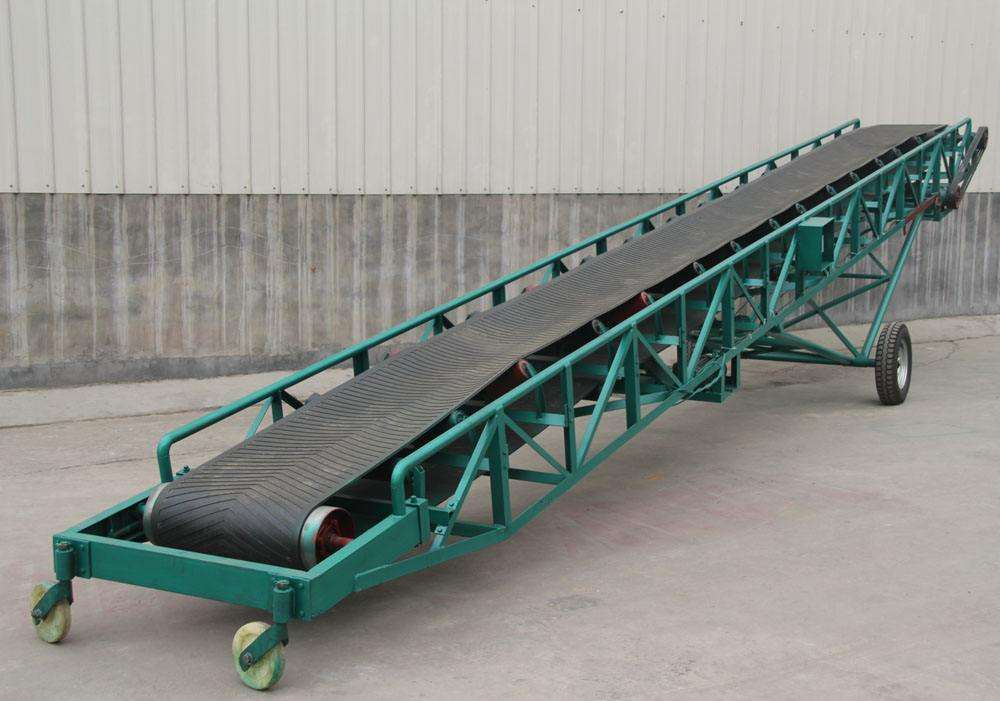
Material Characteristics Determine the Belt Material and Width
The belt material is dictated by the material to be conveyed. Examine three aspects: whether temperature exceeds 80°C, whether it has sharp edges, and whether it contains grease or acids and alkalis. High-temperature materials require metal mesh belts or rubber belts rated above 120°C. Materials with sharp edges need abrasion-resistant rubber belts at least 10 mm thick. Food and pharmaceutical applications require PU or food-grade PVC belts meeting FDA or EU 10/2011 standards.
Belt width should be selected at 3 to 5 times the maximum particle size. Many factories experience frequent spillage from their Belt Conveyor System simply because the belt width was chosen too narrow. Material should be tested and measured rather than estimated by experience.
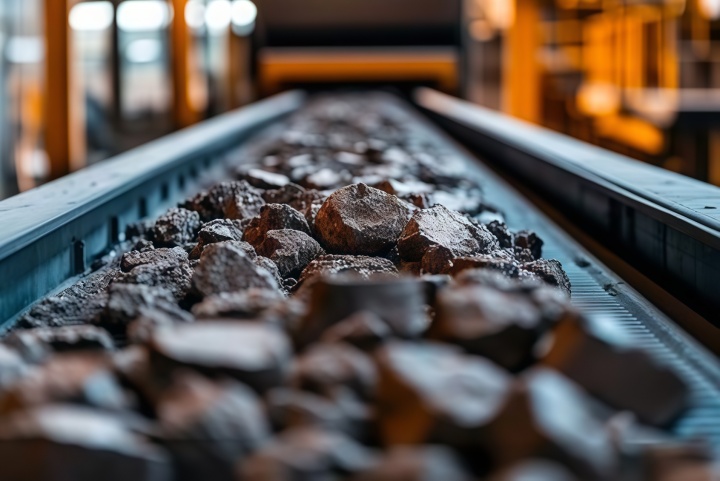
Conveying Capacity Determines Motor Power and Belt Speed
Conveying capacity is determined by belt width, belt speed, and motor power. Higher belt speed increases throughput, but exceeding 3.5 meters per second causes powdery materials to become airborne. Reference ISO 5048 for power and tension calculations using the formula: capacity roughly equals belt width times belt speed times material bulk density times fill factor, which typically ranges from 0.7 to 0.9.
Leave a 15% to 20% margin rather than calculating at 100% capacity, ensuring the Belt Conveyor System does not become a bottleneck during future expansion. Belt speed should also consider material properties: fragile items require low speed, free-flowing powders suit medium speed, and lumpy materials should not be conveyed too fast.
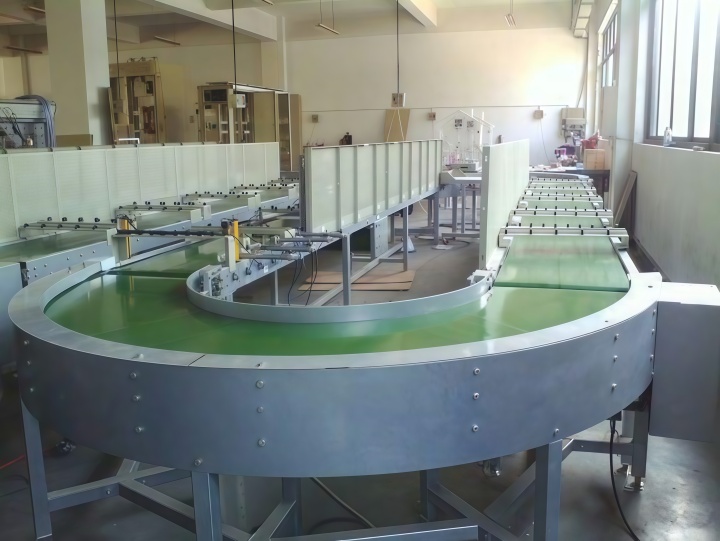
Conveying Path Determines Structural Configuration
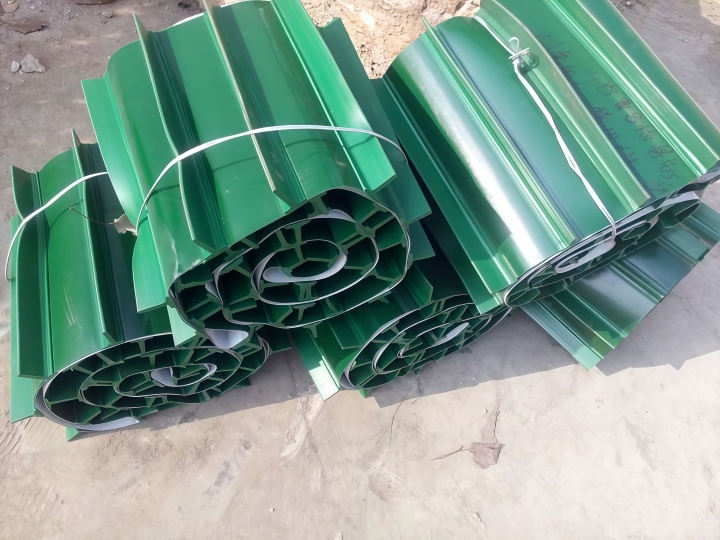
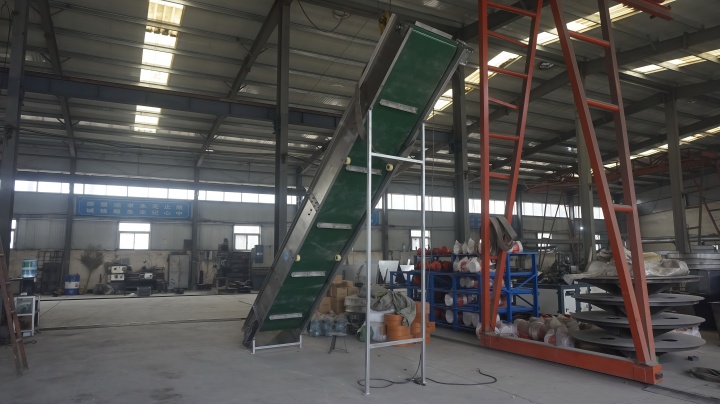
The conveying path extends beyond a simple point-to-point line. When an incline exceeds 18 to 20 degrees, a standard smooth belt will slip, requiring a belt with cleats or a textured surface. Curved conveying requires arc-section belts or corner roller mechanisms, costing 30% to 50% more than straight-line configurations.
Clear height and width of the installation space affect whether the Belt Conveyor System is floor-mounted, suspended, or mobile. Conduct an on-site survey before selection, marking every turning point along the path.
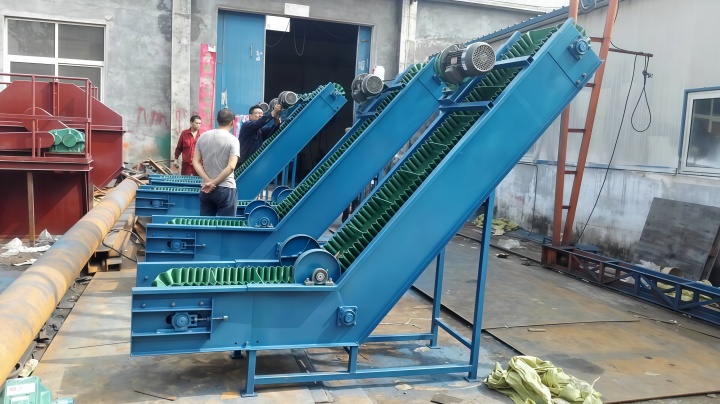
Operating Environment Determines Frame Material and Protection Rating
The operating environment often poses greater challenges than the material itself. Food plants require daily high-pressure washing, demanding 304 stainless steel frames and motors with at least IP65 protection. Cold storage at minus 25°C requires low-temperature rubber. Mining and foundries with high dust concentrations require fully enclosed motors and bearings, plus explosion-proof and emergency stop devices.
Chemical plants with acid and alkali corrosion require 316 stainless steel frames or heavy-duty anti-corrosion coatings. Ignoring environmental factors can cut the life of a Belt Conveyor System by more than half.
Lifecycle Cost Determines Overall Value
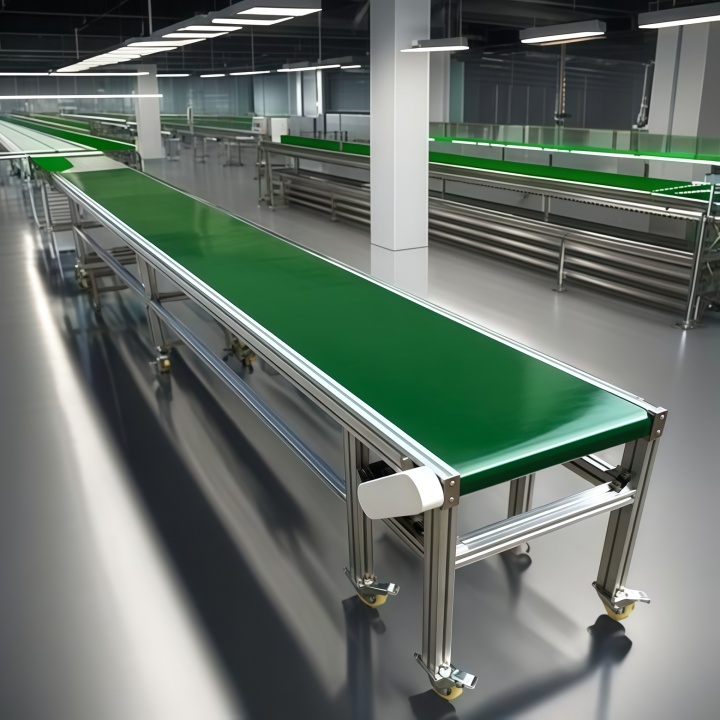
The purchase price accounts for only 20% to 30% of total cost of ownership. The remainder consists of energy, belt replacement, roller re-lagging, bearing replacement, and downtime losses. TCO includes five components: initial purchase and installation, daily energy, planned and unplanned maintenance, downtime losses, and disposal costs.
A standard PVC belt may cost a few hundred dollars but need replacement every six months, while a higher-quality rubber belt may cost over a thousand dollars but last three to five years. Factor in five years of maintenance and downtime costs when selecting a Belt Conveyor System.
Belt Conveyor System vs. Other Conveying Equipment
| Comparison Dimension | Belt Conveyor System | Roller Conveyor | Chain Conveyor |
|---|---|---|---|
| Suitable Materials | Bulk, granular, powders, bags, irregular items | Flat-bottomed rigid goods like pallets, cartons, metal parts | Heavy loads, high-temp, impact-prone items |
| Conveying Incline | Up to 20 degrees | Horizontal or very slight | Horizontal or slight, weaker than belt |
| Core Advantages | Simple structure, smooth, low noise, continuous long-distance | High capacity, sturdy, low maintenance | Excellent load capacity, heat-resistant, precise cycle control |
| Key Limitations | Belt is consumable; heat and sharp materials shorten life | No bulk/irregular materials; weak incline; limited small items | High cost, noisy, complex chain maintenance |
| Typical Applications | Mining, food packaging, logistics, chemical post-packaging | Warehousing, pallet lines, | Auto assembly, foundry, appliance lines |
| Maintenance Focus | Belt splices, roller lagging, idlers | Roller bearings, drive chains | Chain tension, sprocket wear, rail lubrication |
Belt Conveyor System Common Faults and Troubleshooting
Misalignment: Belt runs to one side, caused by non-parallel rollers, off-center loading, or crooked splices. Solutions include adjusting roller alignment, correcting the drop point, or re-splicing.
Slippage: Drive roller turns but belt does not move, caused by insufficient tension, worn lagging, or overload. Solutions include adjusting tension or re-lagging.
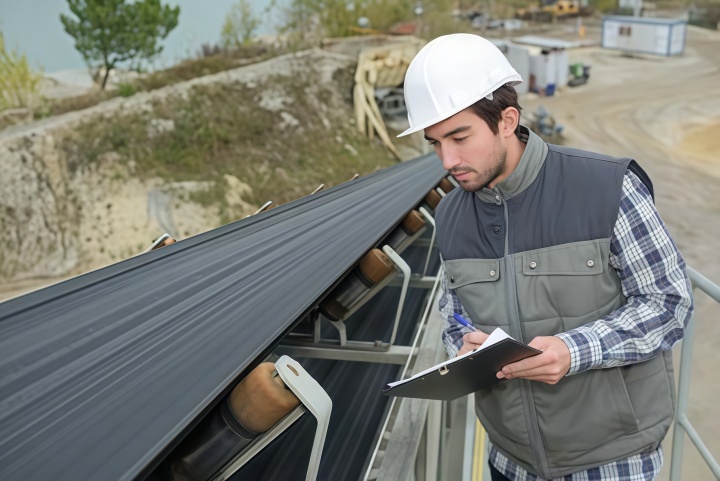
Excessive Wear: Surface wear or cracking caused by seized idlers, sharp materials, or belt-to-frame friction. Solutions include replacing damaged idlers, installing impact beds, and adjusting clearances.
Belt Conveyor System Selection Quick Self-Check Checklist
Material temperature, moisture, acidity/alkalinity, and particle size measured and recorded
Peak capacity below 80% of rated capacity
Maximum incline angle below belt's maximum allowable angle
Minimum clear height and width measured on site
Ambient temperature, humidity, dust class, and cleaning frequency confirmed
Expansion plans for next two years and sufficient margin allowed
Spare parts lead times and prices confirmed with supplier
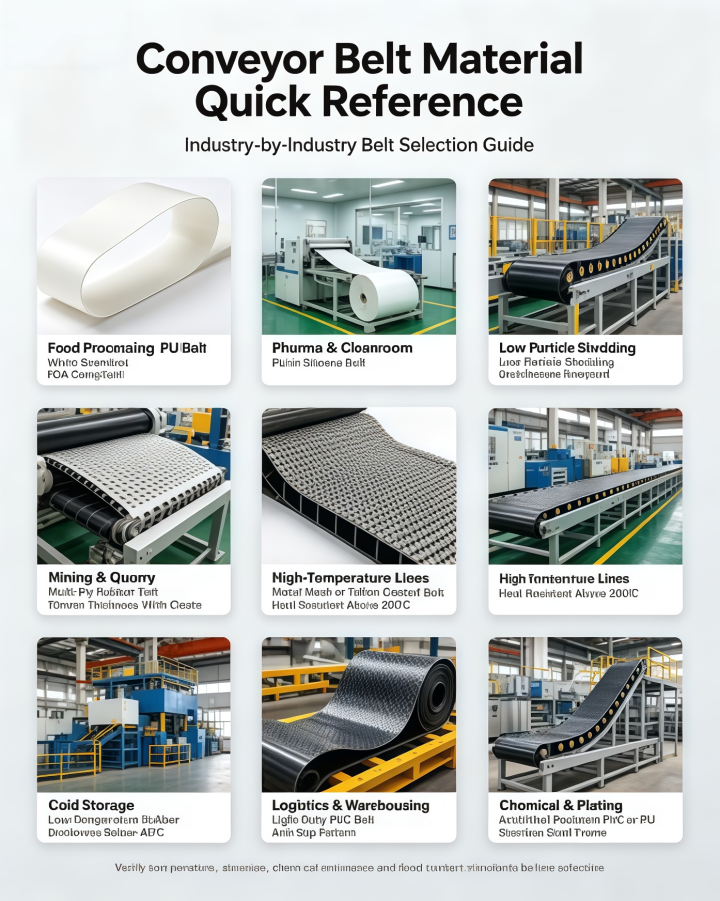
Quick Reference: Belt Materials by Industry
Food processing: PU belt, white seamless, FDA-compliant
Pharma and cleanrooms: PU or silicone belt, low particle shedding, disinfectant-resistant
Mining and quarries: Multi-ply rubber belt, 10mm minimum, with cleats
High-temperature lines: Metal mesh or Teflon-coated belt, heat-resistant above 200°C
Cold storage: Low-temperature rubber, brittleness below minus 40°C
Logistics: PVC light-duty belt, anti-slip surface
Chemical: PVC or PU acid/alkali-resistant, stainless steel frame
Three Overlooked Details in Belt Conveyor System Selection
Belt splice method, roller lagging material, and idler spacing are three overlooked details affecting long-term reliability.
First, the belt splice. Mechanical fasteners install quickly but damage roller lagging. Hot vulcanized splices offer high strength but require specialized equipment. For small to medium systems, hot vulcanized splices are the better long-term choice.
Second, roller lagging. Ceramic lagging provides excellent friction but costs more. Rubber lagging offers balanced cost-performance. Bare steel rollers almost always slip in wet conditions. For inclined conveying, ceramic or patterned rubber lagging is necessary.
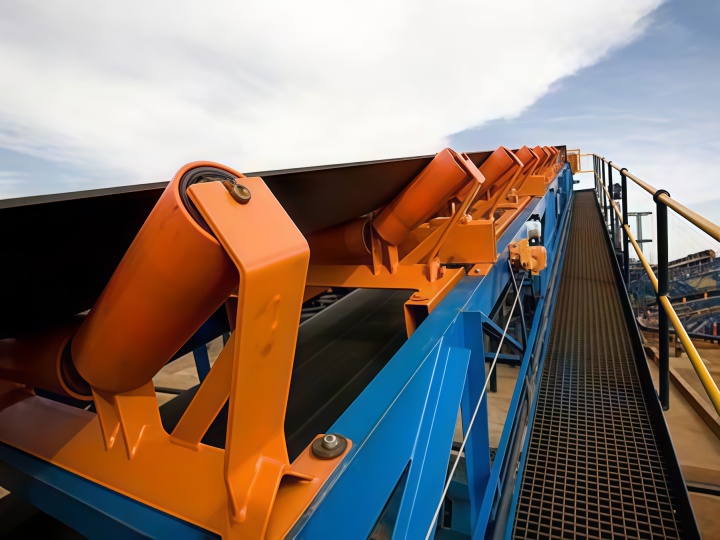
Third, idler spacing. Excessive carrying idler spacing causes belt sagging and spillage. Standard spacing is 1 to 1.2 meters for the carrying section and 2.5 to 3 meters for the return section, adjusted based on belt tension.
Frequently Asked Questions
Where do most people get stuck when selecting a Belt Conveyor System?
Measured material property data is the most frequently overlooked factor—estimating temperature or particle size often leads to mismatched belt materials.
What belt speed is appropriate for a Belt Conveyor System?
Powdery materials should not exceed 2.5 m/s, granular materials between 2.5 and 3.5 m/s, and lumpy materials no more than 2 m/s, with final speed determined by distance and throughput requirements.
How often does the belt on a Belt Conveyor System need replacement?
PU belts in food plants typically last 2 to 4 years, while rubber belts in mining may last only 6 to 12 months. Belt surface wear and splice condition should be inspected quarterly.
Can a Belt Conveyor System be extended or have its path changed later?
Yes, but at significant cost—requiring belt replacement, drive position adjustment, and new splices. Future path changes should be anticipated during initial selection.
Closing Remarks
Whether a Belt Conveyor System performs well is largely determined during selection. Measure material accurately, leave enough capacity margin, map the path clearly, understand the environment thoroughly, and calculate total costs completely—run through all five dimensions, compare against other conveyor types, and go through the self-check checklist item by item.
When in doubt about belt materials, refer directly to the quick-reference table. For specific parameters, you are welcome to send your operating conditions and on-site photos for review.
Sugested Products
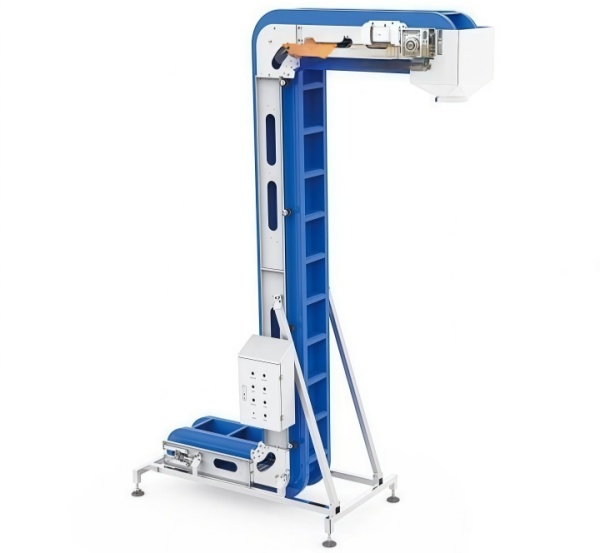
Vertical Belt Conveyor System | 90° Space-Saving Lifting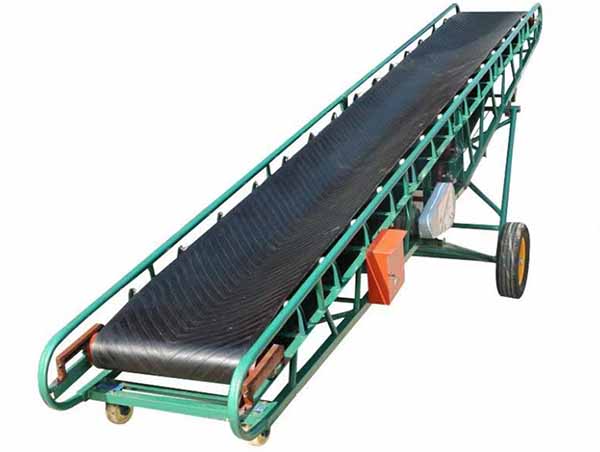
Portable belt conveyor system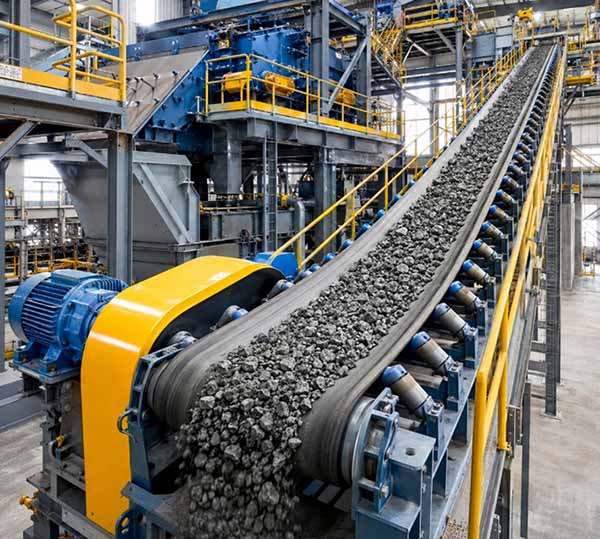
Aggregate belt conveyor system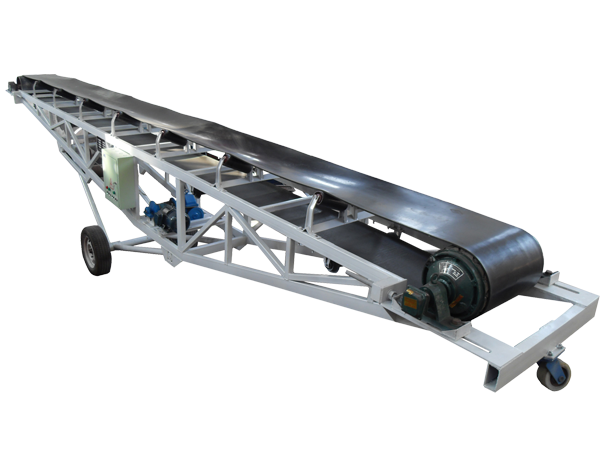
Belt Conveyors System