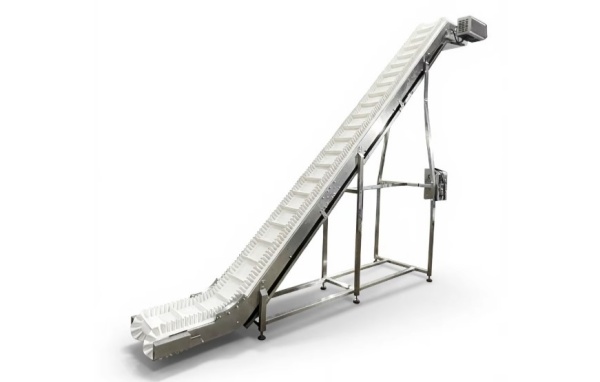
Cleated Belt Conveyor Machine
- Conveying Capacity: 5 m³/h – 250 m³/h
- Belt Width: 400 mm – 1200 mm
- Incline Angle Range: 15° – 75° (Up to 90° Vertical Incline)
- Cleat & Sidewall Height: Cleats 50–300 mm / Sidewalls 60–300 mm
- Drive Motor Power: 2.2 kW – 30 kW
Overview of the Cleated Belt Conveyor Machine
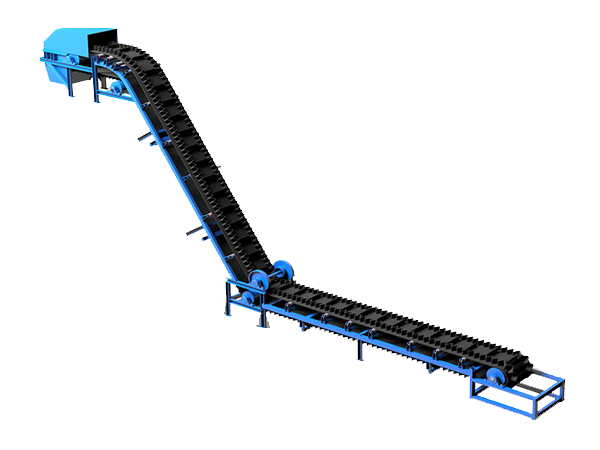
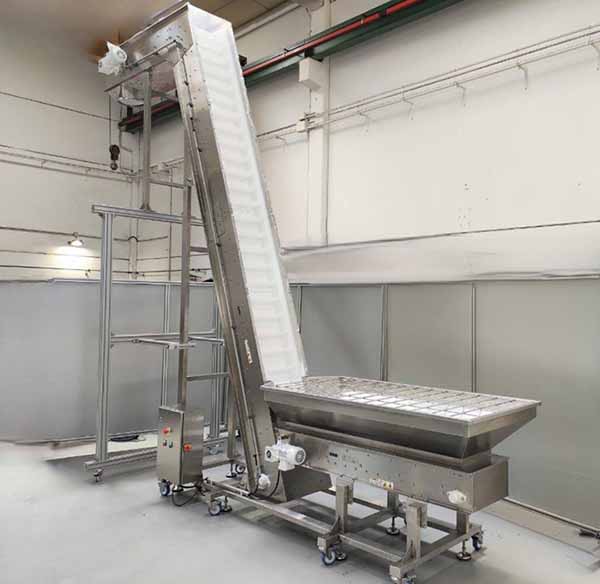
The Cleated Belt Conveyor Machine is a steep-incline conveying device featuring transverse cleats and corrugated sidewalls on the base belt surface, preventing bulk materials from sliding and spilling during steep elevation.
The Cleated Belt Conveyor Machine is used for the continuous upward elevation of bulk materials in medium to large angle spaces, preventing particles from sliding backward along the belt surface. The equipment consists of transverse cleats, corrugated sidewalls, a base belt, a drive pulley, a bend pulley, idlers, and a beater wheel cleaning device. The system sets a conveying capacity range of 5 to 250 cubic meters per hour, adjusting material transfer rates based on belt width specifications from 400 mm to 1200 mm and linear belt speed.
Steep Incline Material Handling Bottlenecks
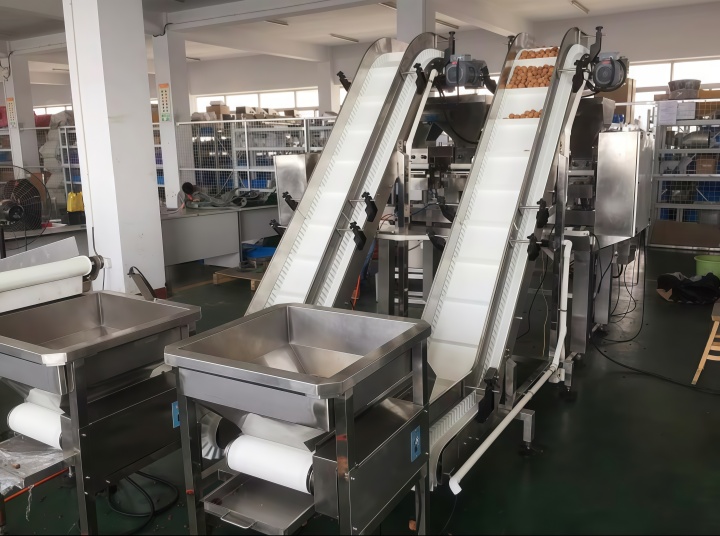
Bulk granules tend to slide backward during inclined elevation as gravitational force components exceed friction limits. Flat belt equipment allows bulk materials to slide backward and spill laterally along the belt when incline angles exceed 15° to 20°, resulting in material loss and accumulation in loading areas. To meet elevation height requirements, flat belt conveyors are forced to extend frame lengths, increasing plant footprint and steel structure construction costs. Achieving steep-angle elevation in confined spaces remains a geometric constraint challenge in bulk material handling line engineering layout.
Technical Specifications of Cleated Belt Conveyor Machine
| Parameter | Specification / Range | Engineering Detail |
| Conveying Capacity | 5 m³/h – 250 m³/h | Volumetric rating based on bulk density and speed |
| Belt Width | 400 mm – 1200 mm | Heavy-duty PVC / PU / Rubber belt options |
| Incline Angle | 15° – 75° (Up to 90°) | Steep incline design reduces footprint by up to 70% |
| Cleat Profile Types | T-Type / C-Type / TC-Type | Cleat height 50 mm – 300 mm with heavy reinforcement |
| Sidewall Height | 60 mm – 300 mm | Corrugated sidewalls prevent side spillage |
| Drive Configuration | Motor Reducer with Backstop | Anti-backstop gear brake prevents reversal under load |
Working Principle: Pocket Conveying & Cleat Mechanics
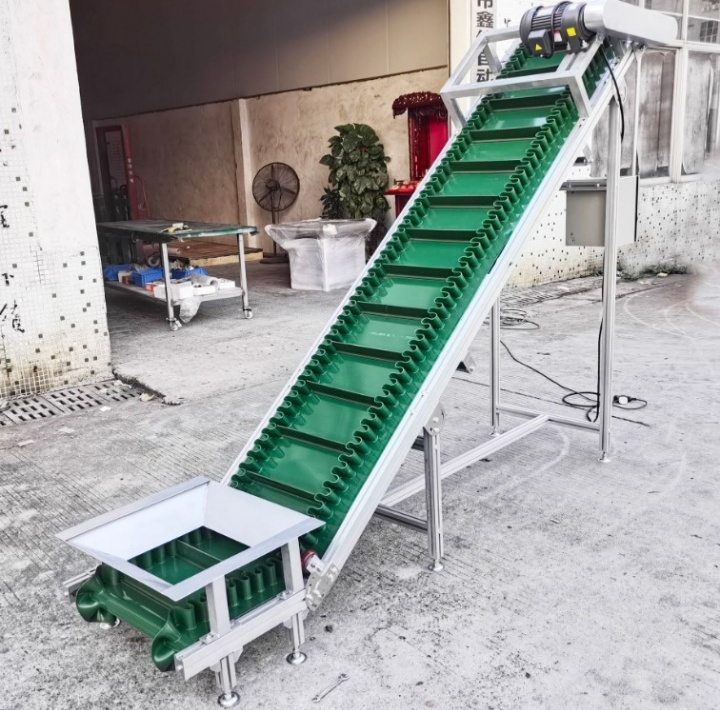
The Cleated Belt Conveyor Machine forms continuous closed pocket cavities on the base belt surface using transverse cleats and corrugated sidewalls, blocking materials from sliding down inclined surfaces.
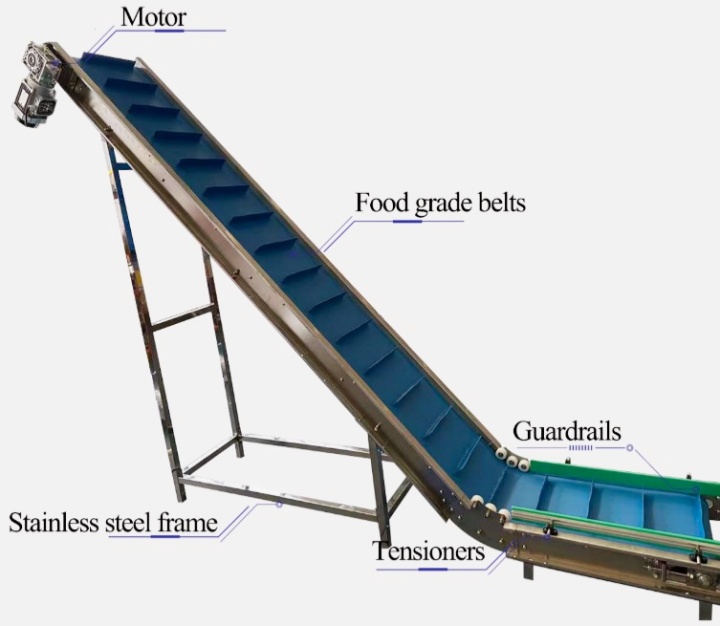
The unit differs structurally from a traditional flat belt conveyor; while a flat belt relies on surface friction to pull materials, a cleated belt builds physical barrier blockades through specific conveyor belt cleat types such as T-type, C-type, or TC-type profiles. In complex site layouts, the system can integrate with custom cleated belt conveyor structures or refer to a cleated belt conveyor 3d model for spatial adaptation, connecting to a curved belt conveyor at turning sections to complete line re-direction. Materials are contained inside pocket cells enclosed by sidewalls and cleats, translating upward along guide rails at angles from 15° to 90°.
Cleated Belt Conveyor vs. Flat Belt Conveyor vs. Bucket Elevator
| Comparison Dimension | Cleated Belt Conveyor | Flat Belt Conveyor | Bucket Elevator |
| Max Incline Angle | Up to 90° steep angle | Limited to 15° – 20° | Vertical 90° fixed |
| Footprint Requirement | Minimal floor space needed | Large horizontal run required | Minimal vertical footprint |
| Material Degradation | Zero shear, gentle pocket carrying | Zero shear | High shear friction during scooping |
| Cleaning & Maintenance | Open pocket easy to wash | Easy to scrape and clean | Boot area traps powders, hard to wash |
| Mechanical Parts | Rollers and vulcanized belt | Simple rollers and belt | Chains, sprockets, and metal buckets |
Manufacturing Quality: Cleat Vulcanization & Anti-Deviation Systems
To address the risk of cleat detachment and tearing, elastomeric rubber materials utilize hot vulcanization molding processes, employing high pressure and temperature to cross-cure the cleat root with the base belt molecular chains into a single integral unit; PVC and PU materials use high-frequency welding to fuse edges and increase shear resistance.
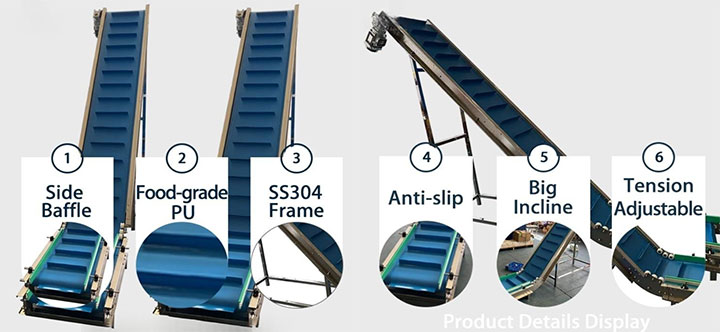
The sidewall structure incorporates tracking guide strips that work with recessed rollers at both ends of the frame to limit transverse belt displacement to within 5 mm. An independently driven rotary beater wheel is installed at the head discharge position to strike the belt backside and dislodge residual fine powders.
Industrial Applications & Space-Saving Conveying
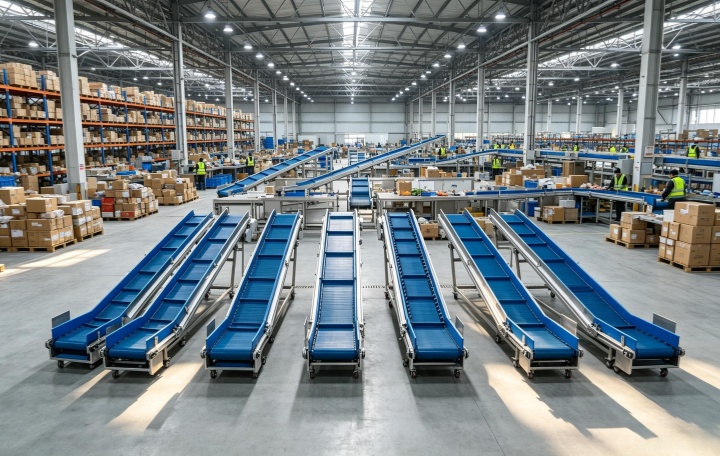
The equipment is installed in plastic recycling plant flake and shred steep incline elevation sections, grain storehouse bulk grain steep incline loading lines, construction sand/gravel and mining crushed stone high-angle transfer galleries, and municipal solid waste processing plant sorter feeding ends. In retrofit projects where existing plant spaces cannot accommodate extended flat belt runs, steep-incline cleated belt conveyors utilize existing vertical shafts or narrow passages to complete cross-floor material elevation.
Frequently Asked Questions
Q: How do I select the right cleat pattern based on a cleated conveyor belt selection guide?
Select based on incline angle and material particle size: use upright T-type cleats for angles under 30° with particle sizes below 20 mm; use angled C-type cleats for angles between 30° and 60°; use TC-type cleats with lateral support ribs for angles above 60° carrying heavy-duty materials.
Q: What details should be provided when ordering a cleated replacement belt for conveyor maintenance?
Provide the base belt width, sidewall height, cleat height and pitch, cleat profile type (T/C/TC), total belt length, material requirements (PVC/PU/Rubber), and geometric dimensions of any tracking guide strips on the bottom surface.
Q: How does the conveyor handle discharge for sticky powders trapped inside belt pockets?
A high-frequency beater wheel or pneumatic vibrator nozzle is positioned ahead of the tail bend pulley, applying mechanical vibration to the backside of the belt the moment it turns downward to knock off sticky powders adhering to the cleat roots.
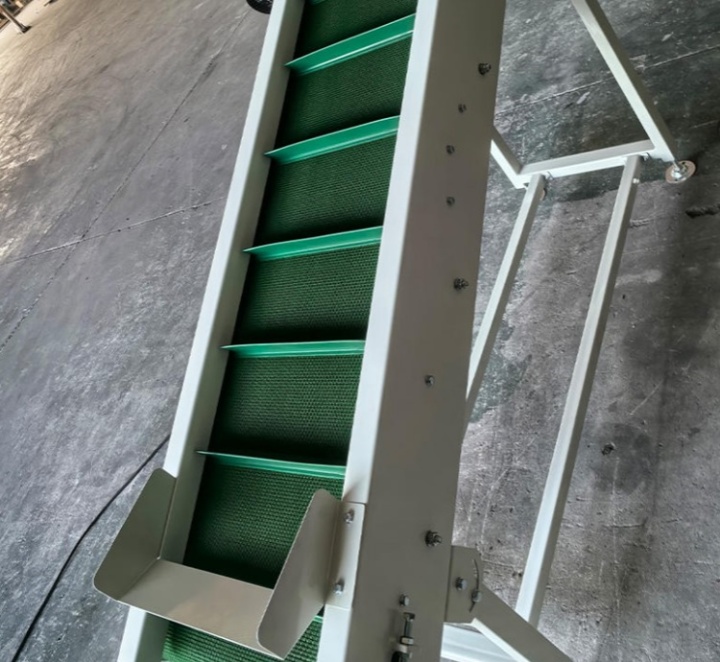
The Cleated Belt Conveyor Machine utilizes hot-vulcanized transverse cleats and corrugated sidewalls to resolve issues of material sliding and excessive plant footprint during steep-incline bulk handling. The equipment forms enclosed pocket cavities to push bulk particles forward at angles from 15° to 90°, replacing long-run flat belt conveyors and bucket elevators prone to jamming. By configuring high-frequency welding processes, anti-deviation tracking guide strips, and cleaning beater wheels, cleat tearing and belt mistracking are prevented. The system provides belt width specifications from 400 mm to 1200 mm and flow outputs from 5 m³/h to 250 m³/h, adapting to elevation applications in space-constrained sites across plastic recycling, grain transfer, and mining/construction industries.